About the artist
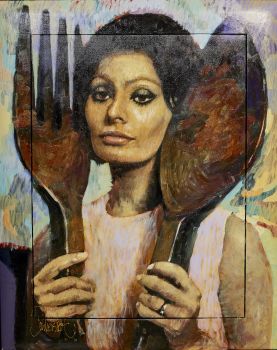
Gijsbert George Martens, born on 8 November 1894 in Groningen, was a prominent Dutch expressionist painter, watercolourist, draftsman and etcher. He died on 17 April 1979 in his hometown. Martens received his first painting lessons from his father, Gijsbert Martens, an amateur marine painter. He studied at the Minerva Academy in Groningen, where he became friends with artists such as Johan Dijkstra and Jan Wiegers. Together with them he founded the Groningen Art Circle De Ploeg in 1918.
Martens began his career painting portraits, often on commission. He also regularly painted 'en plein air' and captured the city life of Groningen. He loved the hustle and bustle of the city and the dynamics of traffic. Martens himself led a lively life; he rode a Harley Davidson and was fascinated by movement. Within De Ploeg he was the only one who painted fast sports, such as motorcycle races at the TT in Assen, skaters and sulkies with trotters.
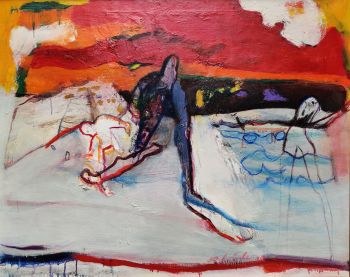
His working method was energetic and expressive. Martens eagerly and sketchily searched for forms, whereby his expressive handwriting was driven by his sensitivity. In addition to the drawing pen and the soft chalk, he gave quick impressions of what he saw with the brush, and he sketched with paint. In the 1920s he briefly used wax paint, but from 1928 he worked exclusively with oil paint. Like other expressionists, Martens made woodcuts. Within De Ploeg he was mainly influenced by Jan Wiegers and through him by Kirchner, who, like Martens, also made cityscapes. But while Wiegers showed the hard side of city life, Martens preferred cheerful street scenes, with colorfully dressed, chatting women who strolled in the rain or did their shopping on the Vismarkt.
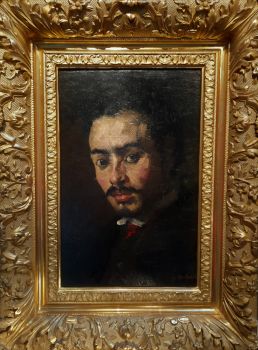
In 1922 Martens married Alida Pott, a fellow artist and member of De Ploeg. After her death in 1931 he lost his artistic drive and exchanged the lively expressionism for a calmer impressionism, a trend that also became visible in the work of other members of De Ploeg after 1929. Instead of city life he focused more on painting portraits. The sea also remained a source of inspiration.
Martens remained connected to De Ploeg throughout his life and took part in numerous exhibitions before and after the Second World War. In 1963 he was chairman of De Ploeg. In 1976 he made a study trip to North and South America.
George Martens' work is characterized by his love of city life and his ability to capture movement and dynamics. His expressive style and diverse themes make him a unique figure in Dutch art history.
Artworks
Filter Artworks
1 artwork for sale by George Martens

Related artworks for sale

Henk Melgers
Haringkar op de Haarlemmersluis te Amsterdam1930 - 1940
Price on requestBruning Heintz Fine Art


Jannes de Vries
Het Boterdiep bij Bedum op een winterse avond1920 - 1980
Price on requestBruning Heintz Fine Art