About the artist
Paul Grégoire (1915–1988) was a Dutch sculptor and draftsman known for his precision craftsmanship, monumental formal sense, and understated, often symbolic subject matter. Born in Amsterdam, he grew up at a time when the art world was slowly recovering from the First World War and new movements such as Modernism and Expressionism were gaining ground. Grégoire trained at the Rijksakademie van Beeldende Kunsten (State Academy of Fine Arts), where he developed under the influence of classical sculptural techniques and an emphasis on anatomical knowledge.
His early work showed a strong connection to realistic and figurative traditions, but over the course of his career, his style evolved toward more stylized and austere forms. Grégoire worked extensively in stone, bronze, and wood, often choosing subjects from the human figure, religious imagery, and allegories. In addition to his independent work, he completed various commissions for public spaces, including facade sculptures, memorials, and reliefs, often in collaboration with architects.
A defining aspect of his oeuvre is the balance between strength and simplicity: he was able to sculpt heavy materials into flowing forms without losing their monumentality. His work exudes tranquility, yet also a certain solemnity, and therefore fits seamlessly into both intimate interiors and grand public settings.
Throughout his career, Grégoire received numerous commissions from municipalities, churches, and institutions. He was a member of artists' associations such as the Dutch Circle of Sculptors and actively contributed to the debate on the role of sculpture in the reconstruction period after World War II. His art is now found in museum collections and in countless cityscapes throughout the Netherlands.
Paul Grégoire died in 1988, but left behind a legacy that testifies to craftsmanship, dedication, and the desire to allow sculpture to speak in silence. His work remains an example of how traditional techniques and modern simplicity can reinforce each other.
Artworks
Filter Artworks
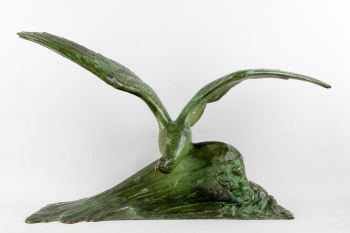
1 artwork for sale by Paul Grégoire