About the artist
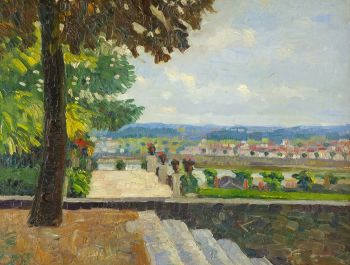
William Henry Singer Jr. (July 5, 1868 – December 29, 1943) was an American painter and patron, known for his impressionist landscapes and his contributions to the art communities in both Europe and the United States.
Early Life and Education
Born into a prominent steel family in Pittsburgh, Singer was destined to succeed his father in the family business, Singer and Nimick Company. However, his mother, Hester Harton Singer, encouraged his artistic aspirations, while his father was a Sunday painter himself and his grandfather, George Singer, a chair painter and gilder in Greensburg, Pennsylvania.
In 1895, Singer married Anna Spencer Brugh of Hagerstown, Maryland. In the summer of 1900, they traveled to Monhegan Island, Maine, where Singer devoted himself entirely to painting. The following year they crossed the Atlantic and settled in Paris, where Singer studied for several months at the Académie Julian. His love of nature prompted him to leave the academy to paint directly en plein air.
Artistic Development and European Influences
In 1901 Singer and his wife moved to Laren, the Netherlands, a flourishing artists' village near Amsterdam. Here he befriended the Dutch painter Jacob Dooijewaard and became acquainted with the Laren School. Although he initially painted Gooi landscapes, he lost his inspiration over time. On the advice of his friend, the Norwegian artist Martin Borgord, he traveled to Norway in 1904 to paint there.
Norway: The Ultimate Inspiration
During World War I, the Singers spent their summers on the west coast of Norway, eventually settling near the village of Olden on the Nordfjord, north of Bergen. The majestic fjords and imposing mountains of Norway became his main sources of inspiration. His work from this period shows influences of pointillism, characterized by stippled applications of color and a post-impressionist style.
Contributions to the Art World
In addition to his painting, William and Anna Singer were avid art collectors and philanthropists. In 1931, they founded the Washington County Museum of Fine Arts in Hagerstown, Maryland, where a significant portion of their collection is on display.
In 1929, Singer was awarded the Commander's Cross and Star of the Royal Order of St. Olaf by King Haakon of Norway. Two years later, he received the distinction of Chevalier of the Order of Leopold from King Albert of Belgium.
Final Years and Legacy
During World War II, the Singers remained in Norway. Despite the German occupation, they were protected by the local population of Olden. William Henry Singer Jr. died of a heart attack in 1943, two years before the liberation of Norway.
His legacy lives on in the many works of art he left behind and the cultural institutions he supported. His work is marked by a deep appreciation for the natural world, captured in a style that is both impressionistic and pointillist, and continues to inspire art lovers worldwide.
Artworks
Filter Artworks
1 artwork for sale by William Henry Singer

Related artworks for sale


Cornelis Vreedenburgh
Het atelier van de schilder aan de Vredelaan 1 te Laren1920 - 1940
Price on requestBruning Heintz Fine Art


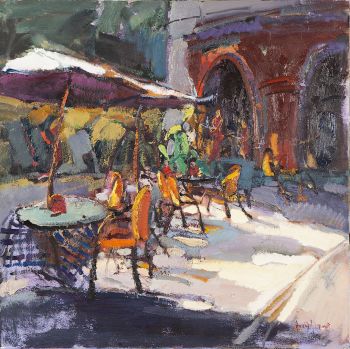

Jozef Israels
Naaisters op de Place Vendôme in Parijs1900 - 1920
Price on requestBruning Heintz Fine Art