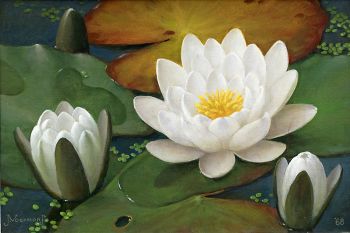
Jan Voerman Jr. was born on January 3, 1890 in Hattem, a picturesque town on the edge of the Veluwe, where the sky is wide and the light is generous. As the son of the famous IJssel painter Jan Voerman Sr., he grew up in a house saturated with the smells of paint and the soft sounds of brush on canvas. Yet he chose his own path — not the large romantic cloudy skies of his father, but the quiet, rhythmic beauty of the farmland.
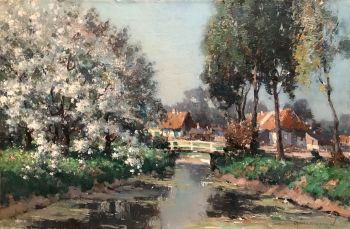
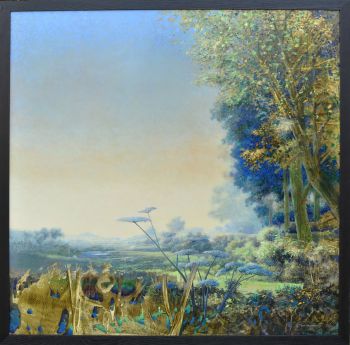
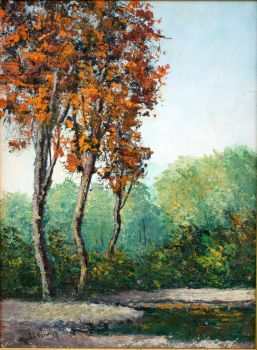
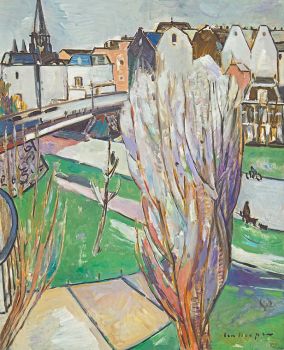
In contrast to the drama that many painters of his time sought, Voerman Jr. found his inspiration in the everyday. He painted farms, quiet roads, wide fields with rows of poplars — landscapes that radiated an almost meditative tranquility in their simplicity. His work is precise, almost graphic, and evokes memories of the illustrative style of the Art Deco period, without ever becoming decorative.
Although he was trained in the craft of painting, Jan Jr. developed a signature style all his own: his use of colour is subdued, his compositions well thought out, his world stylised but never sterile. He had an eye for rhythm, for repetition in the landscape — a row of cows, a fence, a ditch with flowering reeds. His works are tranquil, almost timeless, and are reminiscent of a Netherlands that is slowly disappearing.
Voerman Jr. was not only a painter, but also an illustrator. He worked for Verkade albums, among others, where his clear, careful style came into its own. His collaboration with Jac. P. Thijsse made him popular with a wide audience, and his work contributed to the romantic image of the Dutch countryside in the early twentieth century.
Yet Jan Voerman Jr. remained modest. Not a man of big words or public appearances — he was a worker in silence, an observer of the small. In his later years he remained true to his subjects, even as the world around him changed. His work is an ode to the landscape he knew, without frills, without sensationalism.
Jan Voerman Jr. died in 1976, in his beloved Hattem. His work lives on in collections including the Voerman Museum, where father and son are honored side by side — one a painter of heaven, the other of earth.