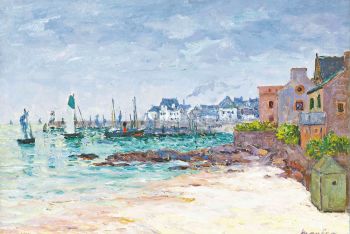
RIVIERLANDSCHAP 1886
Louis Alexandre Bouche
Adhesive tape
33 ⨯ 46 cm
Price on request
Studio 2000 Art Gallery
- About the artwork33 x 46 cm.
Gesigneerd: rechts onder ‘Louis Bouché’
Herkomst: Barbizon – realist and French landscape paintings, Christie’s New York, 22 may 1997, lot. 275, illustrations p. 125 of the catalogue.
De Franse landschapschilder Louis Alexandre Bouché was onder andere een leerling van Camille Corot (1796-1875). Men ziet veel invloeden van deze kunstenaar terug in het werk van Bouché. Hij koos voor het schilderen van landschappen in de regio Île-de-France, vlakbij Parijs. Zijn werken worden gekenmerkt door de grote aandacht voor het licht en veranderende sfeer in subtiele kleuren.
Mogelijk schilderde hij rivierlandschap in 1886 in de omgeving van Lyzancy, waarop de rivier La Marne te zien is.
Zijn collega en tevens vriend Léon Lhermitte (1844-1925) liet weten na de dood van zijn vriend Bouché hem te herinneren als: ‘de noble artiste, d’ami sûr, d’homme de bien’. Het dorp Luzancy zal hem onthouden als de schilder van het landschap van Luzancy, de omgeploegde weilanden en de rivier de Marne met haar wasvrouwen. - About the artist
Louis-Alexandre Bouché (1838–1911) was a distinguished French landscape painter closely associated with the Barbizon School and the artistic movement that paved the way for Impressionism. Born in Luzancy in the Marne region of France, he devoted much of his career to depicting the tranquil countryside, riverbanks, forests, and villages of the Marne Valley.
Bouché developed a highly sensitive approach to landscape painting, focusing on the effects of natural light, seasonal changes, and atmospheric nuances. Working largely en plein air, he sought to capture the fleeting moods of nature with a freshness and spontaneity that anticipated many of the concerns later embraced by the Impressionists. His compositions are characterized by their harmonious balance, subtle color palette, and deep appreciation for rural life and the French landscape.
Although rooted in the realism and naturalism of the Barbizon tradition, Bouché’s work often reveals a lighter touch and greater emphasis on luminosity, placing him among the important transitional figures between mid-19th-century landscape painting and the emergence of Impressionism. His paintings were regularly exhibited in France and were appreciated for their poetic interpretation of nature and their faithful rendering of the countryside.
Today, Louis-Alexandre Bouché is remembered as a skilled observer of the French landscape whose works capture the quiet beauty and changing character of the Marne Valley, preserving a vision of rural France at a time of significant social and artistic transformation.
Are you interested in buying this artwork?
Artwork details
Related artworks
Emil Rizek
Bloemenmarkt bij het Janskerkhof te Utrecht1930 - 1960
Price on requestBruning Heintz Fine Art
1 - 4 / 24Willem Witsen
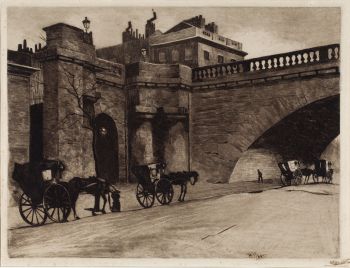
Waiting carriages in front of Waterloo Bridge1850 - 1900
Price on requestKunsthandel Pygmalion
Bob Buys
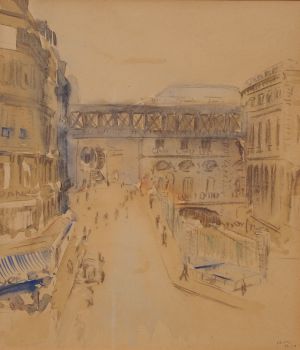
Paris, Gare de L'Est, Passerelle de la Rue d'Alsace1940 - 1950
Price on requestAdelwein Kunst
Egbert Rubertus Derk Schaap
GEZICHT OP KORTENHOEF1862 - 1939
Price on requestGalerie Het Noorderlicht
Ekke Kleima
Twee boerderijen in Noord-Nederlands landschap1920 - 1960
Price on requestBruning Heintz Fine Art
1 - 4 / 24- 1 - 4 / 12