About the artist
Johannes Christiaan van der Meer Mohr was born on 18 August 1821 in The Hague. In the tradition of the Dutch landscape painters of the 19th century, he built up a solid oeuvre of rural scenes, tranquil village views and timeless impressions of nature. Although his name did not gain the fame of his more famous contemporaries, Van der Meer Mohr was respected in his time as a skilled and sensitive painter who captured the Dutch landscape with reverence and precision.
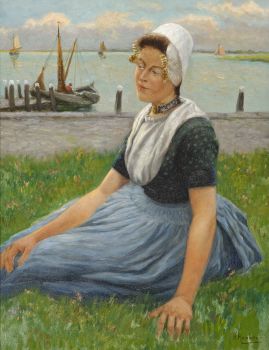
Van der Meer Mohr was educated at the Royal Academy of Art in The Hague, where he learned the traditional techniques of drawing and painting. He developed into a classically oriented artist, rooted in romantic realism. His paintings often show pastoral landscapes: flat meadows, winding paths, bodies of water with reeds and ducks, farmhouses, and groups of trees that stand out against a Dutch sky.
What characterizes his work is the calm atmosphere: the absence of spectacle. He painted the ordinary — but with an eye for composition, detail and atmosphere. His use of colour is balanced and natural, often composed of warm earth tones, soft greens and greys, in which the light is never bright but always diffuse. People appear in his work mainly as small figures, embedded in the landscape, never obtrusive, but as part of the rhythm of outdoor life.
In the spirit of the Hague School — with which he partly worked simultaneously — Van der Meer Mohr preferred to depict the mood of a landscape above the exact detail. Yet he remained closer to the romantic tradition than the more impressionistic touch of the later generation. His work thus stood still on the border of two art periods.
In the 1860s and 1870s he worked regularly in Zeeland, where he found inspiration in the dune landscapes and the simple farm life. He eventually died on 11 August 1876 in Koudekerke, a Zeeland village that he painted more often and where he probably retired in his later years.
Today, works by J.C. van der Meer Mohr are mainly found in private collections and at auctions. His oeuvre forms a quiet ode to the Dutch landscape in a time of emerging change — a painter who did not innovate, but preserved: the light, the peace, the earth.