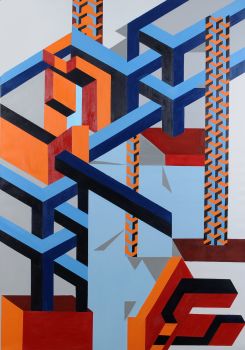
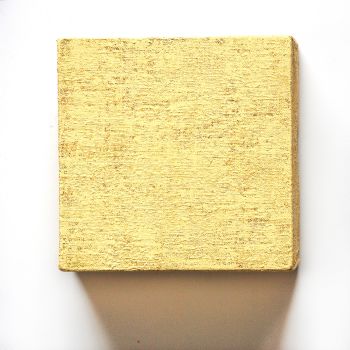
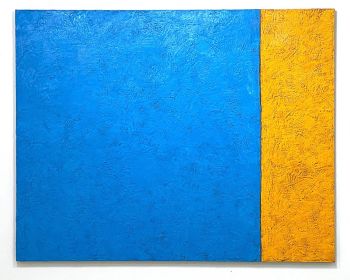
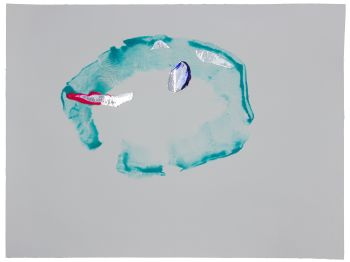
Ole Schwalbe (Ole Albert Christian Schwalbe; 23 July 1929 – 15 October 1990) was a Danish painter and a key figure in the development of postwar concrete and constructivist art in Denmark. He is best known as a member of the Linien artists’ association and as one of the initiators of the second generation of Danish Constructivism, a movement the group defined in 1956 as concrete realism.
Born in the Brønshøj district of Copenhagen, Ole Schwalbe was largely self-taught as a painter, though he trained as a printmaker between 1945 and 1950. His artistic talent emerged early: at just sixteen years old, he debuted at the prestigious Kunstnernes Efterårsudstilling (Artists’ Autumn Exhibition) in 1945. This early recognition positioned him among the most promising young artists of his generation.
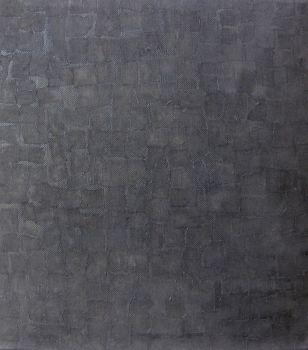
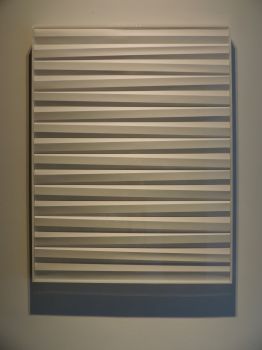
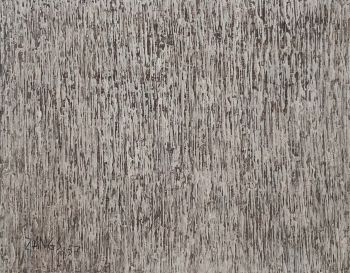
Schwalbe’s work is characterized by a rigorous, analytical approach to form and color. After early experiments with color, he made a decisive turn in 1953 by restricting his palette to black and white. Using positive and negative segments of circles—often compared to the marks left by a paperclip—he explored perception, balance, and spatial tension. In the late 1950s, he introduced red alongside black and white, using the three colors symbolically to reflect life and death, body and soul. Around 1960, his compositions evolved into nuanced greys, as seen in works such as Signet 1 (1960), before color gradually returned, notably with deep blue tones in Entre chien et loup (1965).
A defining aspect of Ole Schwalbe’s practice was his belief in the total integration of art and architecture. He viewed art as an essential component of the built environment rather than an applied afterthought. This philosophy is evident in his architectural commissions, including the integrated artistic decoration of Brandbjerg School (1970), as well as works for Sukkertoppen Forsamlingshus (1972), the Danish Embassy in London (1977), Holstebro Library (1981), and Holstebro Town Hall (1986). One of his few sculptural works, Kuglen, is permanently installed in the entrance hall of Holstebro Town Hall.
Today, Ole Schwalbe is regarded as a central figure in 20th-century Danish concrete art. His disciplined visual language, intellectual clarity, and commitment to the synthesis of art and architecture have secured his lasting place in the history of Scandinavian modernism.