A Brazilian rosewood and mahogany roomdivider – KP Møbler, Denmark 1960
Kurt Østervig
WoodRosewoodMahogany
180 ⨯ 104 ⨯ 40 cm
ConditionVery good
Price on request
Van Kerkhoff Art
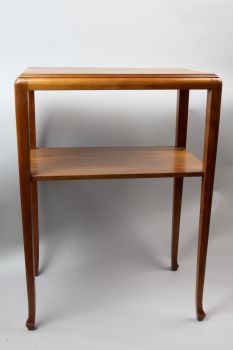
- About the artworkA rare Brazilian Rosewood veneered and solid mahogany freestanding bookcase or roomdivider. Designed by the Danish designer Kurt Østervig and executed by the cabinetmaker KP Møbler circa 1960.
This room divider, designed by Kurt Østervig around 1960 and executed by KP Møbler, is crafted in Brazilian rosewood veneer with solid mahogany supports. The open, vertical structure combines adjustable shelving with gently tapered legs, giving the piece a light yet architectural presence. Østervig’s focus on proportion and material is evident in the restrained detailing and balanced construction. While this model was more commonly produced in teak or beech, examples in Brazilian rosewood are comparatively rare and especially valued for their depth of color and refined grain.
About Kurt Østervig
Kurt Østervig (Odense, Denmark 1912 – Odense, Denmark 1986) was a Danish designer whose work represents a calm, well-balanced interpretation of mid-century Scandinavian modernism. Best known for his furniture designs from the 1950s and 1960s, Østervig combined practical construction with a clear sense of proportion, producing pieces that were understated, functional, and well suited to everyday use.
Østervig trained as a shipbuilder before turning to furniture design, a background that informed his understanding of structure and materials. This technical foundation is evident in his work, which emphasizes stability, clarity, and sound construction rather than visual novelty. Unlike some of his contemporaries, Østervig did not pursue a strongly personal or expressive style; instead, his designs are marked by balance and restraint.
During the postwar years, Østervig collaborated with several Danish manufacturers, most notably KP Møbler and Sibast Furniture. These partnerships allowed his designs to reach a wider audience while maintaining a high standard of craftsmanship. His furniture often features solid teak or oak, sometimes combined with cane or upholstery, chosen for durability and warmth. Forms are generally soft but controlled, with gently curved elements integrated into otherwise straightforward structures.
Østervig’s chairs and seating designs are among his most recognized works. They are typically comfortable and well-proportioned, with an emphasis on ergonomic considerations rather than sculptural statement. Armrests, legs, and backrests are shaped with care, but always within a measured visual language. This approach reflects the broader Danish design ethos of the period, in which furniture was intended to serve daily life while maintaining a quiet aesthetic presence.
While Østervig’s work does not seek historical references in the same way as designers such as Ole Wanscher, it similarly avoids decorative excess. Details are modest and purposeful, often revealed only through close inspection. Joinery is clean and logical, and surfaces are treated to highlight the natural character of the wood rather than to draw attention to the designer’s hand.
Østervig’s designs were widely used in domestic interiors as well as in public and commercial settings, where durability and comfort were essential. His furniture fit easily into modern interiors, contributing to the international appeal of Danish design during the mid-20th century.
Today, Kurt Østervig is regarded as a solid and reliable figure within Danish modern furniture design. While his name may be less prominent than some of his contemporaries, his work remains appreciated for its consistency, practicality, and quiet elegance. His furniture continues to be collected and used, valued for its straightforward design and enduring functionality rather than for stylistic statement.
Execution
KP Møbler, Denmark
Labeled
Condition
This roomdivider is in very good vintage condition.
Dimensions
Height 180 cm
Width 104 cm
Depth 40 cm
Cites
A Cites permit within the European Union is included. - About the artist
Kurt Østervig (1912–1986) was a Danish furniture designer whose work occupies a distinctive place within mid-century Scandinavian modern design. Known for his refined craftsmanship, architectural clarity, and warm material choices, Østervig created furniture that combined functional rigor with understated elegance.
Originally trained as a shipbuilder in Odense on the island of Funen, Kurt Østervig developed a strong technical understanding of construction and materials. Unlike many contemporaries who embraced steel, Østervig felt a deeper affinity with wood—an inclination that led him to work as a furniture designer at E. Knudsen’s Studio, one of the most prominent design studios of its time. This background laid the foundation for his lifelong focus on wood as both a structural and expressive material.
In 1947, Østervig established his own design studio and began collaborating with several of Scandinavia’s leading furniture manufacturers. He was particularly fond of oak, frequently pairing it with leather to create furniture that was robust yet refined. His designs were not limited to domestic interiors; he also produced bespoke furniture for ships, hotels, cinemas, and nursing homes, demonstrating a strong sensitivity to context, durability, and human use.
Kurt Østervig’s furniture is characterized by clean lines, balanced proportions, and a quiet confidence. Among his most notable works from the 1950s are a simply styled yet elegant daybed and a freestanding shelving system incorporating a bar—pieces that exemplify his ability to merge practicality with sculptural presence. His distinctive approach attracted international attention, culminating in exhibitions of his work at institutions such as the Museum of Modern Art in New York.
Today, Kurt Østervig is regarded as an important figure in 20th-century Danish design. His furniture remains highly sought after by collectors and is valued for its timeless aesthetics, fine materials, and the seamless integration of craftsmanship and modernist principles.
Are you interested in buying this artwork?
Artwork details
Related artworks
Kurt Østervig
A Brazilian rosewood sideboard with bar – KP Møbler, Denmark1960 - 1969
Price on requestVan Kerkhoff Art
1 - 1 / 1Poul Henningsen
A copper ‘PH Artichoke’ pendant – Louis Poulsen, Denmark2000 - 2010
Price on requestVan Kerkhoff Art
Børge Mogensen
Teak wood “dropleaf” desk – Søborg Møbler, Denmark circa 19551950 - 1960
Price on requestVan Kerkhoff Art
Arne Jacobsen
A vintage ‘Swan’ sofa, model 3321 – Fritz Hansen, Denmark1970 - 1979
Price on requestVan Kerkhoff Art
1 - 4 / 24Arne Jacobsen
A vintage ‘Swan’ sofa, model 3321 – Fritz Hansen, Denmark1970 - 1979
Price on requestVan Kerkhoff Art
Børge Mogensen
Teak wood “dropleaf” desk – Søborg Møbler, Denmark circa 19551950 - 1960
Price on requestVan Kerkhoff Art
1 - 4 / 24Kurt Østervig
A Brazilian rosewood sideboard with bar – KP Møbler, Denmark1960 - 1969
Price on requestVan Kerkhoff Art
1 - 4 / 24- 1 - 4 / 12