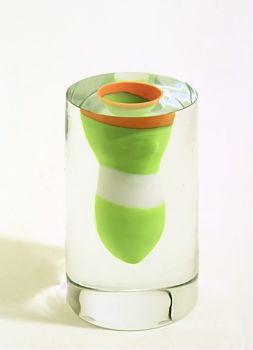
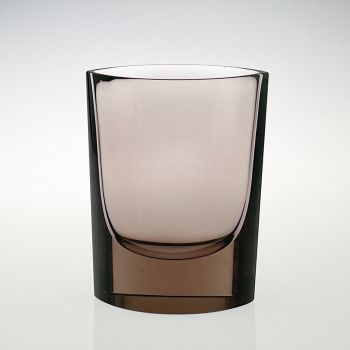
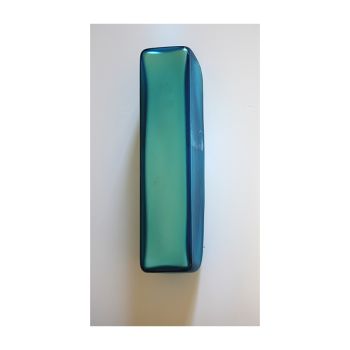
Three turned mould blown, cased glass, facet cut art-objects “Pilari”, models KF 249 & KF 250, in purple and turquoise hues. Designed by Kaj Franck in 1958 and executed by the Nuutajärvi-Notsjö glassworks, Finland in 1958, 1959 & 1960.
These rare hexagonal shaped vases were made by the Finish Nuutajärvi-Notsjö glassworks in three variants. The lower and wider Model KF 249 was designed in 1958 and made between 1958 and 1964 in one size. The taller ‘Pilari’s’ were designed in 1956 and were made in two sizes between 1958 and 1968.
The use of different colours in thin layers and the shape gives it the prismatic effect much like the model KF 215 “Prisma”, designed by Kaj Franck in 1954. It took the glassblowers at Nuutajärvi-Notsjö glassworks four year (until 1958) until they were able to make the “Prisma” and “Pilari” vases.
The examples of this complete set of ‘Pilari’ vases are fully marked underneath the base in diamond-pen: K. Frank – Nuutajärvi-Notsjö – ’58, ’59 & ’60 (1958-1960) and are all in very good condition.
About Kaj Franck
Kaj Franck (Vyborg, Finland 1911 – Santorini, Greece 1989) was an influential Finnish designer and leading figure in Finnish art-world between 1940-1980. Today his name is used for the prestigious “The Kaj Franck Design Prize” annually awarded by the Finnish Design Forum.
Born in 1911 on the Finnish Russian border in a family of architects (his grandfather was director of the famous Arabia Ceramics factory) of Finnish-German-Swedish decent.
He attended the furniture department of Taideteollinen korkeakoulu (todays Aalto university school of Arts, Design and Architecture) in Helsinki.
After his studies he worked as a freelance designer until he joined Arabia as a designer in 1945. In 1950 he became Arabia’s Artistic Director. He also designed glass–objects for Iittala between 1946 and 1950 and between 1950 and 1976 for Nuutajärvi-Notsjö glassworks.
From 1945 onwards he worked as and educator at Taideteollinen korkeakoulu and he became the institute’s Artistic Director in 1960.
His modernist designs in everyday tableware glass are considered to be a revolution and classic Finnish design object (most notably his Kilta tableware and Kartio glassware).
He is often referred to as “the conscience of Finnish design”, moderation, ecology and equality were Franck’s principles. He strove to minimise the number of everyday objects we need in our lives, drawing attention to the sustainability and life cycle of products.
Kay Franck’s designs are in collections of numerous museums all over the world. Among others: Design Museum Helsinki, Museum of Modern Art, New York, Stedelijk Museum Amsterdam and The British Museum, London. He was a recipient of many prizes. Most notably the Lunning prize in 1955, a “Grand prix” and several “Gold medals” at the Triennale di Milano.
Marked
All signed and dated underneath the base in diamondpen: K. Franck Nuutajärvi-Notsjö ’58, '59, '60. The Tallest KF 249 is made in 1960, Model KF 250 is made in 1958.
Condition
These art-objects are in very good vintage condition, some minor scratches and wear consistent with age and use. No chips or cracks.
Literature
Marianne Aav (ed.), Kaj Franck, Universal Forms, p. 223 (illustrated), p.325
Dimensions
Height 11,7, 21,1 & 26,7 cm
Width 15,7, 8,5 & 8,7 cm
Depth 9,7, 8,4 & 8,6 cm