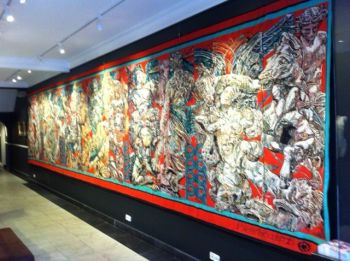
A handmade ‘Rölakan’ rug, model ‘Vårflöden’ (Spring flows) – JJ Vävateljén, Sweden by Judith Johansson

A handmade ‘Rölakan’ rug, model ‘Vårflöden’ (Spring flows) – JJ Vävateljén, Sweden 1960 - 1969

Judith Johansson

TextileWool
180 ⨯ 230 cm
ConditionGood
€ 2.950

Van Kerkhoff Art

  • About the artwork
    A handmade ‘Rölakan’ (flat weave) rug, model ‘Vårflöden’ (Spring flows). Designed by Judith Johansson and handmade by her at JJ Vävateljén, Sweden ca 1960.

    Rölakan rugs are a traditional type of Swedish flat-weave rug that have been produced for centuries. Unlike pile rugs, rölakan rugs are woven flat, without knots, using a tapestry-like technique. The weft threads are passed over and under the warp threads to create the design. Designs are usually geometric or stylized, sometimes inspired by folk art, nature, or Scandinavian motifs. Traditional patterns include diamonds, stripes, and floral or tree motifs.

    In the 20th century, designers like Judith Johansson and others modernized the technique, incorporating contemporary motifs and abstract designs while maintaining traditional weaving methods. Today, rölakan rugs are appreciated both as folk art and design objects and vintage Rölakan rugs are highly collectible, particularly mid-century examples from Swedish ateliers that blended traditional craft with modern design aesthetics.


    About Judith Johansson
    Judith Johansson (1916 Trollhättan – 1993 Knäred) was a Swedish textile artist renowned for her contributions to mid-20th-century Scandinavian rug design. Born in 1916 in southern Sweden, she grew up in a rural environment that deeply influenced her aesthetic sensibilities. Her maternal grandmother, a skilled weaver, introduced her to the craft at an early age, instilling in her a lifelong appreciation for textiles.

    In 1937, Judith married John Johansson, and together they established JJ Vävateljén, a weaving studio in Knäred, Halland. Over the next five decades, they produced an extensive collection of over 400 rug and tapestry designs, both ecclesiastical and secular. Their work was characterized by a harmonious blend of traditional Swedish craftsmanship and modern design principles.

    Johansson’s designs often drew inspiration from the natural landscapes of Sweden, incorporating elements such as rolling hills, forests, and lakes into her compositions. She employed a variety of weaving techniques, including the traditional Swedish flat-weave method known as röllakan, to create textures that added depth and interest to her pieces.

    Throughout her career, Johansson’s work was recognized for its artistic merit and technical proficiency. Her rugs and tapestries were featured in various exhibitions and were sought after by collectors and institutions alike. In the mid-1980s, her daughter took over the atelier, continuing the family legacy in textile design.

    Judith Johansson passed away in 1993, leaving behind a legacy of finely crafted textiles that continue to be celebrated for their beauty and craftsmanship.

    Marked
    Signed "JJ"

    Execution
    JJ Vävateljén, Sweden ca 1960

    Condition
    Good original condition. Wear consistent with age and use, Rewired.

    Literature
    Torsten Andersson, JJ Så vävdes ett livsverk

    Dimensions
    Width 180 cm
    Length 230 cm
  • About the artist

    Judith Johansson (1916–1993) was a highly influential Swedish textile artist, designer, and weaver, best known for her flat-weave rugs and tapestries that bridge traditional Scandinavian craftsmanship and mid-20th-century modern design. Active primarily from the late 1940s through the mid-1960s, Johansson created an extensive body of ecclesiastical and secular textiles that today are regarded as exemplary works of Swedish modern textile art.

    Born in a small rural village in southern Sweden, a region renowned for its long-standing textile and weaving traditions, Judith Johansson remained closely connected to her local environment throughout her life. She established her atelier in this area, where she lived and worked for decades. The workshop became a center of creative production and was later continued by her daughter in the mid-1980s, underscoring the intergenerational nature of Johansson’s artistic legacy. Johansson played an active role in the regional revival of decorative flat-weave röllakan rugs and soft furnishings, contributing significantly to the postwar resurgence of Swedish textile design.

    Johansson developed a distinctive design process in which she translated delicate watercolor sketches into contemporary weaving patterns. Hundreds of these original watercolors are still preserved in her atelier, offering rare insight into her creative method and visual thinking. While much of her work draws inspiration from the Swedish countryside—its rhythms, colors, and natural forms—she also produced bold geometric compositions and stylized floral abstractions that align her firmly with mid-century modern aesthetics.

    Among her most innovative works are experimental designs such as the Tjärmark carpet, characterized by borderless compositions and rich, gem-tone color palettes that reflect the spirit of Scandinavian modernism. Her textiles balance structure and softness, tradition and experimentation, making them both decorative and conceptually forward-looking.

    Judith Johansson’s artistic achievements were formally recognized in the 1980s, when she received several distinguished awards for her contribution to Swedish textile art. Works that were both designed and woven by her bear the hallmark “JJ,” a signature that today signifies authenticity, craftsmanship, and enduring quality. Johansson is now widely regarded as an important figure in 20th-century Swedish design, whose rugs and tapestries continue to be valued by collectors, institutions, and admirers of Scandinavian modern textiles.

Are you interested in buying this artwork?