A Japanese Bronze Flower Vase, Edo Period (1603-1868) 1603 - 1868
Unknown artist
BronzeMetal
18 cm, ø 14.30 cm
ConditionGood
€ 1.200
Menken Works of Art
- About the artworkA fine Japanese bronze zun-shaped flower vase depicting the sages Xu You and Chao Fu.
Japan, Edo period (1603-1868), probably first half 17th century or 19th century.
This zun-shaped vessel, likely a flower vase, features a bowl-shaped body on a decorated foot, angular shoulders, and a trumpet-shaped mouth. The vase’s standout feature is the figural group on the shoulder, depicting two gentlemen and an ox in a scene from Chinese mythology. The design incorporates flower-like elements, with the segmented upper section resembling petals. The scene portrays Xu You and Chao Fu, two Chinese sages who lived during the reign of the Emperor Yao (c. 2356–2255 BC).
According to legend, the emperor Yao offered to give Xu You his throne. Xu You responded by saying that his ears had gotten dirty and washed them out with water from a waterfall to purify himself of worldly temptations. Chao Fu came to the same river to give his ox a drink but declared that he could not give his ox such dirty water and left, leading his ox away from the “contaminated” stream.
Despite the Chinese origin of the story, the vase's form and decoration suggest it was most likely made in 17th-century Japan. Its tall neck, trumpet-shaped mouth, and distinctly frontal orientation are characteristic of Japanese Edo-period bronzes, differing from traditional Chinese designs, which emphasize rounded bodies and encircling decoration.
This vase exemplifies the Japanese adaptation of Chinese art during the Edo period. Japanese artisans drew inspiration from late Ming Chinese designs, such as high-relief decorations and symbolic imagery, while adding their unique stylistic elements. As a result, the vase reflects a blend of Chinese influence and Japanese innovation, showcasing the cultural interplay between the two traditions.
Ref:
An identical vase is in the Phoenix Art Museum collection, Clague Collection Number 245, and illustrated in China’s Renaissance in Bronze – The Robert H. Clague Collection of Later Chinese Bronzes 1100-1900 (Robert D. Mowry, 1993), pp. 56-60, no. 10.
Another similar vase with slight variations is in the Dresden Zwinger collection, inventory number 17365.
Dimensions:
Height 18 cm, diameter mouth 14.3 cm.
Condition:
Very good condition with normal wear and a warm patina.
Worldwide registered and insured shipping.
Inv. No: MW162 - About the artist
It might happen that an artist or maker is unknown.
Some works are not to be determined by whom it is made or it is made by (a group of) craftsmen. Examples are statues from the Ancient Time, furniture, mirroirs, or signatures that are not clear or readible but as well some works are not signed at all.
As well you can find the following description:
•“Attributed to ….” In their opinion probably a work by the artist, at least in part
•“Studio of ….” or “Workshop of” In their opinion a work executed in the studio or workshop of the artist, possibly under his supervision
•“Circle of ….” In their opinion a work of the period of the artist showing his influence, closely associated with the artist but not necessarily his pupil
•“Style of ….” or “Follower of ….” In their opinion a work executed in the artist’s style but not necessarily by a pupil; may be contemporary or nearly contemporary
•“Manner of ….” In their opinion a work in the style of the artist but of a later date
•“After ….” In their opinion a copy (of any date) of a work of the artist
•“Signed…”, “Dated….” or “Inscribed” In their opinion the work has been signed/dated/inscribed by the artist. The addition of a question mark indicates an element of doubt
•"With signature ….”, “With date ….”, “With inscription….” or “Bears signature/date/inscription” in their opinion the signature/ date/ inscription has been added by someone other than the artist
Are you interested in buying this artwork?
Artwork details
Related artworks
- 1 - 4 / 12
Unknown artist
Set Arita 'dog training' plates, 18th century 1700 - 1730
Price on requestVerkoulen Oriental & European Antiques
Unknown artist
A rare Sawasa ware book-form box and cover, Edo period, early 18th century1700 - 1750
Price on requestMenken Works of Art
1 - 3 / 3Unknown artist
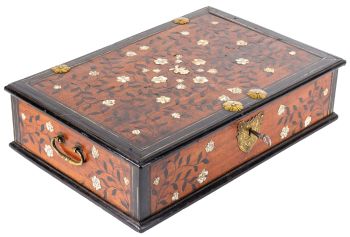
Indian colonial inlaid work box, 18th century1700 - 1750
Price on requestVerkoulen Oriental & European Antiques
Unknown artist
A pair of Dutch Colonial Solid Satinwood Chairs, Ceylon 18th century1725 - 1750
Price on requestMenken Works of Art
1 - 4 / 24- 1 - 4 / 24
- 1 - 4 / 24
Unknown artist
A Chinese famille verte ‘fishermen’ bowl, Kangxi period (1662-1722)1662 - 1722
Price on requestMenken Works of Art
Unknown artist
A rare Chinese blue and white bottle vase, Ming dynasty, Wanli period1573 - 1620
Price on requestMenken Works of Art
Unknown artist
Chinese gilt bronze censer, Xuande mark, 18th century, Qing dynasty18th century
Price on requestMenken Works of Art
Unknown artist
A pair of Dutch Colonial Solid Satinwood Chairs, Ceylon 18th century1725 - 1750
Price on requestMenken Works of Art
1 - 4 / 12