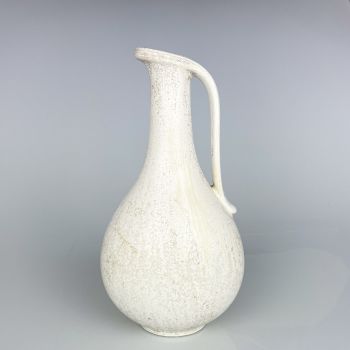
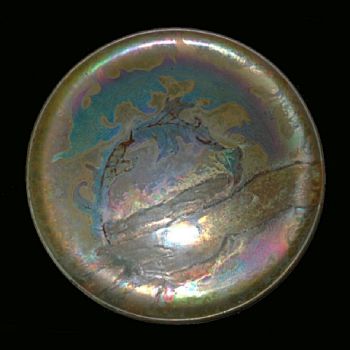
A unique glazed stoneware deep dish – Gustavsberg Sweden 1974
Stig Lindberg
StoneGlazeStonewarePaint
6 cm, ø 24 cm
ConditionVery good
€ 750
Van Kerkhoff Art
- About the artworkA unique glazed stoneware deep dish. Handthrown by Stig Lindberg at the Swedish ceramics studio Gustavsberg in 1974. Fully marked.
About Stig Lindberg
Stig Lindberg (1916–1982) was a Swedish designer and ceramic artist whose work spanned a wide range of disciplines, from ceramics and illustration to industrial design and textiles. He is known for blending playfulness with functionality, and for helping to define Swedish design in the postwar era.
Born in Umeå, Sweden, Lindberg studied at the University College of Arts, Crafts and Design (Konstfack) in Stockholm. In the late 1930s, he joined the Gustavsberg porcelain factory, where he worked under Wilhelm Kåge. After World War II, Lindberg became one of the factory’s leading designers and eventually took over as artistic director.
Lindberg’s ceramics ranged from everyday tableware to one-off art pieces. He was especially known for his imaginative, sometimes whimsical designs, as well as for his ability to balance mass production with artistic expression. In addition to ceramics, he designed textiles for Nordiska Kompaniet (NK), illustrated children’s books, and created iconic industrial designs, including radio and television casings.
His work was widely exhibited during his lifetime and attracted international attention. Today, his ceramics and other designs are included in the collections of several major museums, such as the Nationalmuseum in Stockholm, the Röhsska Museum in Gothenburg, the Victoria and Albert Museum in London, and the Cooper Hewitt Smithsonian Design Museum in New York.
Marked
Marked underneath the base: Stig L – G (Gustavsberg) Studio Hand – \ (1974)
Execution
Gustavsberg, Sweden 1974
Condition
This dish is in very good condition. No cracks or chips.
Literature
Mel Bryans – The Design Encyclopedia
Dimensions
Height 6,5 cm
Diameter 24 cm - About the artist
Stig Lindberg (1916–1982) was one of Sweden’s most celebrated post-war designers — a true creative polymath whose work spanned ceramics, glass, textiles, painting, and illustration. Playful yet refined, his designs helped define the golden age of Swedish modernism and brought a sense of whimsy and optimism to everyday objects.
Born in Umeå, Lindberg studied at the University College of Arts, Crafts and Design in Stockholm before joining the renowned Gustavsberg porcelain factory in 1937. There, under the mentorship of Wilhelm Kåge, he developed a distinctive style that combined imaginative decoration with functional form. By the 1940s, Lindberg had become Gustavsberg’s artistic director, turning the factory into a creative hub and transforming Swedish ceramics into a world-famous export.
His iconic creations — from the Terma stoneware series and Spisa Ribb tableware to his hand-painted studio ceramics — remain cherished examples of mid-century Scandinavian design. Beyond ceramics, he was also known for his vibrant textile patterns for NK and whimsical illustrations for children’s books, such as Krakel Spektakel, which captured his lifelong fascination with fantasy and humor.
Lindberg’s work balanced artistry and accessibility, bringing joy, color, and personality into modern life. Today, his pieces are treasured by collectors and museums alike, standing as timeless symbols of Swedish creativity and the enduring charm of everyday beauty.

Are you interested in buying this artwork?
Related artworks
- 1 - 4 / 24
- 1 - 4 / 24
Rudolf de Bruyn Ouboter
Still life with red bowl, blue salt cellar, weck jar and Japanese print1940 - 1960
Price on requestAdelwein Kunst
1 - 4 / 24Unknown artist
Set Arita 'dog training' plates, 18th century 1700 - 1730
Price on requestVerkoulen Oriental & European Antiques
1 - 4 / 24Kurt Østervig
A Brazilian rosewood sideboard with bar – KP Møbler, Denmark1960 - 1969
Price on requestVan Kerkhoff Art
Juul Neumann
untitled, 1959 – oil on canvas, profesionally framed1959
Price on requestVan Kerkhoff Art
1 - 4 / 12