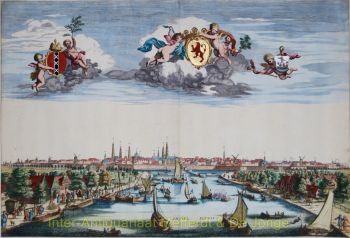
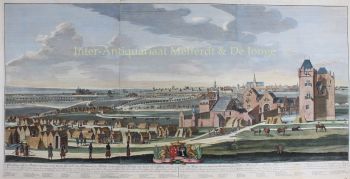
Amsterdam, Prinsengracht - Jan Schenk after Abraham Rademaker, ca. 1720 by Unknown artist
Scroll to zoom, click for slideshow

Amsterdam, Prinsengracht - Jan Schenk after Abraham Rademaker, ca. 1720 1720

Unknown artist

55 ⨯ 94.50 cm
€ 4.850

Inter-Antiquariaat Mefferdt & De Jonge

  • About the artwork
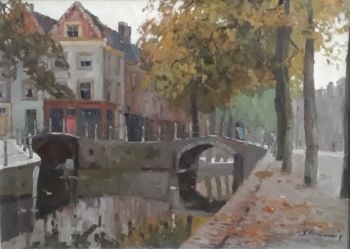
    BEAUTIFUL VIEW OF THE PRINSENGRACHT IN AMSTERDAM "Gesicht van de Groen-markt, van de Ree Sluys te sien naar de Wester Kerk tot Amsterdam" [View of the vegetable market, from the Reesluis towards the Westerkerk in Amsterdam.] Etching with engraving on two sheets made by Jan Schenk after the design of Abraham Rademaker and published by Leon Schenk around 1720. Coloured by a later hand. Size: 55 x 94.5 cm. We see the Prinsengracht at the level of the Reesluis ["deer-sluice"] (of which the name recalls the leather trade, that was concentrated here and later in the nearby Jordaan) in a northern direction. On the left, on the even side, is the Groenmarkt (vegetable market). It is bustling with activity. At the end of the odd side there's the 17th-century Westerkerk. The vegetable market on the Prinsengracht was established in 1644, replacing those on the Oudezijds and Nieuwezijdsvoorburgwal. It was by far the largest in the city and ran from approximately the Looiersgracht along both sides to beyond the Rozengracht. Growers from the wide area around the city sold vegetables and fruit from their barges to traders and individuals. This engraving is from a series of 25 rare large views of Amsterdam and provides a colourful picture of the life and business of the city at the beginning of the 18th century. This extraordinary print is not only important for the townscape and architecture of that time but also for its charming decoration that depicts customs and habits. Literature: Auction catalogue Collection R.W.P. de Vries - Oud en Nieuw Amsterdam (1925), no. 278. "Very fine example with wide margins. Charming depiction of the vegetable barges lying at the quay." Result: 300 guilders + 15% premium. Price: Euro 4.850,- (including frame)


  • About the artist

    It might happen that an artist or maker is unknown.

    Some works are not to be determined by whom it is made or it is made by (a group of) craftsmen. Examples are statues from the Ancient Time, furniture, mirroirs, or signatures that are not clear or readible but as well some works are not signed at all.

    As well you can find the following description:

    •“Attributed to ….” In their opinion probably a work by the artist, at least in part

    •“Studio of ….” or “Workshop of” In their opinion a work executed in the studio or workshop of the artist, possibly under his supervision

    •“Circle of ….” In their opinion a work of the period of the artist showing his influence, closely associated with the artist but not necessarily his pupil

    •“Style of ….” or “Follower of ….” In their opinion a work executed in the artist’s style but not necessarily by a pupil; may be contemporary or nearly contemporary

    •“Manner of ….” In their opinion a work in the style of the artist but of a later date

    •“After ….” In their opinion a copy (of any date) of a work of the artist

    •“Signed…”, “Dated….” or “Inscribed” In their opinion the work has been signed/dated/inscribed by the artist. The addition of a question mark indicates an element of doubt

    •"With signature ….”, “With date ….”, “With inscription….” or “Bears signature/date/inscription” in their opinion the signature/ date/ inscription has been added by someone other than the artist

Are you interested in buying this artwork?