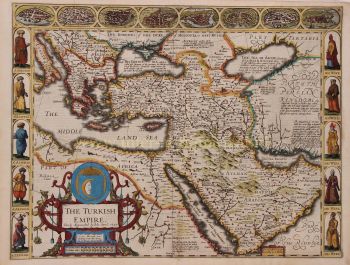
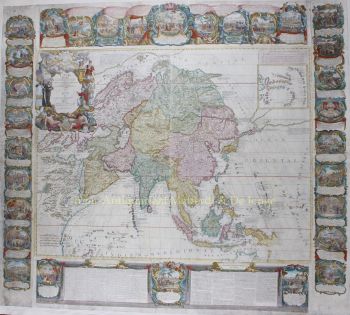
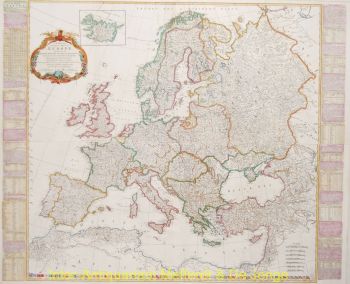
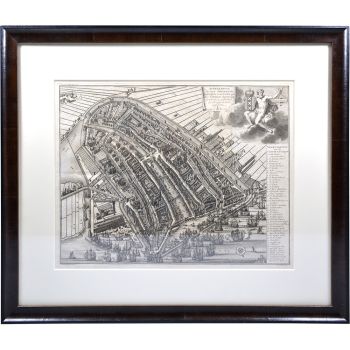
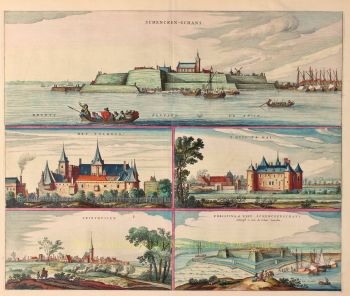
SPEED’S NOTABLE CARTE-A-FIGURES OF EUROPE “Europe, and the cheife Cities contained therein, described with the habits of most Kingdoms now in use.“ Copper engraving made by Abraham Goos and published by George Humble in 1626 as part of John Speed’s “Prospect of the Most Famous Parts of the World.“ Coloured by a later hand. Size: 57,6 x 44,6 cm. Europe as it is shown here, is framed by Northern Africa, Turkey (“The Lesser Asia now called Natolia”), and part of Greenland. The mythical island of Frisland is just to the west of Iceland. The Black Sea is labeled as the “Euxine Sea” (lit.: hospitable sea), the Greek historic name for the body of water. The landmasses are filled with towns, cities, rivers, forests, and mountains. Various sea monsters roam the waters of the North Atlantic and the Mediterranean. In the Atlantic the Dutch seem to battle the Spanish during the ongoing Eigthy Years’ War (c. 1566/1568-1648). Some of the most notable features of the map are its decorative borders in the carte-a-figures style. Along the top are a mixture of plans and bird’s-eye-views of Europe’s most prominent cities. From left to right are London, Paris, Rome, Constantinople (Istanbul), Venice, Prague, Amsterdam, and Lisbon. Along the side borders are examples of the dress of several European. These include, at left, an English woman, a Venetian man, a German woman, a Polish man, and a Hungarian woman. At right are a Spanish man, a French woman, a Belgian man, a Bohemian woman, and a Greek man. This map was featured in the first atlas of the world published by an Englishman. John Speed died in 1629, and George Humble passed in 1640. The copper plates from the Prospect, including this map’s plate, passed to George’s son, William Humble. Humble reissued the maps on an ad hoc basis before passing the plates to William Garrett, who passed them to Roger Rea. This is the initial state of the map, with the date of 1626. Price: Euro 2.150,-