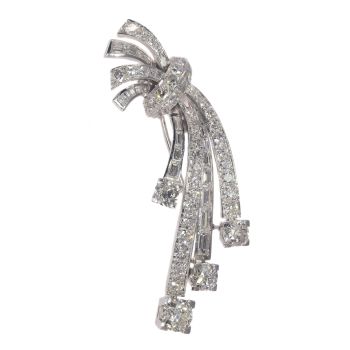
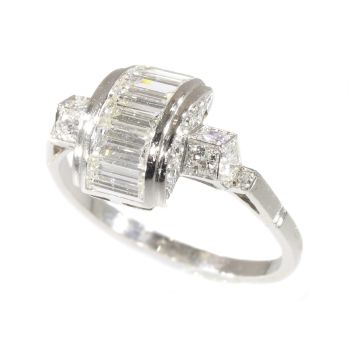
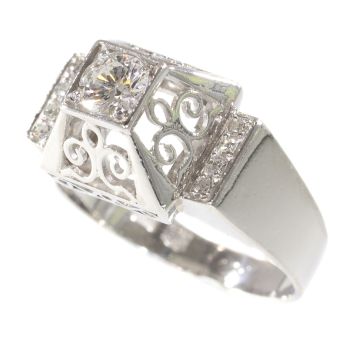
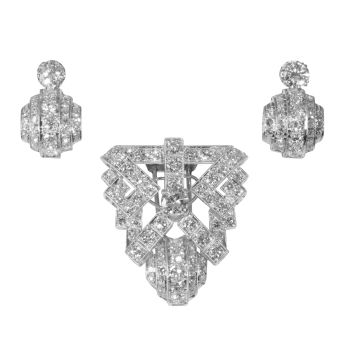
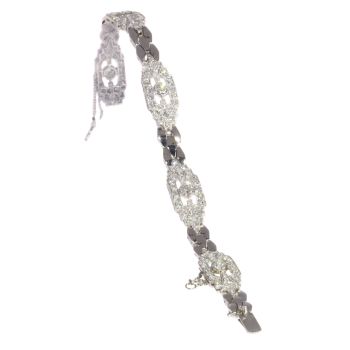
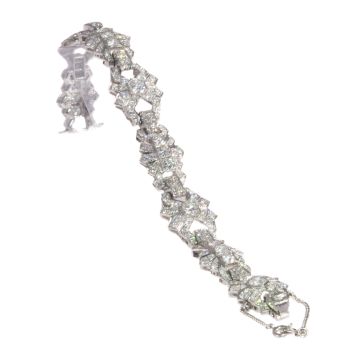
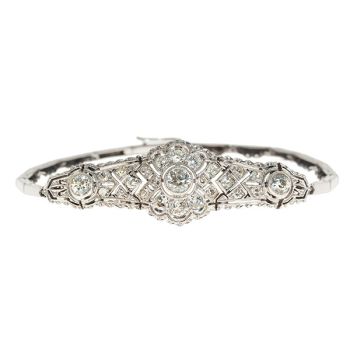
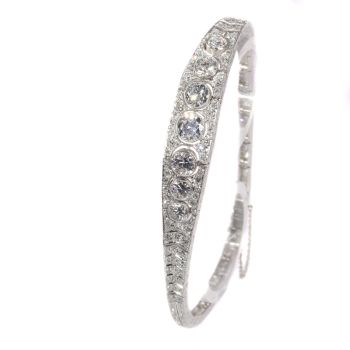
This platinum bracelet from the early 1950s is a substantial example of mid-century diamond craftsmanship. Its broad, articulated construction allows the piece to fall naturally on the wrist, while more than fifty-four carats of diamonds in high colourand clarity create a striking, deliberate brilliance. The assured design and well-resolved structure reflect the period’s renewed appetite for luxury, achieved through discipline and technical competence rather than excess.
The lady who brought the bracelet to us explained that she had inherited it from her mother. Her father, a prominent Antwerp diamond merchant, selected the stones from his own stock, choosing only those he considered his finest. He then engaged ahigh-quality atelier to create the design and commissioned the bracelet as a personal gift for his wife. She described this provenance as part of her family history, and our own examination of the piece, in both the consistency of the diamond quality and the precision of the construction, aligns closely with her story.
Seen in this light, the bracelet is both an impressive diamond jewel and a carefully conceived work of craftsmanship. Its scale, coherence and assured construction reflect the expertise and intention that shaped it, and there is a quiet sense of personal devotion in the care with which the stones were chosen and the piece realised. These qualities remain evident in the bracelet itself and become almost tangible once its story is known.
Jewellery Type high-jewellery bracelet
Condition very good condition more info on our condition scale
Country of origin Although it does not carry any legible control marks we believe this to be of Belgian origin.
Additional provenance note The bracelet is accompanied by a fitted case signed by the Antwerp jeweller K. Schlüsselberg, Pelikaanstraat 86, suggesting it was retailed there.
Style Vintage Fifties (of the twentieth century) See also: Fifties (of the twentieth century) more info on styles
Style specifics This type of jewellery is highly characteristic of the 1950s. Although the Art Deco period had ended only two decades earlier, its geometric language remained a strong source of inspiration. The abundant pavé work and sculptural volume, however, clearlyplace this bracelet within the post-war Fifties idiom, which often makes it challenging, even for trained experts, to distinguish it from late Art Deco creations.
Period ca. 1950 Events & facts of this era:
Post-war economic recovery leading to renewed demand for luxury goods.
Jewellery houses reintroducing lavish diamond designs after wartime restrictions.
Poetry of this era:
Writers such as Dylan Thomas, T. S. Eliot (late period) and Louis MacNeice shaped the mid-century poetic landscape, reflecting both post-war introspection and emerging optimism.
Fashion of this era:
Dior’s New Look encouraging opulence, sculptural silhouettes and generous accessorising.
A natural environment for wide, luxurious diamond bracelets such as this one.
Source of inspiration A sophisticated fusion of lingering Art Deco geometry and the renewed opulence of post-war couture, echoing the radiating motifs and sculptural lines that defined high-end jewellery of the 1950s.
Theme Radiance and symmetry expressed through geometric floral abstraction, capturing the glamour and optimism characteristic of the early post-war decades.
Material platinum (touchstone tested) more info on precious metals
Technique The refined execution, articulated construction and sculptural design all attest to first-class craftsmanship, further distinguished by diamonds of consistently high colour and clarity, carefully matched to support the piece’s visual coherence andbrilliance.
Extra information Accompanied by a custom-fitted case by the Antwerp jeweller K. Schlüsselberg, Pelikaanstraat 86, strengthening the likelihood of Belgian manufacture.
Diamonds Three brilliant cut diamondswith an estimated weight of ± 3.05ct 519 brilliant cut diamondswith an estimated weight of ± 44.38ct 42 baguette (long rectangular) cut diamondswith an estimated weight of ± 7.20ct
Total diamond count 564 pcs.
Total diamond weight approx. 54.63 crt with an average colour and clarity E/G, vvs/vs
- When we provide weights, colour grades, and clarity of diamonds, these are approximate unless otherwise stated, as we do not remove diamonds from their settings to preserve the integrity of the piece.
- All diamonds, regardless of their size or shape, in our vintage and antique jewellery are verified as 100% natural by the IJGC laboratory.
- We do not sell lab-grown (synthetic) diamonds.
Birthstones Diamond is the birthstone (or month stone) for April. more info on birthstones
Brand No maker’s mark found on the bracelet itself.
Signature None but accompanied by retailer’s case signed K. Schlüsselberg, Antwerp.
Hallmarks No hallmarks found, which is not unusual for Belgian high-jewellery pieces of the mid-twentieth century, especially when retailed privately or custom-made. more info on hallmarks
Dimensions 3,75 cm (1,48 inch) x 23,00 cm (9,06 inch) see picture with a ruler in millimeters and inches
Weight 115,10 gram (74,01 dwt)
Adin Reference Nº 25325-0281
Copyright photography Adin, fine antique jewellery
Additional information our latest acquisitions jewelry glossary wall of fame visit us in Antwerp subscribe to our mailinglist
It might happen that an artist or maker is unknown.
Some works are not to be determined by whom it is made or it is made by (a group of) craftsmen. Examples are statues from the Ancient Time, furniture, mirroirs, or signatures that are not clear or readible but as well some works are not signed at all.
As well you can find the following description:
•“Attributed to ….” In their opinion probably a work by the artist, at least in part
•“Studio of ….” or “Workshop of” In their opinion a work executed in the studio or workshop of the artist, possibly under his supervision
•“Circle of ….” In their opinion a work of the period of the artist showing his influence, closely associated with the artist but not necessarily his pupil
•“Style of ….” or “Follower of ….” In their opinion a work executed in the artist’s style but not necessarily by a pupil; may be contemporary or nearly contemporary
•“Manner of ….” In their opinion a work in the style of the artist but of a later date
•“After ….” In their opinion a copy (of any date) of a work of the artist
•“Signed…”, “Dated….” or “Inscribed” In their opinion the work has been signed/dated/inscribed by the artist. The addition of a question mark indicates an element of doubt
•"With signature ….”, “With date ….”, “With inscription….” or “Bears signature/date/inscription” in their opinion the signature/ date/ inscription has been added by someone other than the artist