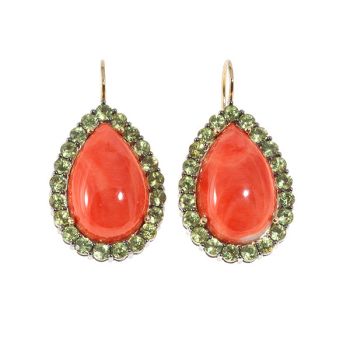
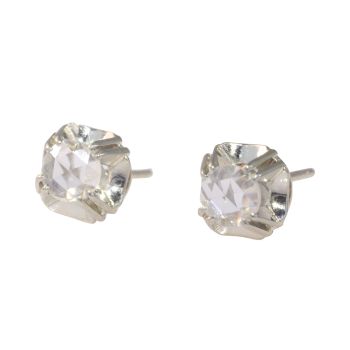
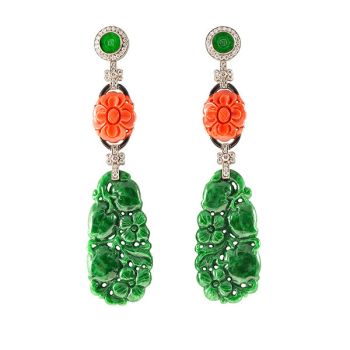
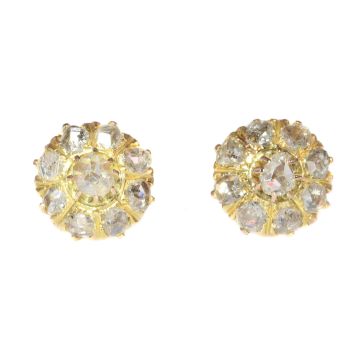
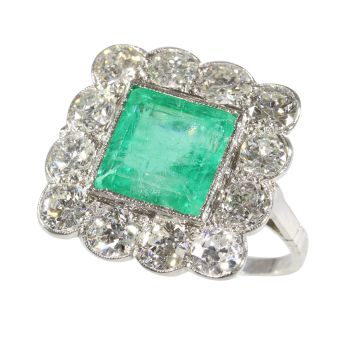
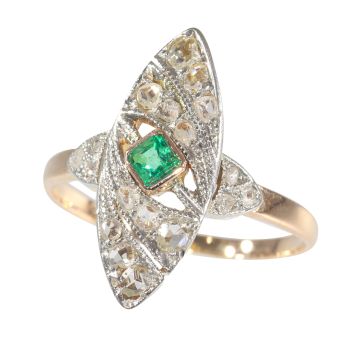
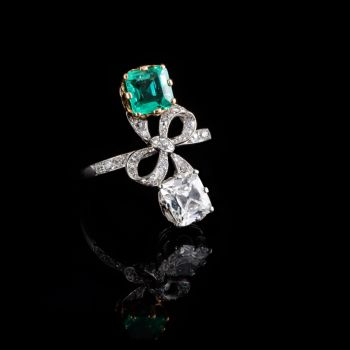
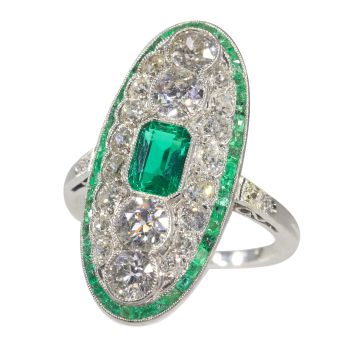
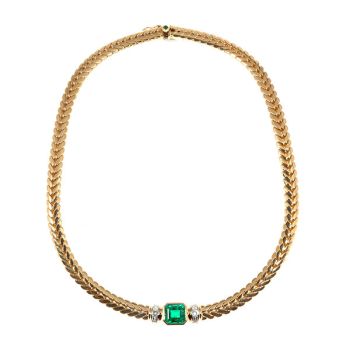
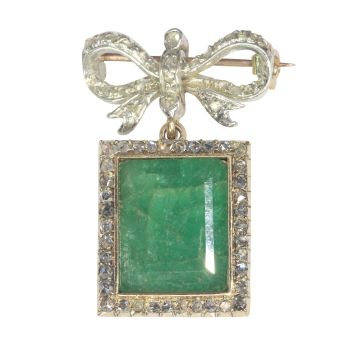
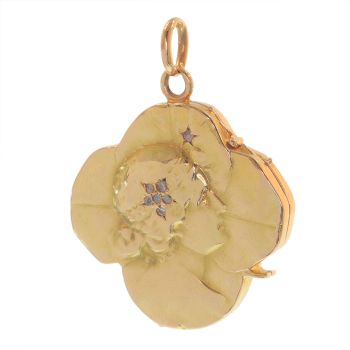
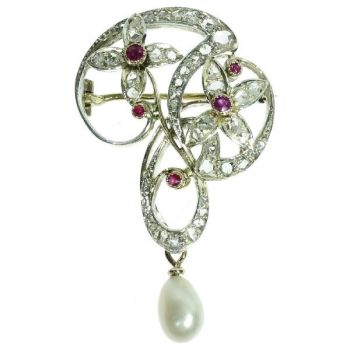
Baroque Iberian Emerald Earrings, 18th Century Goldwork with 58 Emeralds by Unknown artist

Baroque Iberian Emerald Earrings, 18th Century Goldwork with 58 Emeralds 1750

Unknown artist

EmeraldGemstone
€ 7.250

Adin Fine Antique Jewellery

  • About the artwork

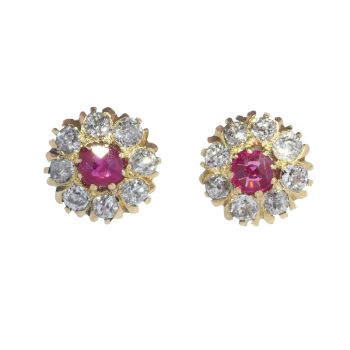
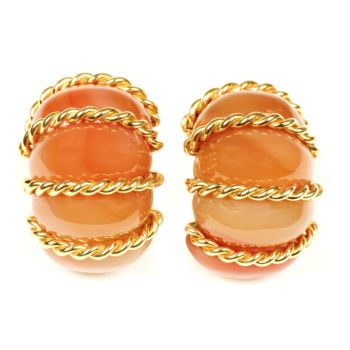
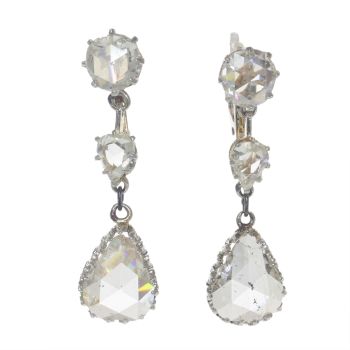
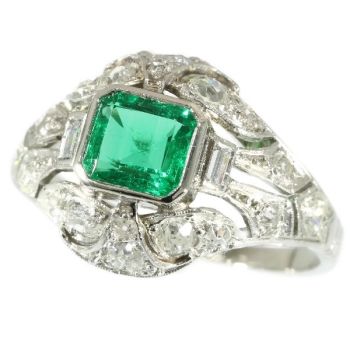
    Circa 1750 Iberian Baroque pendent earrings in 18ct yellow gold, each composed of two oval panels linked by a foliate bow and crowned with airy openwork. Set throughout with a lively scatter of emeralds in square and rectangular cuts, their cool greenflashing against warm gold and fine beaded borders. The domed, closed back construction gives pleasing depth in profile, with a gentle swing when worn.


    Jewellery Type
    pendent earrings

    Condition
    good condition
    more info on our condition scale

    Country of origin
    Iberian Peninsula (Spain or Portugal)

    Style

    Baroque - Baroque is an artistic style that dominated Europe from the late 16th century to the early 18th century. Often described as "the leading style in European art between the Mannerist and Rococo periods, characterised by dynamic movement,heightened emotion, and bold expression."
    Find more info on Baroque
    more info on styles

    Style specifics
    Baroque is a style in art and decoration that developed shortly before 1600 and remained current in Europe until the emergence of the Rococo style c.1730. It was started in Italy, and spread to Germany, Austria, the Low Countries, and Spain andPortugal, with only a somewhat severely classical version being popular in France under Louis XIV. The style was a development of the Renaissance style and is characterized by lively, curved, and exuberant forms, by vigorous movement, and by richornament, based on classical sources, being symmetrical as distinguished from the asymmetry of the following Rococo style.

    Period
    ca. 1750
    Events & facts of this era, poetry of this era, fashion of this era.

    Material 18K
    yellow gold (touchstone tested)
    more info on precious metals

    Precious stones
    58 emeralds

    Birthstones
    Emerald is the birthstone (or month stone) for May.
    more info on birthstones

    Hallmarks
    No trace.
    more info on hallmarks

    Dimensions
    4,70 cm (1,85 inch) x 2,80 cm (1,10 inch)
    see picture with a ruler in millimeters and inches

    Weight
    8,60 gram (5,53 dwt)

    Adin Reference Nº
    25115-0313

    Copyright photography
    Adin, fine antique jewellery


    Additional information
    our latest acquisitions
    jewelry glossary
    wall of fame
    visit us in Antwerp
    subscribe to our mailinglist

  • About the artist

    It might happen that an artist or maker is unknown.

    Some works are not to be determined by whom it is made or it is made by (a group of) craftsmen. Examples are statues from the Ancient Time, furniture, mirroirs, or signatures that are not clear or readible but as well some works are not signed at all.

    As well you can find the following description:

    •“Attributed to ….” In their opinion probably a work by the artist, at least in part

    •“Studio of ….” or “Workshop of” In their opinion a work executed in the studio or workshop of the artist, possibly under his supervision

    •“Circle of ….” In their opinion a work of the period of the artist showing his influence, closely associated with the artist but not necessarily his pupil

    •“Style of ….” or “Follower of ….” In their opinion a work executed in the artist’s style but not necessarily by a pupil; may be contemporary or nearly contemporary

    •“Manner of ….” In their opinion a work in the style of the artist but of a later date

    •“After ….” In their opinion a copy (of any date) of a work of the artist

    •“Signed…”, “Dated….” or “Inscribed” In their opinion the work has been signed/dated/inscribed by the artist. The addition of a question mark indicates an element of doubt

    •"With signature ….”, “With date ….”, “With inscription….” or “Bears signature/date/inscription” in their opinion the signature/ date/ inscription has been added by someone other than the artist

Are you interested in buying this artwork?

Artwork details

Category
Style
Material & Technique
Colour