Dutch Loango-Angola - Salomon Saverij after Frans Post, 1647 1647
Unknown artist
Print
38 ⨯ 100 cm
€ 1.250
Inter-Antiquariaat Mefferdt & De Jonge
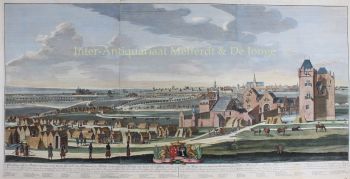
- About the artworkLUANDA ON THE DUTCH LOANGO-ANGOLA COAST “Loanda S. Pauli” (São Paulo de Luanda), etching and engraving printed from two plates made by Salomon Saverij, after a drawing by Frans Post of 1645, from Caspar Barlaeus’, “Rerum per octennium in Brasilia et alibi nuper gestarum sub praefectura J. Mauritii, Nassoviae, c. comitis... historia” piblished by Joan Blaeu in 1647. Size: approx. 38 x 100 cm. View of Luanda in Angola with several Dutch ships off the coast. The fort was part of the Dutch Loango-Angola coast. In the seventeenth century, the city of Luanda was the largest Portuguese slave depot in West Africa. Therefore, on behalf of the Dutch West India Company (WIC), admiral Piet Hein attempted to conquer the city, defended by a fort, as early as 1624. However, due to a lack of troops and ships, this attack failed. In 1641, a second and successful attempt followed under the leadership of Cornelis Jol, a.k.a. "Houtebeen" (pegleg), after which the city and the fort (renamed Fort Aardenburgh) came under the control of the WIC. Due to its southern location, the city was not governed from Elmina (in present-day Ghana), and a new government was established under the name Luango-Angola, with the governor's seat in Luanda. However, in the period until 1648, 'only' 14,000 slaves were transported from the city, and the Dutch colony was not profitable. When the city was recaptured by Portugal in 1648, it was decided not to sail to places south of Congo. The Portuguese were considerably more 'successful' in the slave trade. From around 1550 to 1850, over 2.8 million slaves were shipped from Luanda. This print was part of a series depicting the journey to and stay in Brazil of Governor-General John Maurice of Naussau in the years 1636-1644. The drawings were made by Frans Post, who was the first European to capture the New World. We now see that journey to Brazil passed through Luanda, which was under the control of the WIC for about 8 years. Price: 1.250,-
- About the artist
It might happen that an artist or maker is unknown.
Some works are not to be determined by whom it is made or it is made by (a group of) craftsmen. Examples are statues from the Ancient Time, furniture, mirroirs, or signatures that are not clear or readible but as well some works are not signed at all.
As well you can find the following description:
•“Attributed to ….” In their opinion probably a work by the artist, at least in part
•“Studio of ….” or “Workshop of” In their opinion a work executed in the studio or workshop of the artist, possibly under his supervision
•“Circle of ….” In their opinion a work of the period of the artist showing his influence, closely associated with the artist but not necessarily his pupil
•“Style of ….” or “Follower of ….” In their opinion a work executed in the artist’s style but not necessarily by a pupil; may be contemporary or nearly contemporary
•“Manner of ….” In their opinion a work in the style of the artist but of a later date
•“After ….” In their opinion a copy (of any date) of a work of the artist
•“Signed…”, “Dated….” or “Inscribed” In their opinion the work has been signed/dated/inscribed by the artist. The addition of a question mark indicates an element of doubt
•"With signature ….”, “With date ….”, “With inscription….” or “Bears signature/date/inscription” in their opinion the signature/ date/ inscription has been added by someone other than the artist

Are you interested in buying this artwork?
Artwork details
Related artworks
- 1 - 4 / 12
- 1 - 4 / 24
Cornelis Anthonisz Theunissen
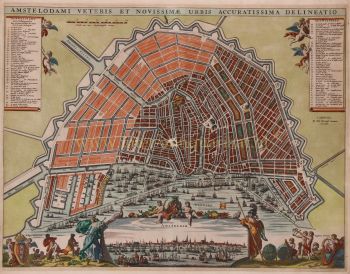
VERY RARE FIRST PRINTED MAP OF AMSTERDAM, A CITY ON THE RISE1544
€ 125.000Inter-Antiquariaat Mefferdt & De Jonge
Curated byDanny Bree
1 - 4 / 24- 1 - 4 / 24
- 1 - 4 / 12