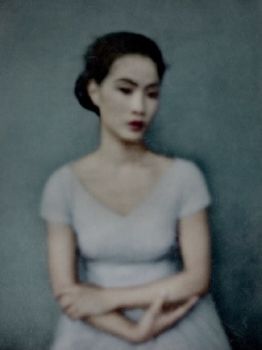
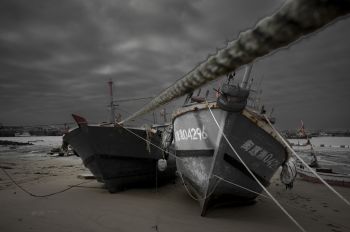
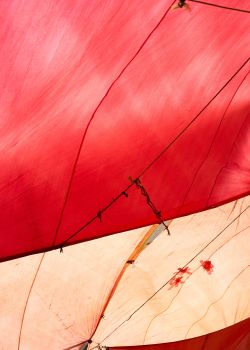
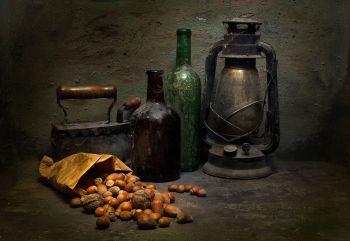
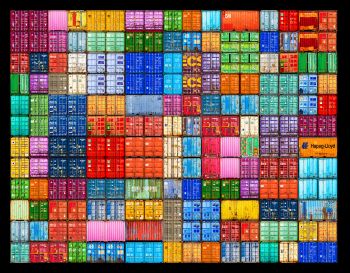
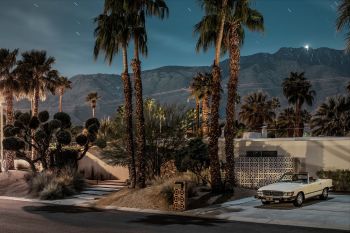
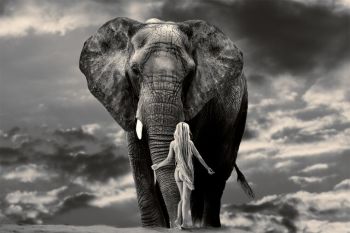
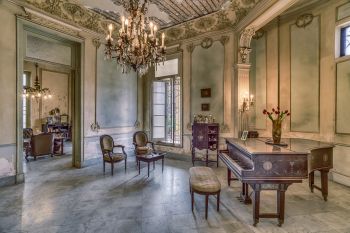
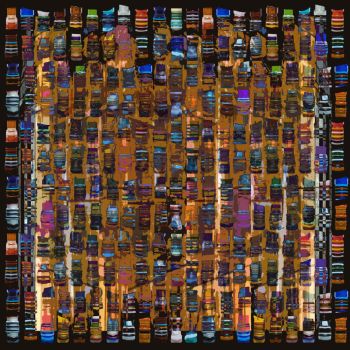
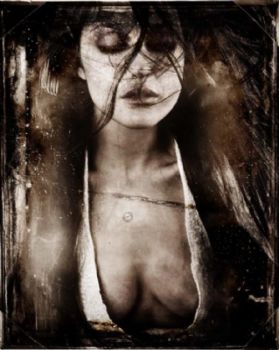
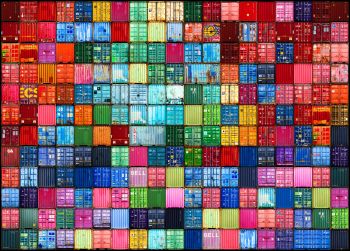
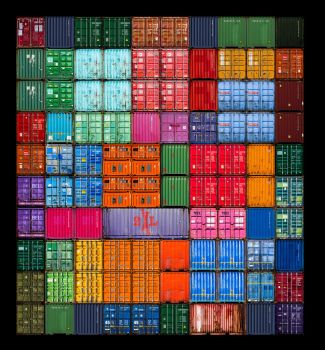
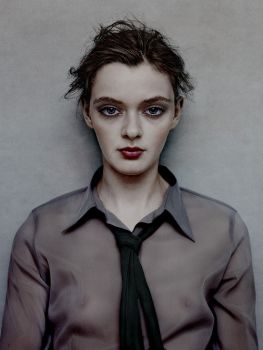
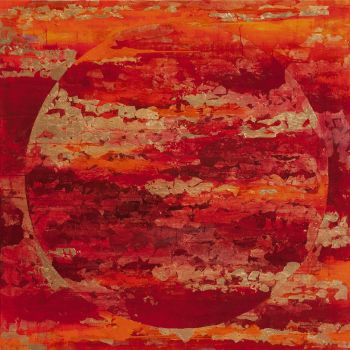
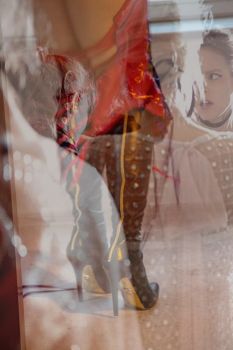
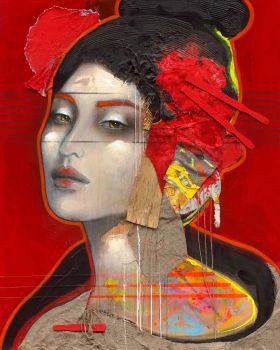
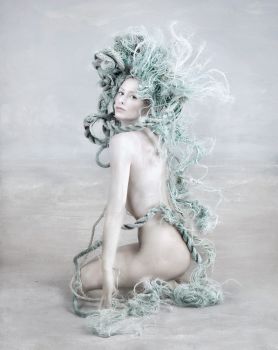
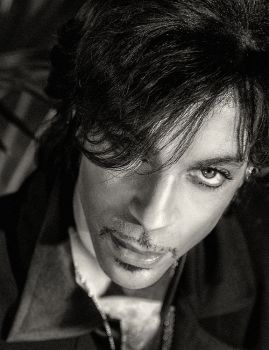
'Ephemeral as smoke and clouds 7' by Yu Ji
Scroll to zoom, click for slideshow

'Ephemeral as smoke and clouds 7' 2006

Yu Ji

Photographic print
120 ⨯ 155 ⨯ 5 cm
ConditionVery good
€ 4.000

Willem Kerseboom Gallery

  • About the artwork
    Photograph, framed on Dibond, 120x155 cm


    Yu Ji: A Game of Simultaneous Void and Fullness
    by Qiu Zhijie

    In the mid to late nineties, Yu Ji was known as representative of the
    performance artists from Chengdu. Compared to those in Beijing whose
    main focus was on the body, and whose emphasis was on performance art
    characterized by the stimulation of extreme experience, the
    performance art around Chengdu often relied on a special location to
    show the reason for the action. The history and cultural attributes of
    this location were often forcefully explicated; in fact, it determined
    the artworks' function of cultural evaluation. Even though they were
    also often based on bodily performance, these performances were more
    allusive and they tried to achieve a balance between intellectual
    pleasure and excitement for the senses. Even though it became
    fashionable at the time to represent the body's sense of resistance
    and impediment, there was always in the end an attempt to resort to
    language-not simply being satisfied with the stimulation that could be
    derived from contemporary myths. That is to say, the artworks could
    also be spoken about. Therefore, the titles of their works often
    derived from poetry or idioms. This was a distinct difference in
    comparison with the use of numbers for the titles of artworks in
    Beijing.

    In these circumstances, Yu Ji obviously could not completely avoid a
    degree of vulgarity. His earlier performances consisted of a type of
    repetitious dialogue; they became a platform for mutual referral built
    on the state of the body and issues gathered from popular culture.
    Their Chengdu flavor was most apparent in the use of harmonizing
    characters, the use of idioms, pre-designed theatrical process, etc.
    Pre-designing a theatrical process does not mean that the designer has
    absolute control - these performances are directly presented to the
    audience, they are not an experience revealed only with the help of
    media. Therefore, in terms of the predictable design of theatrical
    change during the performance, even though there were tones of
    subjective physical experience, it would be presented as the
    performance of that experience.

    These features were all clearly exhibited in Yu Ji's earlier
    performances, including "Playing Qin to Water" and "Kiss from an
    Outstanding Person". In one of Yu Ji's performances, he imitated a
    soldier crawling forward-as often seen in the revolutionary war
    films-allowing threads hanging from his clothes to be slowly ripped
    off until he became nude. This use of insinuated motion was, like the
    playing of the qin, a type of cultural "classic use". In these
    predictable moments, the combination of classic motions and the nude
    body-the most basically allusive body-became the trigger for
    theatricality. "The Kiss of an Outstanding Person" gained fame as a
    representative of the aesthetics of violence in the late nineties. It
    was a union of the significance of psychological and cultural allusion
    with physical suicide. It's tones of violence were mainly from the
    repetitive triggering of this theatricality. During the progress of
    the play, this trigger became predictable, thus becoming preconceived
    facts that the viewer had to bear. This rashly put the viewer in the
    position of an accomplice; it became an unbearable crime for the
    viewer.

    What's worth noticing is this: the characteristic of pre-planning
    slowly oriented Yu Ji to a pursuit of location, and this eventually
    distanced him from the type of performance art that build on a certain
    viewpoint. Yu Ji thus slowly distanced himself from Chengdu artistic
    trends, and entered the sort of experimentation that was mainly taking
    place in Beijing.

    When he participated in the group exhibition of a 24-hour performance
    titled "On Scene Collaboration", his body for the first time left the
    stage. He began to build the space of theatrical possibility through
    his manipulation of elements involved in designing the event and
    dispatching of uncontrollable ones. In such a performance, theatrical
    planning could only be carried in rough approximation. However, the
    various uncontrollable elements that floated around in the artwork
    guaranteed the imminent arrival of theatricality. In this instance,
    the dancer set amongst wooden structures built by carpenters was
    increasingly restricted by the densely placed wooden frames until it
    became difficult to move. The carpenters' work and that of the dancers
    progressed simultaneously; at this moment, the dance and the carpentry
    were genuine motions of their own rather than allusions to a cultural
    reality. However, folding the two together created a foreshadowing of
    the final moment of explosion. As the exhausted dancers and carpenters
    exploded simultaneously, and dismantled all the frames, the two
    identities were elevated, producing a shocking and dizzying experience
    of climax. Moreover, the ritualistic elements in his early performance
    art made an entrance at this instant.

    In my opinion, the 24-hour performance acts as a significant turning
    point in Yu Ji's artistic life. This work expanded the energetic
    pre-planning in his early performance art, removing other adjectives
    used in cultural allusions, adopting a framework to contain rituals
    and daily behaviors. This framework became a place of negotiation
    between the logic and theatricality of everyday behavior.

    For this reason, as we look at the photographs of "Reeky View", "Once
    over" and the installation of "So so Bazooka", we once again perceive
    a re-organization of everyday life which, to reiterate, obviously
    replaces the representation of cultural allusions. In fact, these
    images themselves should be considered the residue of theatrical
    scenes. I was at the set where Yu Ji took these photographs-when the
    smoke suddenly filled the room, the usual objects acquired a new
    appearance, and this brought about the same experience of excitement
    as a theatrical climax. The power of the scene formed an extremely
    complete theatricality. It is only that Yu Ji has chosen to make
    theatricality occur in the space of daily lives, this is not something
    that we have been able to see in the theatres. Yu Ji could only
    condense his scenes into photographs.

    Yu Ji's works have always had a uniquely empty position. "Playing Qin
    to Water" uses the emptiness of water to replace the physicality of
    the listener. The kiss in "Kiss of an Outstanding Person" is defined
    as a pause of breathing/life - for the actor it was a short pause, for
    the chicks it was an eternal emptiness. In a performance on breathing,
    Yu Ji once asked others to layer wet paper on his nose, to make his
    breathing gradually more difficult-this is perhaps the most vivid
    experience of emptiness in Yu Ji's performance series. Yu Ji often
    uses microphones to produce discontinuous, non-linguistic sounds, a
    pause of language. Stuttering creates a type of frustration, it
    inserts a doubt into smooth exchange: Can we really communicate? As we
    advance triumphantly in our everyday lives, the practical rationale of
    self-confidence insists that we never pause or vacillate. However Yu
    Ji is incessantly creating unharmonious sounds and rest notes for this
    marching rhythm. He seems to treat the display of vacillation as a
    type of introspection. Again, among these images smoke is a type of
    emptiness. Smoke permeates into our everyday spaces and redefines the
    attributes of these spaces. Because of smoke, these spaces become the
    stage on which reality becomes fantastic.

    Yu Ji's photograph "Reeky View" was done in the artists' own studios.
    In these famous artists' studios there are classical images familiar
    in the field of contemporary Chinese art, they construct the reality
    closest to us. The studios are often thought of as fields of strong
    personal will, all who enter will be rolled into this type of field.
    Therefore, in my opinion, Yu Ji has chosen a rather challenging
    task-if he would have chosen to shoot even more common types of
    spaces, the artwork would have been more lucid and comprehensible. The
    facts prove Yu Ji's tendency to avoid the easy path for the hard and
    the profundity of his intentions. With the installation of smoke and
    the presence of partly visible actors, such imagery becomes a type of
    text, a new visual experience is recorded into these texts, they
    become image-like. The photography becomes a type of drawing.

    Precisely because we are, to a certain extent, familiar with images
    done by these artists, Yu Ji's use of smoke creates a sense of
    distance that is imbued with a concept of time. Despite being
    symbolic, they will gradually wear down the fixed meanings. The smoke
    surging in seems to be a prophecy. In order to truly understand what
    we are doing, we must take further consideration of time. Thus, Yu
    Ji's smoke is not only a type of pause. The smoke defines everything
    it surrounds as things that will pass - all Chinese people would agree
    with this judgement.


    2006.7.22
  • About the artist

    1965 Born in Chengdu, China
    1992 BFC, Graduated from Sichuan Academy of Fine Arts, China
    Currently lives and works in Beijing, China

    Solo Exhibitions

    2007 ‘Smoke and Clouds’, Willem Kerseboom Gallery,Amsterdam, Holland
    2006 Yuji OEM Image Project-1: My younger brother’s first film exercise, Bizart, Shanghai, China

    2002 Beauty washing my feet during an hour (performance), 31 Bookstore, Chengdu, China
    Breath (performance), Chengdu Academy of Painting, Chengdu, China

    Group Exhibitions

    2007 ArtAmsterdam 2007 artfair, Willem Kerseboom Gallery, Amsterdam, Holland
    2006 A ticket to Beijing, Willem Kerseboom Gallery, Amsterdam, The Netherlands
    Lust-Unfulfilled Desire, Vanessa Art Link, Jakarta, Indonesia
    Black White Zoo, live art exhibition, Taipei, Taiwan
    Common Link, Vanessa Art Link, 798 Factory, Beijing, China
    New Folk Movement – the reconstruct of the commonly living, contemporary art exhibition, Beijng, China
    The First MoCA Envisage Entry Gate: Chinese Aesthetics of Heterogenity, Shanghai MoCA, Fun Art Space, Beijing, Bizart, Shanghai
    High Art - from Contemporary Shanghai Art, Paris, France

    2005 CHINARTE, Titanik Media Space SUMU, Turku, Finland
    Maze - multimedia performance exhibition, Dream Factory laboratorial art center, Shanghai, China
    Ten becoming ten, Songzhao Headquarters, Beijing, China
    The City's Skin - Feasibility Research for Contemporary Metropolis Image exhibition, Shenzhen Art Museum, Tap Seac Gallery, China
    Conspire - Beijing TS1 Contemporary Art Center 1st Exhibition, TS1, Bejing, China
    Inward Gazes: Documentaries of Chinese Performance Arts - Call for Submissions,
    The Macao Museum of Art, China
    East Wind-West Wind, Shanghai Mixed Media Art Exhibition, The Creek Art Center, Shanghai, China
    Power of body, Blue Gallery, Chengdu, China
    24 hours, complete art experience, Beijing, China
    Making Relationships, China Performance Art Exhibition, Taipei Museum, Taiwan
    Second Chengdu Biennale, Museum of Modern Art , Chengdu, China
    The Biennale of Contemporary Chinese Art in Montpellier, Montpellier, France

    2004 Ten Preces of Red Bricks, Blue Gallery, Chengdu, China
    Taiwan-Asia Performance Art Meeting, Tainan, Kaohsiung and Taipei, Taiwan
    Dusseldorf Art Exhibition, Great Palace Arts Museum, Germany
    Matchmaking at Suzhou creek, Eastlink Gallery, Shanghai, China
    BizArt - Current , Shanghai, China
    Is It Art? An Exhibition of Contemporary Art, Shanxi Provincial Art Museum, Xi'an, China
    The First Beijing Dashanzi International Art Festival - Radiance and Resonance/Signals of Time, 798 Factory , Beijng, China
    2004 In Chengdu, Bule Art Center, Chengdu, China

    2003 Together with Migrants-Contemporary Art Exhibition , Today Museum, Beijng, China
    Return NatureⅡPastoral - An Exhibition of International Contemporary Art, Nanjing Shenghua Arts Center, China
    Asia - Middle Europe International Performance Art , Slovakia, Hungary, Poland
    Live International Performance Art , 798 Factory, Beijng, China
    China-Japan performance Art Exchange project, Chengdu Academy of Fine Art, China
    Unbalanced City, SiChuan Stadium, Chengdu, China
    Nippon International Performance Art Festival (NIPAF), Tokyo-Nagoya-Nagano-Osaka, Japan

    2002 Daydream - Chinese Contemporary Art Exhibition, Nanjing Museum, Nanjing, China
    Mushroom Clouds or Utopia - Chinese Contemporary Art Exhibition, Shanghai Weitan Art Gallery, Shanghai, China
    China New Photo - International Festival of Photography, Pingyao, Shanxi, China
    To Each His Own - Contemporary Art Exhibition, Guanzhou University, Guangzhou, China
    The First Triennial of Chinese Art, Guangzhou Arts Museum, Guangzhou, China
    New Urbanism, Guangdong Museum of Art, Guangzhou, China

    2001 First Chengdu Biennale, Museum of Modern Art, Chengdu, China
    Dialogue: The Other - Chinese Contemporary Art Exhibition, Chiesa Santa Teresa dei Maschi, Bari, Italy
    Body Resources and Objects, Hongkong Art Commune, Hongkong, China
    Chinese Proposal, Paragold Int’l Art Center, Shanghai, China
    Friday: on Sound - Performance Show, Chengdu, China
    Second Open Performance Art Festival of China, Chengdu-Pengshan-Leshan, China
    Cross Road - Urban Public Environmental Art Proposals Exhibition, Beijing, China
    Up Down Left Right – 2001 Summer Academic Exhibition, Museum of Modern Art, Chengdu, China
    Remains, Chengdu Cultural palace, Chengdu, China
    Chinese Glamours in Thailand, Art Center, Bangkok, Thailand
    Holding the White Piece, Chengdu Academy of Painting, Chengdu, China

    2000 Explain Water – Outdoor Art Performance Show, Dujiangyan, Sichuan, China
    Documentary Exhibition of China Avant-garde in the 1990’s, Fukoukoa Modern Art Museum, Japan
    Chinese Humanistic Mountains and Water – Environmental Artistic Exhibition, Lan Island, Guilin, China
    Men and Animals - Performance show, 31 Bookstore, Chengdu, China
    Home? - Contemporay Art Project Exhibition, Yuexing Furniture Square, Shanghai, China

    1999 Internet Experimentel Arts of 1999-2000, on Internet

    1997 Wildlife, Lighting Festival – Beginnings – Outdoor Art Performances, Be

Are you interested in buying this artwork?

Artwork details

Category
Style
Material & Technique