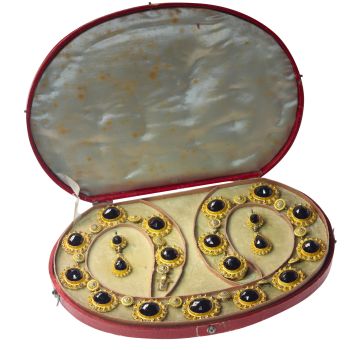
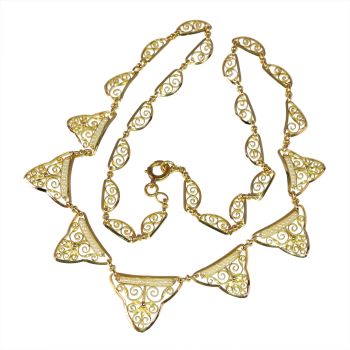
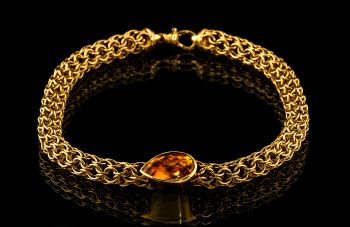
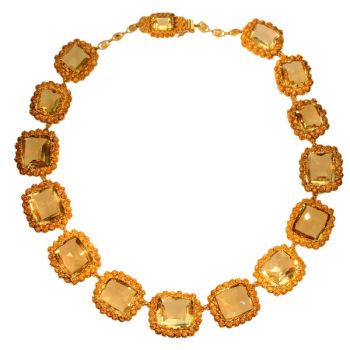
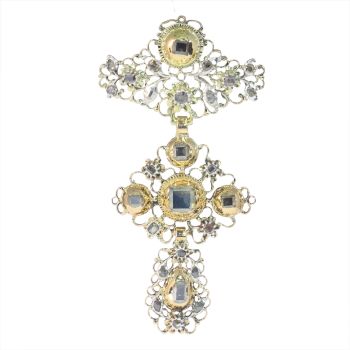
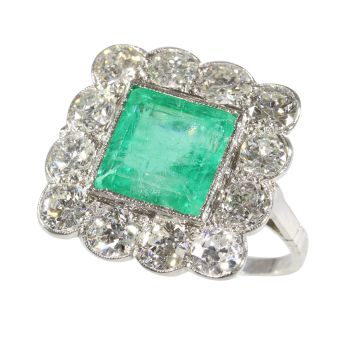
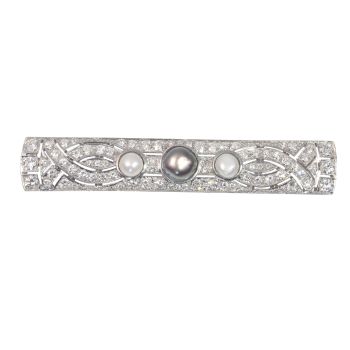
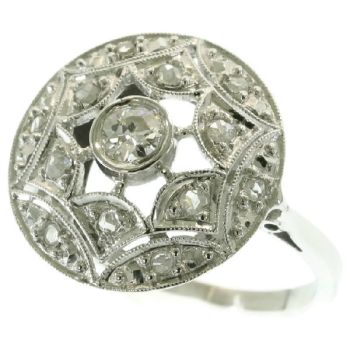
Historic 1820 Citrine and Gold Necklace, Filigree and Granulation, Very Fine Condition 1820
Unknown artist
CitrineFiligreeGoldGemstone
€ 18.500
Adin Fine Antique Jewellery
- About the artwork
A radiant necklace from the Southern Netherlands, circa 1820, crafted in 18K yellow gold with fine filigree and granulation work. The design showcases fourteen oval citrines, their honeyed glow framed by delicate scrolls of gold wire. Both Georgian andearly Victorian in spirit, this jewel reflects the transition of taste between eras, blending opulence with refined lace-like artistry. The cornucopia hallmark affirms its regional origin, while its generous proportions and luminous stones evoke theelegance of early 19th-century fashion. A jewel of distinction, still in very good condition, offering a timeless glimpse of its age.
Jewellery Type
necklace
Condition
very good condition
more info on our condition scale
Country of origin
"The Southern Netherlands" refers to the historical term used for the southern region that encompasses present-day Belgium and the southern part of the Netherlands. (Belgium gained independence from the Netherlands in 1831.)
Style
Pre-Victorian -
See also: Pre-Victorian
more info on styles
Period
ca. 1820
Events & facts of this era, poetry of this era, fashion of this era.
Material 18K
yellow gold (touchstone tested)
more info on precious metals
Technique
Granulation is a technique where the goldsmith uses very small balls (granules) of metal, which are not soldered to the piece but welded. This technique demand very high skills and precision from the maker. And filigree (formerly written filigrann orfiligrane) which is a delicate kind of jewel work made with twisted threads usually of gold and silver or stitching of the same curving motifs. It often suggests lace and French from 1660 to the late 19th century. It should not be confused with ajourejewellery work; while both have many open areas, filigree involves threads being soldered together to form an object and ajoure involves holes being punched, drilled, or cut through an existing piece of metal. (from:Wikipedia)
Precious stones
Fourteenoval citrine stones
It is a very common practice to treat gemstones to intensify their clarity or colour. The item in question has not been tested in this regard.
Birthstones
Citrine is the birthstone (or month stone) for November.
more info on birthstones
Hallmarks
The hallmark found (the cornucopia or horn of plenty) in this jewel was used in the former Southern Netherlands (now Belgium) between 1815 and 1832.
more info on hallmarks
Dimensions
length 42,50 cm (16,73 inch) height center piece 3,28 cm (1,29 inch)
see picture with a ruler in millimeters and inches
Weight
50,10 gram (32,21 dwt)
Adin Reference Nº
25125-0132
Copyright photography
Adin, fine antique jewellery
Additional information
our latest acquisitions
jewelry glossary
wall of fame
visit us in Antwerp
subscribe to our mailinglist
- About the artist
It might happen that an artist or maker is unknown.
Some works are not to be determined by whom it is made or it is made by (a group of) craftsmen. Examples are statues from the Ancient Time, furniture, mirroirs, or signatures that are not clear or readible but as well some works are not signed at all.
As well you can find the following description:
•“Attributed to ….” In their opinion probably a work by the artist, at least in part
•“Studio of ….” or “Workshop of” In their opinion a work executed in the studio or workshop of the artist, possibly under his supervision
•“Circle of ….” In their opinion a work of the period of the artist showing his influence, closely associated with the artist but not necessarily his pupil
•“Style of ….” or “Follower of ….” In their opinion a work executed in the artist’s style but not necessarily by a pupil; may be contemporary or nearly contemporary
•“Manner of ….” In their opinion a work in the style of the artist but of a later date
•“After ….” In their opinion a copy (of any date) of a work of the artist
•“Signed…”, “Dated….” or “Inscribed” In their opinion the work has been signed/dated/inscribed by the artist. The addition of a question mark indicates an element of doubt
•"With signature ….”, “With date ….”, “With inscription….” or “Bears signature/date/inscription” in their opinion the signature/ date/ inscription has been added by someone other than the artist

Are you interested in buying this artwork?
Artwork details
Related artworks
- 1 - 4 / 12
Unknown artist
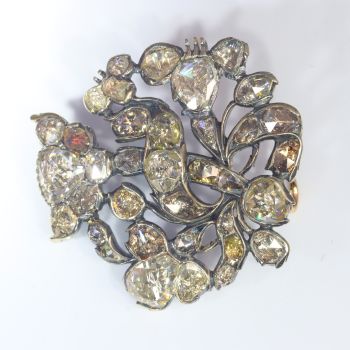
Fleur-de-Lis Splendour: Antique French Brooch with Intense Green Essence1890
€ 14.250Adin Fine Antique Jewellery
Curated byDanny Bree
1 - 4 / 24- 1 - 4 / 24
- 1 - 4 / 24
- 1 - 4 / 12