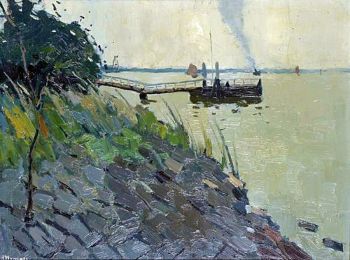
Idyllisch Hollands boerenerf aan het water by Cornelis Vreedenburgh

Idyllisch Hollands boerenerf aan het water 1918

Cornelis Vreedenburgh

Original oil on canvas
83 ⨯ 129 cm
Price on request

Bruning Heintz Fine Art

  • About the artwork
    Gedateerd 1918
    Grootte 83 x 129 cm
    Signatuur Handgesigneerd
    Materiaal Olieverf op doek
    Stroming Klassiek impressionisme
    Locatie Woerden
    Provenance Particuliere collectie Zwitserland

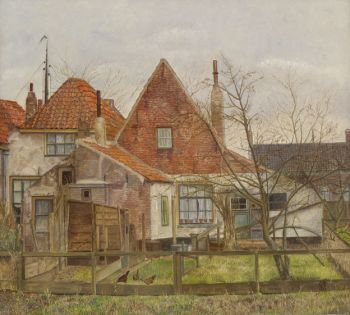
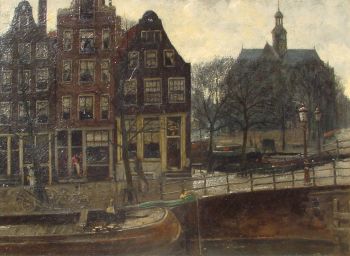
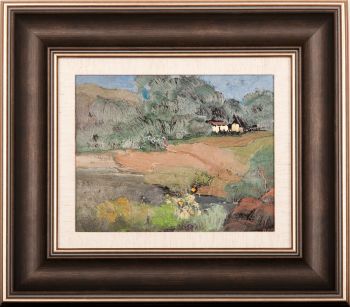
    Dit schilderij van Cornelis Vreedenburgh uit 1918 toont een idyllisch Hollands boerenerf aan het water, badend in een zacht, zomers licht. Op de voorgrond ligt een stille sloot die het tafereel spiegelt: de boerderij, de bomen en de lucht lossen op in het wateroppervlak, waardoor een bijna dromerige dubbelwereld ontstaat. De compositie is zorgvuldig maar voelt nergens geconstrueerd. De boerderij ligt iets terug op het erf, half verscholen achter ranke bomen die het licht filteren. Links leidt een bruggetje het oog het landschap in, terwijl een eenvoudig steigertje met een emmer een menselijk, alledaags detail toevoegt. Dit soort kleine elementen maken het tafereel levendig zonder het rustige karakter te verstoren. Wat vooral opvalt, is de manier waarop Vreedenburgh het licht en de atmosfeer vangt. Met losse, impressionistische penseelstreken suggereert hij bladeren, bloemen en reflecties, zonder ze volledig uit te werken. De kleuren zijn warm en helder en geven het geheel een zinderende zomerse gloed. De lucht is licht bewolkt, maar straalt toch een zachte helderheid uit die over het hele doek verspreid ligt. De vermoedelijke situering rond Woerden past perfect bij Vreedenburghs oeuvre. Hij schilderde dit soort rivier- en polderlandschappen met een grote gevoeligheid voor sfeer en seizoensbeleving. Met zijn breedte van 130 cm heeft het werk een indrukwekkende, bijna panoramische werking (zie ook de interieurfoto). Het nodigt de kijker uit om het landschap binnen te stappen alsof je zelf aan de waterkant staat, omringd door stilte, zonlicht en het zachte ruisen van de natuur. Als u de locatie herkent, horen we dat heel graag.
  • About the artist

    Cornelis Vreedenburgh (25 August 1880 – 27 June 1946) was a Dutch painter, known for his atmospheric depictions of cityscapes and landscapes. Born in Woerden, the Netherlands, he developed a passion for art at an early age, influenced by his father Gerrit Vreedenburgh, who was himself a painter.

    Education and Influences

    Although Vreedenburgh was largely self-taught, he received valuable advice from the impressionist painter Willem Bastiaan Tholen. Together with Tholen, he explored the inland lakes and wide rivers of the Netherlands, capturing the vast skies and open waters. These experiences had a lasting influence on his work, especially in his depiction of light and reflections on water.

    Career and Recognition

    In 1904, Vreedenburgh received a royal grant for promising young artists, allowing him to focus entirely on his painting. His entry at Arti et Amicitiae was awarded the Willink van Collen Prize, and he became a member of both Arti et Amicitiae and Pulchri Studio. His work quickly became popular for its vibrant colours and the way he captured the light and atmosphere of the Dutch landscape.

    Personal Life

    After marrying artist Marie Schotel in 1912, Vreedenburgh settled in Laren, a bustling artists' village at the time. Here he painted many cityscapes of Amsterdam, capturing the charm and character of the city. His work was recognised by Queen Wilhelmina in 1937, who purchased two of his paintings.

    Legacy

    Cornelis Vreedenburgh died on 27 June 1946 in Laren. His paintings remain valued for their technical skill and ability to capture the essence of the Dutch landscape and city life. His work can be found in several museums and private collections, and he is remembered as an important figure in Dutch art history.

Are you interested in buying this artwork?

Artwork details

Category
Subject
Style
Material & Technique