Johann Loetz Witwe – Phänomen Genre 299 – Tricolor vase by Johann Loetz (Lötz) Witwe Klostermühle

Johann Loetz Witwe – Phänomen Genre 299 – Tricolor vase 1900 - 1902

Johann Loetz (Lötz) Witwe Klostermühle

GlassPewterGoldMetal
29 cm, ø 9 cm
ConditionVery good
Price on request

Antiques Emporium

  • About the artwork
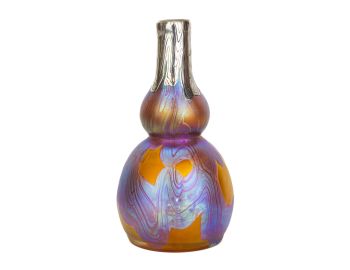
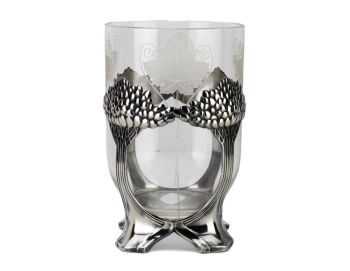
    This Johann Loetz Witwe vase, executed in the exceptional Phänomen Genre 299, known as Tricolor, masterfully embodies the splendor and artistic ingenuity of Jugendstil glass. Standing 29 cm tall, this vase is a refined and rare piece that, due to its color composition and craftsmanship, represents a highly coveted collector’s item. The exquisite Tricolor decoration, introduced around 1900 shortly after the Paris World Exhibition, features broad vertical stripes in rich blue, intense red, and vibrant yellow—a color palette that captivates with its depth and iridescent sheen.

    The delicate color pattern is accentuated by a subtle, oil-like sheen that seems to dance across the glass surface, adding an extra dimension and giving the vase a dynamic appearance. This visual richness is further enhanced by the gilded Jugendstil-style mount, crafted by the renowned German firm Bitter & Gobbers, which seamlessly integrates with the glasswork, lending the vase a noble elegance.

    The Tricolor technique exemplifies the technical mastery of the Loetz workshop and their ability to create timeless glassworks. This piece symbolizes the innovative aesthetics of Art Nouveau, celebrating iridescent color transitions and natural forms. This Loetz vase is not merely an art object but also a testament to a style period that continues to be admired worldwide for its refined craftsmanship and enduring beauty.

    Condition: The vase is in very good condition. The glass is flawless, and the gilding shows minimal wear. The mount has a small fracture.
  • About the artist

    Lötz/Loetz was founded by Johann Lötz in 1840 and was a company based in Bohemia, in the Czech Republic, at the time Lötz belonged to the Empire of Austria-Hungary. In 1879, a grandson of Lötz, Max Ritter-Von Spaun, took over the business from his grandmother and kept the name Joh. Lötz Witwe.

    From that moment on, Johann Lötz Witwe really started to make a name for itself, they developed new innovative glass techniques, but their design and bright colors were also completely innovative. They designed special shapes and vases, luxury items, which they sold in luxury shops in Vienna, Berlin, Hamburg, Paris, London, Milan, Brussels and Madrid. It soon made them very well known and famous.

    It was the period that Art Nouveau or as it was called in Germany Jugendstil flourished. They used organic shapes, nature was their example, also for Lötz, they developed beautiful decors, resembling butterfly wings, such as the papillon decor of this vase, often the shapes were formed organically by using tongs to shape the hot glass unevenly , as also flowers are formed. But also an octopus or sea shells were taken as examples for their special vases and decors.

    Lötz participated in all kinds of World Exhibitions, including the famous World Exhibition of 1900 in Paris where they won the Grand Prize. They were awarded numerous prizes for participation in World Exhibitions. Max Ritter von Spaun also received special awards for his contribution to the glass industry, in 1883 he was allowed to use the Imperial eagle in their shield and seal, they were also allowed to use K.K. Put Private Glass Factory in front of their name. In 1889 he also received a knighthood from Franz Josef. But other royal houses were also involved. He received the Belgian Order of Leopold and the honorable French Legion d'Honneur.

    Their designs were popular, also in the United States. Tiffany worked with Lötz on the Favril set. Lötz patented some of their special techniques, such as the one they used to make the Phänomen decor. They were able to make iridescent glass. In short, Lötz had become a household name. And it still is.

    Lötz also worked closely with other glass manufacturers such as J.&L. Lobmeyer and E. Bakolowits Söhne in Vienna and with Argentor. In addition, Lötz worked closely with various artists, such as Josef Hoffmann, Koloman Moser, Franz Hofstötter, Michael Powolny and other artists from the Wiener Werkstätte. Michael Powolny was responsible for the much tighter tango vases of the 1920s.

    The First World War and the end of the Austrian Empire meant a difficult period for Lötz.
    Lötz existed until 1940, after a bombing raid the factory was completely burnt down. After WWII, the Czech Republic belonged to the satellite states of the Soviet Union, the factory was nationalized until it was finally closed in 1947.

    Lötz glass is still very popular and is collected worldwide, in addition, their oeuvre can also be found in many museum collections.
Are you interested in buying this artwork?