Large Dutch Delft chinoiserie plate from ‘De Paauw’ by Unknown artist

Large Dutch Delft chinoiserie plate from ‘De Paauw’ 1680 - 1700

Unknown artist

GlazeCeramicEarthenwarePaint
40 cm
ConditionVery good
€ 1.950

Verkoulen Oriental & European Antiques

  • About the artwork
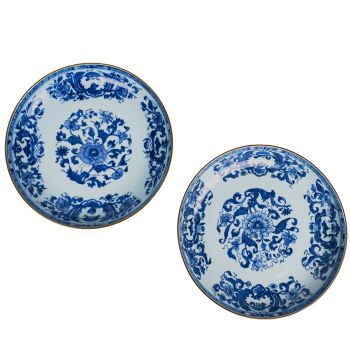
    A large chinoiserie plate with Transition and Kangxi inspired decoration, 17th century, around 1680-1700, Delft, Holland.
    Blue and white

    Dimensions: 40 cm. diameter.

    Signed D-PAUW for pottery factory ‘De Paauw / The Peacock’ (1651-1774).

    This earthenware plate has a beautiful dense and deep blue color, finished with black. In the middle we can see two Long Eliza’s in a fenced garden. On the left side of the fence there is an incense burner and cache-pot displayed.

    Long Eliza is an old common name for the decoration on Chinese export porcelain featuring elegant, slim and long women. The Dutch are credited with giving this Chinese export pattern its name ‘Lange Lijzen’ (or loosely translated Tall Eliza), which is typical for the Kangxi period (1662-1722). This of course did not go unnoticed by the Delft potters. The broad border of the plate is not decorated with a pattern but with similar scenes with lots of space and white in between. This is a typical element derived from the Chinese transitional period porcelain (1621-1662).


    The high-quality decoration of this plate is very recognizable for factory ‘De Paauw’ (The Peacock). The workshop was active from 1651-1774 on the addresses Koornmarkt and Oude Delft, in Delft. Before, in these buildings there was a beer brewery by Jacob Adriaensz Paauw (1558-1620), who also had been major of the Delft City. It was common to use the former name of the older factory (that were in most cases beer breweries) that were located in the pledge before the potters settled in there. A 'fire inspection' from 1668 mentions the presence of one kiln to fire the pottery, but around 1730 two kilns were producing. In 1775 the Paauw went bankrupt. In the 18th century, ways of making Chinese quality porcelain were developed through Europe. By the end of the 18th century the popularity of Delft pottery is rapidly declining and one company after another must close.

    Condition: Very good, some light retouches to the edge.
  • About the artist

    It might happen that an artist or maker is unknown.

    Some works are not to be determined by whom it is made or it is made by (a group of) craftsmen. Examples are statues from the Ancient Time, furniture, mirroirs, or signatures that are not clear or readible but as well some works are not signed at all.
    As well you can find the following description:

    •“Attributed to ….” In their opinion probably a work by the artist, at least in part

    •“Studio of ….” or “Workshop of” In their opinion a work executed in the studio or workshop of the artist, possibly under his supervision

    •“Circle of ….” In their opinion a work of the period of the artist showing his influence, closely associated with the artist but not necessarily his pupil

    •“Style of ….” or “Follower of ….” In their opinion a work executed in the artist’s style but not necessarily by a pupil; may be contemporary or nearly contemporary

    •“Manner of ….” In their opinion a work in the style of the artist but of a later date

    •“After ….” In their opinion a copy (of any date) of a work of the artist

    •“Signed…”, “Dated….” or “Inscribed” In their opinion the work has been signed/dated/inscribed by the artist. The addition of a question mark indicates an element of doubt

    •"With signature ….”, “With date ….”, “With inscription….” or “Bears signature/date/inscription” in their opinion the signature/ date/ inscription has been added by someone other than the artist

Are you interested in buying this artwork?