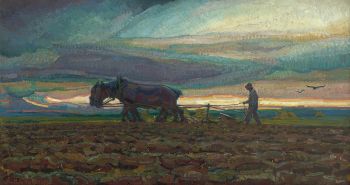
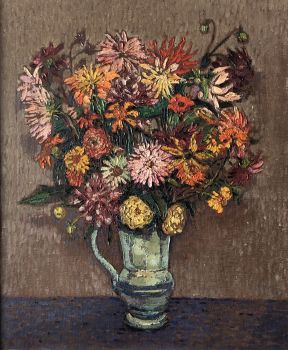
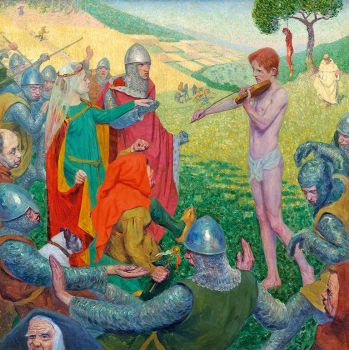
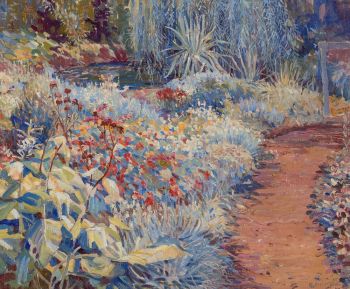
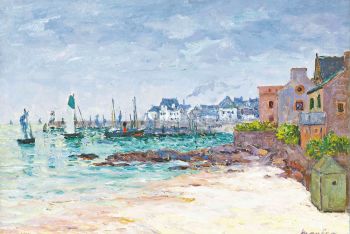
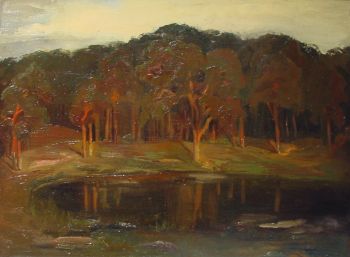
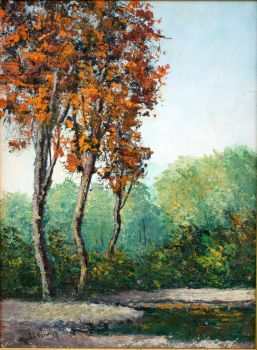
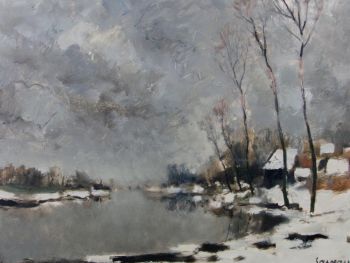
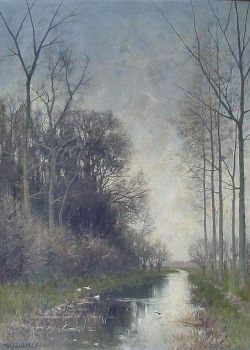
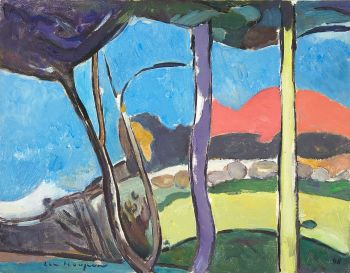
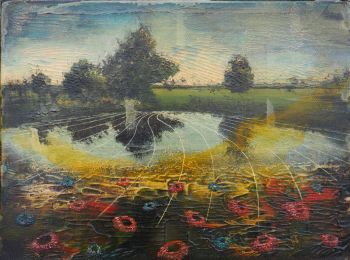
Simon Moulijn (Rotterdam, 20 July 1866 – The Hague, 2 November 1948) was a prominent Dutch painter, draftsman and graphic artist, best known for his lithographic works. His oeuvre is characterised by dreamy landscapes and a strong symbolist influence, which is why he is often referred to as the "painter of romantic loneliness".
Born as the son of manufacturer and merchant Simon Moulijn Sr. and Magdalena Maria Johanna Walter, Moulijn began his education at the Rotterdam Academy of Fine Arts and Technical Sciences in 1882. From 1885 he continued his studies at the Rijksacademie van Beeldende Kunsten in Amsterdam, where he came into contact with contemporaries such as Ferdinand Hart Nibbrig, Richard Roland Holst and Isaac Israëls.
After his education, Moulijn lived and worked in various places, including Drenthe, Rotterdam, The Hague, De Steeg and Renkum. In 1902 he married poet Henriëtte Haitsma Mulier, after which the couple settled in Laren, a former artists' village. Here he had the house "De Egelantier" built in 1903 according to his own design.
Moulijn drew his inspiration from various European countries, including Germany, Switzerland and France. His travels to these countries influenced his work and contributed to the development of his unique style. In 1894, the year in which he captured a farm, he became strongly influenced by symbolism and began to depict nature in a simplified manner.
In addition to paintings, Moulijn also made many watercolours, illustrations for fairy tale books, etchings and lithographs. He even wrote two books on lithographs to draw more attention to graphic art: "De lithografische prentkunst" (1918) and "De eerste jaren van de lithografische prentkunst in Nederland" (1927). His dedication to art was rewarded in 1938 with his appointment as Knight in the Order of Orange-Nassau.
Moulijn was closely involved in the organisation of various exhibitions around the world. For example, he organised an exhibition in San Francisco and in Budapest, for which he received awards. His work is included in the collections of, among others, the Drents Museum in Assen, the Rijksprentenkabinet in Amsterdam and the Gemeentemuseum Den Haag.
Simon Moulijn died on 2 November 1948 in The Hague. His legacy remains an important contribution to Dutch art history, with works that transport the viewer to serene and introspective landscapes.