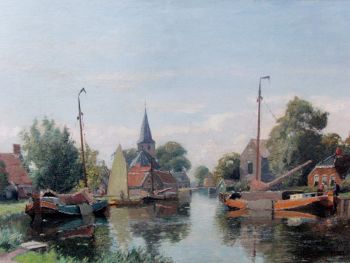
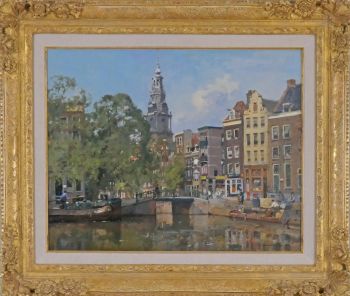
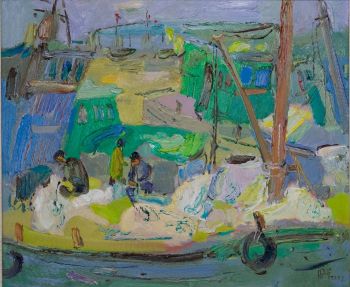
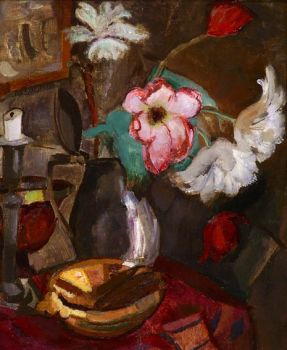
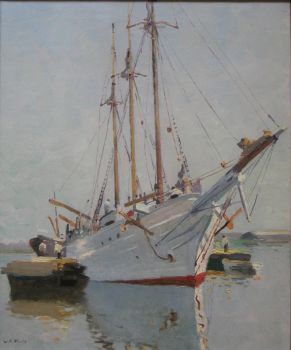
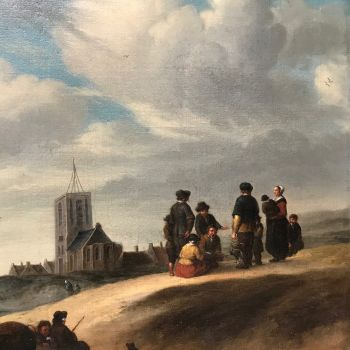
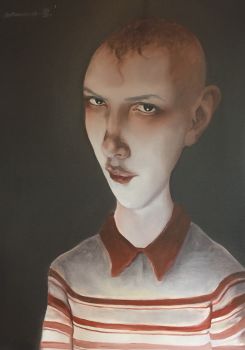
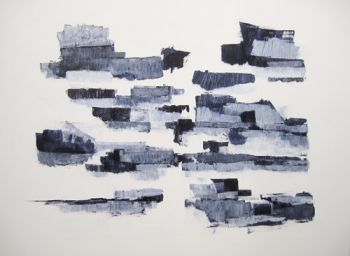
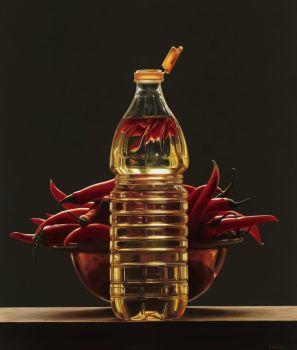
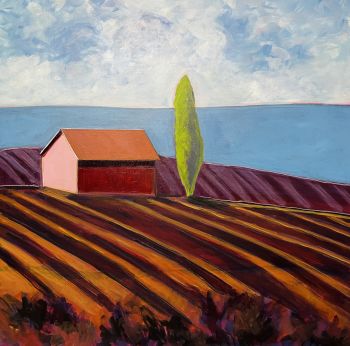
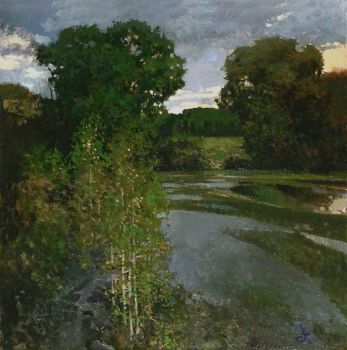
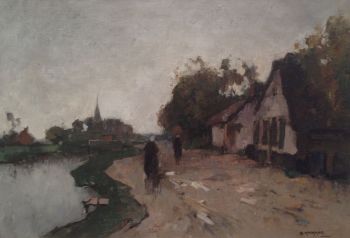
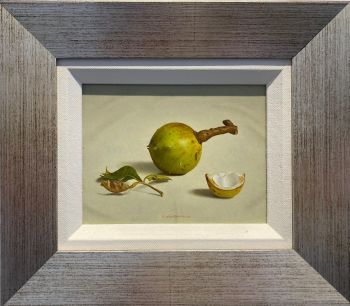
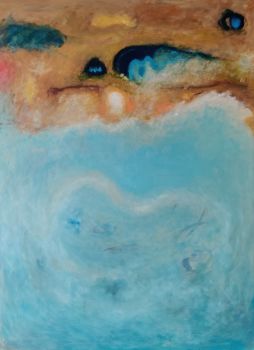
Techniek : olieverf op paneel
Totale afmetingen: 27 x 33cm
Beeldmaat / paneelmaat: 20 x 24cm
Conditie: in goede staat.
Lijst: in originele lijst
Signering: rechtsonder.
Herkomst: collectie jacob Gelt Dekker
Albert André
Lyon, 1869-Laudun, 1954
Albert André was born in Lyon where his father owned a silk hat factory. He studied at the Lycée in Lyon and spent his holidays in Laudun (Gard). Towards 1885 he took up drawing and worked on projects for the silk industry. Faced with his lack of enthusiasm towards this activity, his family accepted to send him to Paris so that he could dedicate himself seriously to the study of painting. He moved to Paris probably around 1889 and attended the Académie Julian where he met, among others, Paul Ranson (a member of the Nabis group) and Valtat. In 1894 he took part for the first time in the Salon des Indépendants. He was noticed by Renoir, who recommended him to Durand-Ruel, his future dealer. This marked the beginning of his career as an artist. In the years that followed, he took part with Toulouse-Lautrec in the stage design for the Chariot de Terre Cuite (an avant-garde play given at the Théâtre de L'Ouvre). With Maurice Denis, Bonnard and Vuillard (all members of the Nabis group), he exhibited works at Bing's, the important Japanese Art dealer and inventor of the Art Nouveau style. His talent was recognised after his first personal exhibition at Durand-Ruel in 1904, and numerous exhibitions and commissions followed. He appeared next to Monet, Cézanne, Renoir, Pissarro in the exhibition entitled Natures Mortes (Durand-Ruel 1908), was commissioned a large decorative panel for the French pavilion at the Universal Exhibition in Turin, and was chosen to celebrate the Interpretation du Midi at the Salon de La Libre Esthétique in Brussels (1913), while his first personal exhibition in New York (Durand-Ruel 1912) met with great success. Then came the war and his demobilisation in 1917, followed by his move to Endoume, near Marseille, where the artist, rediscovering the pleasure of painting, signed some of his most beautiful works (The Day of the Armistice, Walk in Endoume, Terrace by the Sea).
He was the author of Renoir's-and later Monet's-biography and portraits of his latter years, whom he painted in strikingly truthful scenes.
Surrounded by friends such as Julie Manet, Pierre Renoir, Marquet and Paul Signac, his life was spent between Paris, working as a painter and as the secretary of the Salon d'Automne, and his long stays in Laudun (he was the curator of the Musée de Bagnols-sur-Sèze), where he retreated during the Second World War.
Gradually, the bright palette of his initial years became softer. But Albert André remained faithful to himself, to his sense of intimacy, his muffled interiors, the familiar objects, flowers, vases, furniture, mirrors, open windows in Laudun where "he found the landscapes on his doorstep, the flowers in his garden, and his models in his friends" (G. Mermillon).
Evelyne Yeatman-Eiffel