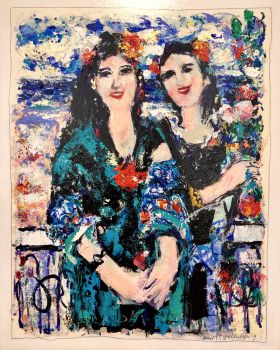
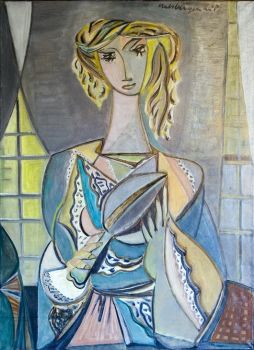
Picador 1963
Rafael Illana Díez
Original oil on canvasMixed techniques
94 ⨯ 67 cm
ConditionExcellent
Price on request
Gallerease Selected
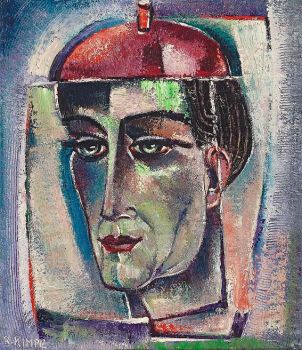
- About the artworkNice expressive and cubistic artwork of Spanish picador a little bit in the style of Picasso.
The artwork has fresh colours and is decorated with subtile textile decorative motifs and reliefs.
The picador has three main functions in a traditional bullfight: To pierce the muscle on the back of the bull's neck in order to - straighten the bull's charge. To fatigue the bull's neck muscles and general stamina as it tries to lift the horse with its head. To lower the bull's head in preparation for the next stage.
If the public feels that a picador is better than the bull the public will whistle, boo or jeer as they see fit. This is because they do not want the bull to lose all its strength and energy as this can lead to a dull bullfight.
The picador is obliged to give the bull two lances in a first-category bullring (Barcelona, Madrid, Sevilla, Zaragoza etc.), but the matador may request that the second be waived in second- and third-category rings. The bull may receive three lances if it is particularly ferocious.
The aim of the bull to charge the picador is often cited as the biggest test of its courage. A bull that does not charge may be punished with a black banderilla, which although somewhat longer than a normal banderilla is largely symbolic and a mark of shame for the breeder.[citation ne - About the artist
Rafael Illana Díez was born in Barcelona in 1940 and became a versatile and colorful artist within the Spanish and international art scene. His artistic education took place at the Academia Baixas in Barcelona and later at the famous Grande Chaumière in Paris — a cradle for European avant-garde artists.
In 1964, Illana received the prestigious Premio de Dibujo del Cercle Maillol, followed by a grant from the French government. This recognition marked the beginning of an international career, with exhibitions in, among others, the Kira de Palma de Mallorca gallery (1963), and then in Madrid, Barcelona, Valencia, León, Frankfurt, Munich, and New York. He participated in prominent group exhibitions, such as the Salones de Mayo in Barcelona, the Salon des Indépendents in Paris and Pintores Figurativos de la España de Hoy (Boston and New York, 1970).
His work moves at the intersection of figuration and magic. Critic A.M. Campoy summed up his style aptly: “Behind his apparent realism lies a magical colorism — expressed in vital light tones — with which he composes new still lifes with printed fabrics and decorative childish fantasies that form a cheerful parody of the serious Velazquez tradition.”
Illana’s paintings have won several awards, including the first prize in the III Certamen Juvenil de Arte and an honorable mention in the IV Bienal Ciudad de Tarrasa. His work is now part of collections such as that of the Frankfurter Kunsthalle, and remains internationally valued for his original use of color and subtle irony.

Are you interested in buying this artwork?
Artwork details
Related artworks
- 1 - 1 / 1
- 1 - 4 / 24
- 1 - 4 / 24
- 1 - 4 / 24
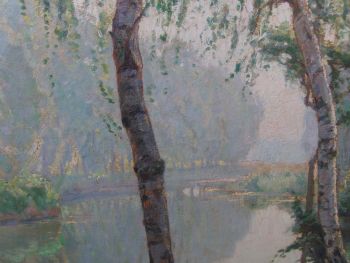
Willem George Frederik Jansen
Rivierlandschap1871 - 1949
Price on requestPrivate Collection Classic Arts
1 - 4 / 24Hermann Nitsch
"UNDER MY SKIN" Signed book incl. small artwork and DVD in a matching box2010 - 2014
Price on requestGallerease Selected
1 - 4 / 12