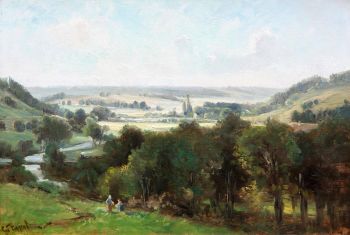
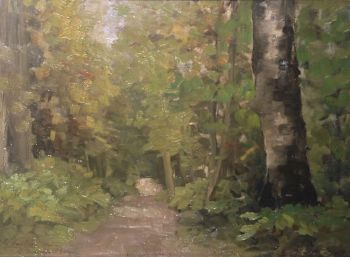
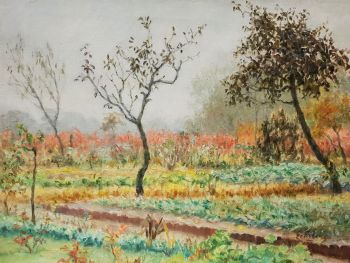
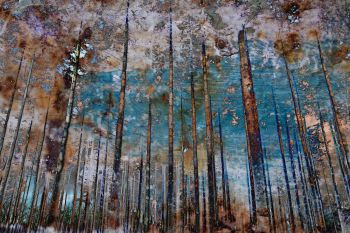
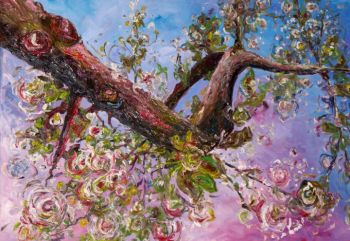
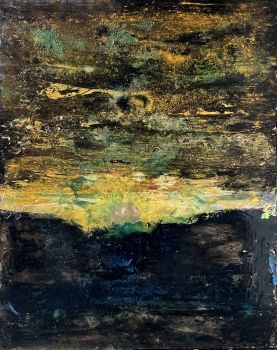
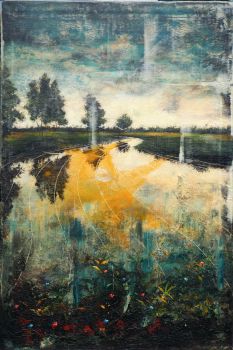
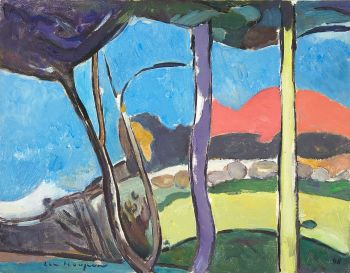
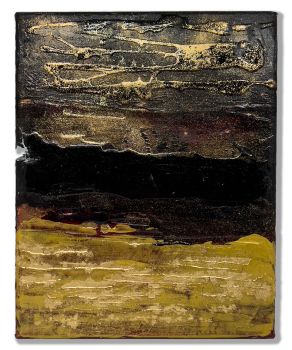
Piet Mondriaan Stream Bordered by Wooded Landscape c. 1894-96 Oil on canvas, mounted on board, 28.5 x 37 cm Signed lower right: Pieter Mondriaan. Currently displayed in Museum Villa Mondriaan in Winterswijk.
Pieter Cornelis Mondriaan (born 7 March 1872 in Amersfoort – died 1 February 1944 in New York) became one of the most influential artists of the twentieth century. His work marks a radical revolution in art history: from traditional figuration to a strictly ordered, geometric abstraction that would teach him to see the world with new eyes.
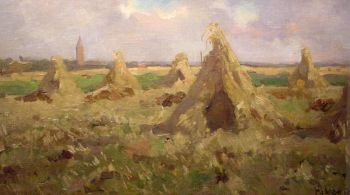
Mondriaan was born into a strict Protestant family where art and religion were closely intertwined. His father was a school principal and amateur painter, and his uncle was a painter. This background gave Mondriaan early access to drawing and painting techniques. In his younger years he mainly painted landscapes – mills, farms, rivers – in an impressionist style, influenced by artists such as the Hague School and Vincent van Gogh.
Around 1908 Mondriaan began to delve into theosophy, a spiritual philosophy based on a hidden order behind visible reality. This interest would profoundly change his art. He began to use colours more symbolically and to simplify natural forms. His trees, church towers and dunes were rendered increasingly tighter and more abstractly.
An important step came during his stay in Paris from 1911 onwards. There he became fascinated by the cubism of Picasso and Braque. He began to analyse his work in planes and lines, and gradually developed his own visual language: geometric shapes, straight lines and a limited palette of primary colours.
In 1917 Mondrian was co-founder of De Stijl, an art movement that strove for universal harmony and order in art and architecture. Together with Theo van Doesburg, among others, he searched for the 'essence' of art - apart from the personal, the anecdotal or the decorative. His style - which he himself called neoplasticism - was limited to horizontal and vertical lines and the use of black, white and the primary colours red, blue and yellow.
His paintings from this period, such as Composition with Red, Blue and Yellow (1930), are regarded as icons of modern art. They seem simple, but are thought out down to the smallest detail. Every line, every color, every proportion was carefully placed in a quest for balance.
In 1940, Mondrian fled the war to New York. There he found new energy and inspiration in the dynamics of the city, jazz music, and the emerging American culture. His work took on a new rhythm, as can be seen in his masterpiece Broadway Boogie Woogie (1942–1943). The straight lines made way for a grid of blocks and bright color accents that were reminiscent of the map of Manhattan and the rhythm of the music he adored.
Mondrian died of pneumonia in 1944, but his influence lives on far beyond painting. His work inspired architects, designers, fashion designers (such as Yves Saint Laurent), graphic designers, and even musicians. He laid the foundation for modernism and minimalism, and his visual language is still recognizable in the streetscape, in design, and in popular culture.
Although his work is often associated with cool rationalism, it testifies to a deep longing for harmony, purity and spiritual order. Mondrian did not want to depict reality, but to make its underlying structure visible – a universal truth in colour and line.