Victorian French gold perfume bottle with turquoise lattice, circa 1860 by Unknown artist

Victorian French gold perfume bottle with turquoise lattice, circa 1860 1860

Unknown artist

StoneCabochonTurquoiseGoldGemstone
€ 18.500

Adin Fine Antique Jewellery

  • About the artwork

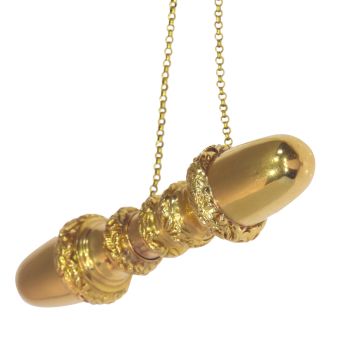
    Victorian, circa 1860, a French 18K gold perfume bottle cased in an openwork gold lattice, each junction set with a cabochon turquoise. A hinged turban cap lends an Ottoman inspired accent, in step with the Orientalist taste fashionable in Paris, inpainting, dress, and the decorative arts, including the harem scenes of Ingres and Delacroix. Turquoise was named for its Turkish route into Europe, a link that suits the turban form rather well. The perfume aperture retains its removable gold applicator stopper for discreet dabbing behind the ears, an oddly intimate object that still suggests scent, skin, and a private ritual.

    Jewellery Type
    perfume bottle

    Condition
    very good condition
    more info on our condition scale

    Country of origin
    France

    Style
    Victorian era, with an Ottoman inspired, Orientalist taste. Mid nineteenth century France embraced ‘turquerie’ and other historicist revivals. In jewellery this often appears as exoticised forms, rich surface pattern, and a deliberate play with foreigndress and courtly objects.
    See also: Victorian
    more info on styles

    Style specifics
    The Romantic Victorian period (about 1837 to 1860). Many experts divide the reign of Queen Victoria (1837 to 1901) into three broad phases: an early or Romantic period, a mid period sometimes called Grand Victorian, and a late or Aesthetic phase.We consider this piece to belong to the late Romantic Victorian years, close to the transition around 1860. Jewellery of this phase often combines sentimental motifs with historicising and exotic tastes, and favours rich surface work such as finechasing, engraving, and occasional enamel. Turquoise was a popular accent, alongside stones such as coral, garnet, amethyst, and seed pearls.

    Period
    ca. 1860
    Events & facts of this era, poetry of this era, fashion of this era.

    Source of inspiration
    Ottoman inspired turban form

    Material18K
    yellow gold (touchstone tested)
    more info on precious metals

    Extra information
    The bottle itself is probably glass, set within an openwork gold lattice, with a turquoise at each junction.A turban shaped cap, hinged to the bottle, opens and closes it. The perfume opening is sealed with a removable applicator stopper, which can be taken out to dab perfume behind the ears.

    Precious stones:
    64 cabochon cut turquoises

    Birthstones
    Turquoise is the birthstone (or month stone) for December.
    more info on birthstones

    Hallmarks
    The French control mark for 18K gold representing an eagle's head that was in use in France from about 1838.
    more info on hallmarks

    Dimensions
    5,11 cm (2,01 inch) x 3,47 cm (1,37 inch)
    see picture with a ruler in millimeters and inches

    Weight
    42,50 gram (27,33 dwt)

    Adin Reference Nº
    26050-0271

    Copyright photography
    Adin, fine antique jewellery

    Additional information
    our latest acquisitions
    jewelry glossary
    wall of fame
    visit us in Antwerp
    subscribe to our mailinglist

  • About the artist

    It might happen that an artist or maker is unknown.

    Some works are not to be determined by whom it is made or it is made by (a group of) craftsmen. Examples are statues from the Ancient Time, furniture, mirroirs, or signatures that are not clear or readible but as well some works are not signed at all.

    As well you can find the following description:

    •“Attributed to ….” In their opinion probably a work by the artist, at least in part

    •“Studio of ….” or “Workshop of” In their opinion a work executed in the studio or workshop of the artist, possibly under his supervision

    •“Circle of ….” In their opinion a work of the period of the artist showing his influence, closely associated with the artist but not necessarily his pupil

    •“Style of ….” or “Follower of ….” In their opinion a work executed in the artist’s style but not necessarily by a pupil; may be contemporary or nearly contemporary

    •“Manner of ….” In their opinion a work in the style of the artist but of a later date

    •“After ….” In their opinion a copy (of any date) of a work of the artist

    •“Signed…”, “Dated….” or “Inscribed” In their opinion the work has been signed/dated/inscribed by the artist. The addition of a question mark indicates an element of doubt

    •"With signature ….”, “With date ….”, “With inscription….” or “Bears signature/date/inscription” in their opinion the signature/ date/ inscription has been added by someone other than the artist

Are you interested in buying this artwork?