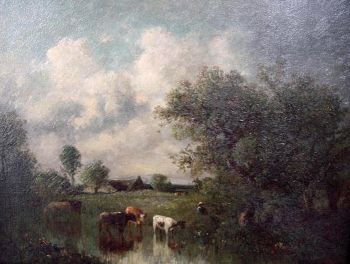
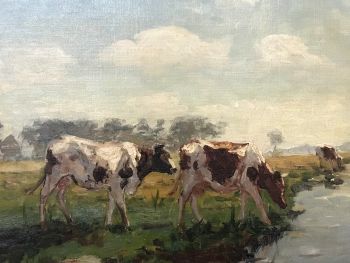
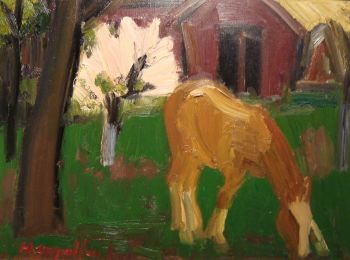
Weidelandschap met koeien 1900 - 1940
Cornelis Vreedenburgh
Oil paintPanelPaint
20 ⨯ 35 cm
Price on request
Bruning Heintz Fine Art
- About the artworkGedateerd 19xx
Grootte 35 x 20 cm
Signatuur Rechtsonder
Materiaal Olieverf op paneel
Stroming Klassiek impressionisme
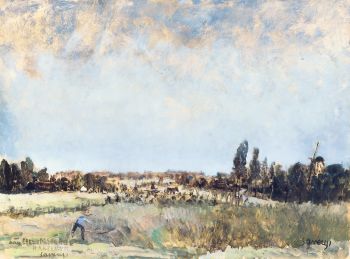
Dit vroege schilderij van Cornelis Vreedenburgh toont een idyllisch Hollands polderlandschap, vermoedelijk geschilderd in de omgeving van Woerden. In het midden van de compositie grazen koeien rustig in een weids, groen weiland, terwijl op de voorgrond een glinsterende sloot het licht op subtiele wijze weerspiegelt. De zachte, atmosferische kleuren en losse toets zijn kenmerkend voor Vreedenburgh’s vroege stijl, waarin hij de serene rust van het Nederlandse platteland op impressionistische wijze vastlegde. Op de achtergrond zijn een boerderij en enkele bomenrijen zichtbaar, die diepte en herkenbare elementen toevoegen aan dit typisch Hollandse landschap. Het werk vangt niet alleen de stille schoonheid van het boerenleven, maar ook de natuurlijke lichtval die zo vaak terugkomt in Vreedenburghs oeuvre. Dit schilderij is een prachtig voorbeeld van zijn vroege meesterlijke beheersing van licht, kleur en sfeer, en vormt een waardevolle aanvulling voor liefhebbers van Nederlandse impressionistische kunst, landschapskunst en werken uit de regio Woerden.
Locatie Woerden
Provenance Particuliere collectie - About the artist
Cornelis Vreedenburgh (25 August 1880 – 27 June 1946) was a Dutch painter, known for his atmospheric depictions of cityscapes and landscapes. Born in Woerden, the Netherlands, he developed a passion for art at an early age, influenced by his father Gerrit Vreedenburgh, who was himself a painter.
Education and Influences
Although Vreedenburgh was largely self-taught, he received valuable advice from the impressionist painter Willem Bastiaan Tholen. Together with Tholen, he explored the inland lakes and wide rivers of the Netherlands, capturing the vast skies and open waters. These experiences had a lasting influence on his work, especially in his depiction of light and reflections on water.
Career and Recognition
In 1904, Vreedenburgh received a royal grant for promising young artists, allowing him to focus entirely on his painting. His entry at Arti et Amicitiae was awarded the Willink van Collen Prize, and he became a member of both Arti et Amicitiae and Pulchri Studio. His work quickly became popular for its vibrant colours and the way he captured the light and atmosphere of the Dutch landscape.
Personal Life
After marrying artist Marie Schotel in 1912, Vreedenburgh settled in Laren, a bustling artists' village at the time. Here he painted many cityscapes of Amsterdam, capturing the charm and character of the city. His work was recognised by Queen Wilhelmina in 1937, who purchased two of his paintings.
Legacy
Cornelis Vreedenburgh died on 27 June 1946 in Laren. His paintings remain valued for their technical skill and ability to capture the essence of the Dutch landscape and city life. His work can be found in several museums and private collections, and he is remembered as an important figure in Dutch art history.

Are you interested in buying this artwork?
Artwork details
Related artworks
Cornelis Vreedenburgh
Riviertje in het Groene Hart1920 - 1940
Price on requestBruning Heintz Fine Art
Cornelis Vreedenburgh
Het atelier van de schilder aan de Vredelaan 1 te Laren1920 - 1940
Price on requestBruning Heintz Fine Art
1 - 4 / 12- 1 - 4 / 24
- 1 - 4 / 24
Willem Maris
Polderlandschap met koeien en molens op warme zomerdag1880 - 1890
Price on requestPrivate Collection Classic Arts
1 - 4 / 24- 1 - 4 / 24
- 1 - 4 / 12