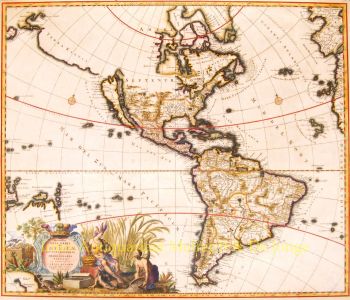
Wind chart, anemographical map 1650
Johannes Janssonius
PrintEngraving
43.50 ⨯ 54.50 cm
€ 2.250
Inter-Antiquariaat Mefferdt & De Jonge
- About the artworkWIND ROSE BY JANSSON, ONE OF THE EARLIEST ANEMOGRAPHIC CHARTS "Tabula Anemographica seu Pyxis Nautica Ventorum nomina sex linguis repraesentans" [Anemographic charts or nautical wind compass representing the names of the winds in six languages], copper engraving published by Johannes Janssonius (a.k.a. Jan Jansson) in 1650 as part of his "Groote Atlas, vervattende de Water-Weereld" [gand atlas, including the water world]. Coloured by a later hand. Size: 43.5 x 54.5 cm. "This chart depicts the sea compass with the magnetic needle, which sailors use on the wild and raging sea, where one sees nothing but sky and water and has no given path before them, and thus determine their true course and may find the places where they wish to sail." This chart was made during a time when directional observation was changing, a time when transitioning from a wind rose to a compass rose. In ancient Greece - before the invention of the magnetic compass - sailors defined directions based on the different winds and where they came from. Homer spoke of four main wind directions, but as navigation and cartography developed further, more directions were added. Names for wind directions were named after gods, constellations of stars, or weather conditions in Greek, Latin, and other languages. The use of different names for the same wind directions made it even more confusing. This "Table of Winds" provided a solution. On a 360° compass, 32 wind directions are indicated with names in Dutch, French, Italian, Latin, and Greek. Each wind is represented by a blowing figure with the characteristics of the people from the area where the wind was associated. The main wind directions are depicted larger. The top left quadrant represents the north: bearded Germanic or Scandinavian types. Top right are the winds from the east: beardless, dark men. The smooth faces from the south and west are less easily identifiable but probably represent the Greeks and indigenous inhabitants of America. So-called anemographic charts like this were functional and used as references. Sea charts already existed in the 17th century, but much use was made of sailors' guides in which (as text) it might say, for example, "follow the southwest wind for three days," then "go with the east wind." A seafarer could consult a chart like this to determine the sailing direction. Price: Euro 2.250,- (incl. frame)
- About the artist
Janssonius was born in Arnhem as the son of Jan Jansz, a printer and publisher there. At a young age he moved to Amsterdam, the then center of the printing and card trade. In 1612 he married Elisabeth Hondius, daughter of Jodocus Hondius. Elisabeth died in 1627 and Janssonius remarried in 1629 with Elisabeth Carlier. He went to work for his father-in-law and continued the publishing business together with Henricus Hondius (son of) after his death. This was developed into one of the largest of its time. There were branches in Berlin, Frankfurt, Geneva, Lyon and Stockholm, among others.
Under Janssonius' leadership, the Mercator-Hondius Atlas was expanded and published as Atlas Novus. This initially one-volume edition soon became a multi-volume atlas, supplemented on request with nautical charts and/or celestial charts. There were publications in Dutch, French, Spanish and Latin. Like his contemporaries, Janssonius also made use of existing copper plates, including those from the city books of Braun & Hogenberg and the Description de touts les Pays Bas (Description of all the Netherlands) by Lodovico Guicciardini - (Cornelis Claesz. edition) from 1609 Although Janssonius has often been accused of copying Willem Blaeu's work, it may be noted that maps by Janssonius also appeared on the market earlier.
After Janssonius' death, the firm was continued by his son-in-law, Johannes (Jan) van Waesbergen, who was married to his daughter Elisabeth Janssonius (1615-1681). Many copper plates of the city books were used (sometimes slightly modified) by Frederik de Wit. The building on Dam Square was leased to Gerard Valck; He also bought a number of printing plates in 1694.

Are you interested in buying this artwork?
Artwork details
Related artworks
- 1 - 4 / 6
Unknown artist
Een Gotische zuidelijke Nederlanden wandklok1580 - 1590
Price on requestNico van den Assem restauratie
Unknown artist
Antique Dutch still life flowers in vase1740 - 1800
Price on requestGallerease Selected
1 - 4 / 24- 1 - 4 / 24
- 1 - 4 / 24
- 1 - 4 / 24
- 1 - 4 / 12


![“Tentation” [temptation], lithograph by Eugène Grasset](https://media-3.gallerease.com/images/b891f1b8-508a-4829-a559-a56b7f765ca7/350x350/tentation-temptation-lithograph.jpg)