17th C representation of the Roof of Folly: An Allegory of the Fall, German School. 1670 - 1685
Artiste Inconnu
44 ⨯ 54 cm
ConditionGood
Prix sur demande
Spectandum Gallery
- Sur l'oeuvre d'art« The Roof of Folly: An Allegory of the Fall »
This enigmatic 17th-century painting, laden with symbolic content, echoes the allegorical tradition of Hieronymus Bosch, fusing grotesque imagery with theological satire. Human and avian forms intermingle within a visionary, dreamlike landscape marked by spiritual tension and uncanny beauty.
At the heart of this dark allegory, a crumbling rooftop serves as a stage for human folly and spiritual neglect. A central figure — a fiddler garbed as a jester — plays a tune of distraction as the world deteriorates beneath him. Surrounding him are distorted figures: a bird-headed demon whispers temptations, a silent monk embodies passive complicity, and a child imitates the foolhardiness of his elders. Overhead, a black-winged angel watches in silence, evoking divine judgment or perhaps lost innocence. Below, an elderly woman ascends through the wreckage, bearing a candle — a solitary seeker of truth in a world steeped in shadow.
Though unsigned, the painting’s precise characterizations and densely layered symbolism suggest a didactic intention — a visual sermon warning against spiritual complacency amid societal upheaval.
In the tradition of Bosch and Pieter Bruegel, this work confronts the viewer with a sobering question: in a world enthralled by spectacle and decay, who among us still strives toward the light? 17th-century German painting brings to life fantastical human creatures with bird-like traits—an eerie, whimsical nod to the surreal genius of Hieronymus Bosch.
Human and avian forms merge in a dreamlike, allegorical scene, channeling Bosch’s visionary world of spiritual tension and strange beauty. - Sur l'artiste
Il peut arriver qu'un artiste ou un créateur soit inconnu.
Certaines œuvres ne doivent pas être déterminées par qui elles sont faites ou elles sont faites par (un groupe d') artisans. Les exemples sont des statues de l'Antiquité, des meubles, des miroirs ou des signatures qui ne sont pas claires ou lisibles, mais aussi certaines œuvres ne sont pas signées du tout.
Vous pouvez également trouver la description suivante :
•"Attribué à …." A leur avis probablement une oeuvre de l'artiste, au moins en partie
•« Atelier de …. ou « Atelier de » À leur avis, une œuvre exécutée dans l'atelier ou l'atelier de l'artiste, éventuellement sous sa direction
•« Cercle de… ». A leur avis une oeuvre de la période de l'artiste témoignant de son influence, étroitement associée à l'artiste mais pas forcément son élève
•« Style de … ». ou "Suiveur de ...." Selon eux, une œuvre exécutée dans le style de l'artiste mais pas nécessairement par un élève ; peut être contemporain ou presque contemporain
•« Manière de… ». A leur avis une oeuvre dans le style de l'artiste mais d'une date plus tardive
•"Après …." A leur avis une copie (quelle qu'en soit la date) d'une oeuvre de l'artiste
•« Signé… », « Daté… ». ou « Inscrit » À leur avis, l'œuvre a été signée/datée/inscrite par l'artiste. L'ajout d'un point d'interrogation indique un élément de doute
• "Avec signature ….", "Avec date ….", "Avec inscription …." ou "Porte signature/date/inscription" à leur avis la signature/date/inscription a été ajoutée par quelqu'un d'autre que l'artiste
Êtes-vous intéressé par l'achat de cette oeuvre?
Artwork details
Related artworks
Artiste Inconnu
Couple Wooden Ancestors Sculptures with Scarifications, Zela People, DRC. 1920 - 1930
Prix sur demandeSpectandum Gallery
1 - 4 / 12Peter Paul Rubens (follower of )
Portrait of a man dressed up as an oriental man1750 - 1850
Prix sur demandeGallerease Selected
Vincent Laurensz van der Vinne
Portrait of a man and woman1640 - 1650
Prix sur demandeArt Gallery Voûte
1 - 4 / 24Artiste Inconnu
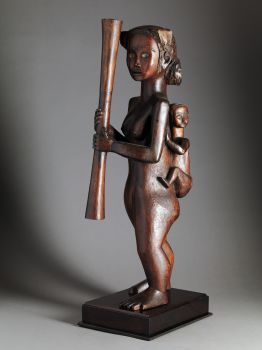
MATERNITY FIGURE, FANG-MABEA, CAMEROON.PROVENANCE R.CAILLOIS-P.RATTON.1920 - 1930
Prix sur demandeSpectandum Gallery
1 - 4 / 12