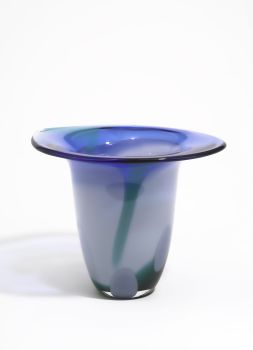
A glass art-object “Panther”, model SH 100 – Nuutajärvi-Notsjö Finland 1957 by Saara Hopea

A glass art-object “Panther”, model SH 100 – Nuutajärvi-Notsjö Finland 1957 1957

Saara Hopea

Verre
16 cm, ø 7 cm
ConditionVery good
€ 1.450

Van Kerkhoff Art

  • Sur l'oeuvre d'art
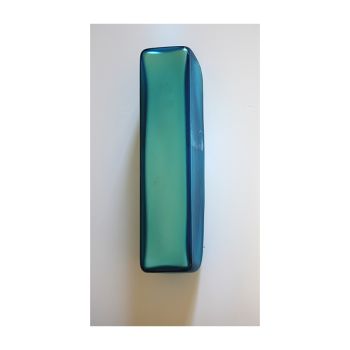
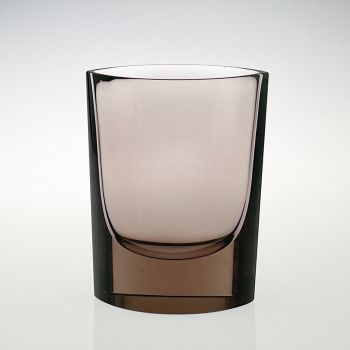
    A free-blown, clear glass Art-object withn moss-green spots “Panther”, model SH 100. Designed by Saara Hopea in 1954 and executed by Nuutajärvi-Notsjö in 1957.

    The ‘Panther’ or ‘Pantteri’ art-objects were made in two variants, the SH 100 and SH 109. This object is a model SH 100 which is cylindrical in form. These objects were made between 1954 and 1961 in two sizes and either made with moss-green spots or lilac spots.

    This particular example is in very good condition and is marked and dated in diamond pen underneath the base: S. Hopea Nuutajärvi-Notsjö ’57.


    About Saara Hopea
    Saara Elisabet Hopea (Porvoo 1925 – Porvoo 1984) was a Finnish designer of Art-glass, furniture and jewellery.

    Saara Hopea was born in 1925 in Porvoo, in the south of Finland. Her parents Ossian Hopea and Lempi Westerlund owned a goldsmithing company.

    After attending secondary school, Hopea studied at the Interior Design Department of the Central School of Art and Design, now the Aalto University of Art and Design.

    She graduated in 1946, and worked for a few years as an illustrator, then she accepted a job at the lighting factory of Taito Oy, headed by the renowned designer Paavo Tynell.

    In the early 1950’s, Saara Hopea became interested in glass design and started working at the Nuutajärvi glass factory, where she worked under artistic director Kaj Franck.

    After her father’s death, Saara Hopea took over the direction of the family business Ossian Hopea Oy in 1959. She worked as the artistic director from 1959 to 1960 and again from 1967 and was responsible for numerous jewellery designs.

    In 1960 Saara Hopea married Oppi Untracht , an American goldsmith, photographer and writer, and they moved to New York City. Together with her husband, Saara Hopea also lived in Nepal and in India over the years until 1967, after which the couple settled permanently in Porvoo.

    For her glass designs, Saara Hopea received a silver medal at the Milan Triennials in both 1954 and 1957. She also received the Porvoo City Culture Prize in 1981 and the State Arts and Crafts Prize in 1982.

    Her retrospective exhibition was held at the Museum of Arts and Crafts in Helsinki in 1987. 28 of her works are in the collection of The British Museum in London and the MoMa in New York holds 11 of her works.

    Marked
    Marked in diamondpen underneath the base: S. Hopea Nuutajärvi-Notsjö '57 (1957)

    Execution
    Nuutajärvi-Notsjö glassworks, Finland 1957

    Condition
    This Art-object is in good vintage condition. Basic wear consistent with age and use. No chips or cracks.

    Literature
    Oppi Untracht – Saara Hopea-Untracht: her life and work. P 98 (illustrated), P 303

    Dimensions
    Height 16 cm
    Diameter 7,5 cm
  • Sur l'artiste

    Saara Hopea a eu une carrière prolifique dans divers domaines du design, laissant une marque significative sur le paysage artistique finlandais des années 1950. Son parcours commence dans le domaine de la conception de meubles, où elle perfectionne ses compétences de 1946 à 1948. À la recherche de nouvelles opportunités, elle s'associe ensuite à l'entreprise du célèbre forgeron Paavo Tynell, où elle travaille jusqu'en 1952.

    Pendant ce temps, elle a contribué à la verrerie Nuutajärvi, où ses créations sont devenues une brillante incarnation de l'esthétique minimaliste qui a défini le style finlandais dans les années 1950, influencée par les principes de la philosophie du design Bauhaus. Notamment, après le décès de son père en 1948, elle se chargea de concevoir de l'argenterie pour sa boutique de Porvoo.

    Un tournant dans la vie de Hopea s'est produit lorsqu'elle s'est mariée et a déménagé à New York avec son mari. C'est ici qu'elle s'engage dans une nouvelle voie artistique, explorant le domaine du travail de l'émail. Grâce à son expérimentation avec des émaux transparents surcuisson sur cuivre, elle a obtenu des résultats remarquables qui ont conféré à ses pièces un aspect spontané et pictural, caractérisé par des couleurs vibrantes et une profondeur remarquable. Ses créations en émail exquises se sont retrouvées entre les mains de clients exigeants dans des boutiques exclusives.

    La soif de connaissances et l'inspiration artistique du couple les ont amenés à entreprendre un voyage remarquable à travers le Népal et l'Inde, qui s'est étalé sur quatre ans. Pendant ce temps, ils se sont plongés dans l'étude, la photographie et la collection de ferronnerie et de bijoux locaux. En 1997, son mari, profondément influencé par leurs expériences, a publié "Traditional Jewelry of India", un témoignage de leur exploration et de leur appréciation du riche patrimoine artistique de la région. En 1967, ils sont retournés à Porvoo, où les efforts artistiques de Hopea englobaient un large éventail de disciplines, notamment l'orfèvrerie, le design textile et l'émaillage.

    L'impact du talent et de l'art de Saara Hopea s'étend au-delà des frontières de la Finlande. Le British Museum possède une collection de 28 de ses œuvres, tandis que le Museum of Modern Art détient 11 objets précieux, témoignage de son héritage durable. En 1988, son mari a publié un récit complet de sa vie et de son œuvre intitulé « Saara Hopea-Untracht : la vie et l'œuvre », mettant en lumière le remarquable parcours artistique de cette tranquille visionnaire scandinave.

Êtes-vous intéressé par l'achat de cette oeuvre?