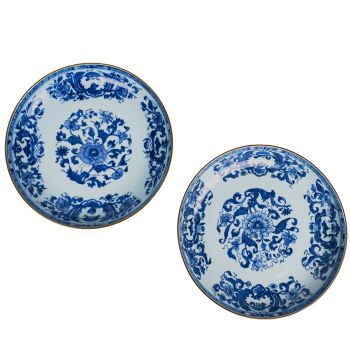
A pair of inscribed blue and white ‘Wild Goose Pagoda’ dishes for the Japanese market, Ko-Sometsuke, Ming dynasty, Tianqi Period (1621–1627). by Artiste Inconnu

A pair of inscribed blue and white ‘Wild Goose Pagoda’ dishes for the Japanese market, Ko-Sometsuke, 1621 - 1672

Artiste Inconnu

PorcelainePorcelaine chinoise
ø 21 cm
ConditionGood
Prix sur demande

Menken Works of Art
  • Sur l'oeuvre d'art
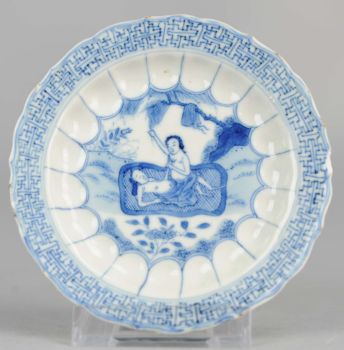
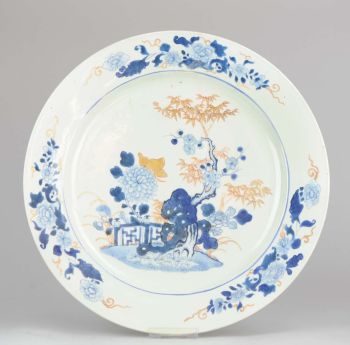
    A pair of inscribed blue and white ‘Wild Goose Pagoda’ dishes for the Japanese market, Ko-Sometsuke.
    Ming dynasty, Tianqi Period (1621–1627).

    The central scene depicts three geese standing in the foreground, with a fourth goose flying above them. Next to this scene appears a four-character inscription that can be translated as: “May your name be inscribed on the wall of the Wild Goose Pagoda in Chang’an.” In the distance, a promontory is shown with a pagoda and a nearby building.

    Below this scene, painted upside down, is another four-line verse. This composition gives the impression of a reflection of the pagoda above. The text can loosely be translated as: “May you enjoy the Imperial Spring Banquet in the Apricot Grove.” Beside the inscription is a flowering apricot plant, with three swallows flying above it. The indented cavetto is decorated with a scrolling lotus motif set against a blue ground, while the outer border features a Greek key pattern on a pale blue background.

    The first inscription, “May Your Name Be Inscribed on the Wall of the Wild Goose Pagoda in Chang’an,” refers to a tradition that began during the Tang dynasty (618–907). Candidates who successfully passed the highest level of the Jinshi civil service examinations were honored by having their names recorded on the wall of the Wild Goose Pagoda in Chang’an, the capital of the Tang empire.

    The second inscription, “May You Enjoy the Imperial Spring Banquet in the Apricot Grove,” alludes to a celebratory banquet traditionally held near the Wild Goose Pagoda for those who had achieved success in the examinations. This message is further emphasized through a visual rebus that combines images of spring swallows with blooming apricot branches, both symbols associated with spring and scholarly achievement.

    Diameter 21 cm.

    Provenance:
    Fa. A.C. Beeling & Zn., Leeuwarden, The Netherlands (sticker on one of the dishes)
    Leegstra collection, Warffum, The Netherlands (sticker on both dishes)

    Ref:
    A similar dish is illustrated in Leaping the Dragon Gate: The Sir Michael Butler Collection of 17th-Century Chinese Porcelain (Katharine Butler, Teresa Canepa, 2021
    Also see Four Centuries of Blue and White – The Frelinghuysen Collection of Chinese and Japanese Export Porcelain (Becky Macguire, 2023), p. 304, no. 248.
    Another dish is in the Groninger Museum collection, object number 2018.0013.

    Worldwide registered and insured shipping.

    Inv. No: MW381
  • Sur l'artiste

    Il peut arriver qu'un artiste ou un créateur soit inconnu.

    Certaines œuvres ne doivent pas être déterminées par qui elles sont faites ou elles sont faites par (un groupe d') artisans. Les exemples sont des statues de l'Antiquité, des meubles, des miroirs ou des signatures qui ne sont pas claires ou lisibles, mais aussi certaines œuvres ne sont pas signées du tout.

    Vous pouvez également trouver la description suivante :

    •"Attribué à …." A leur avis probablement une oeuvre de l'artiste, au moins en partie

    •« Atelier de …. ou « Atelier de » À leur avis, une œuvre exécutée dans l'atelier ou l'atelier de l'artiste, éventuellement sous sa direction

    •« Cercle de… ». A leur avis une oeuvre de la période de l'artiste témoignant de son influence, étroitement associée à l'artiste mais pas forcément son élève

    •« Style de … ». ou "Suiveur de ...." Selon eux, une œuvre exécutée dans le style de l'artiste mais pas nécessairement par un élève ; peut être contemporain ou presque contemporain

    •« Manière de… ». A leur avis une oeuvre dans le style de l'artiste mais d'une date plus tardive

    •"Après …." A leur avis une copie (quelle qu'en soit la date) d'une oeuvre de l'artiste

    •« Signé… », « Daté… ». ou « Inscrit » À leur avis, l'œuvre a été signée/datée/inscrite par l'artiste. L'ajout d'un point d'interrogation indique un élément de doute

    • "Avec signature ….", "Avec date ….", "Avec inscription …." ou "Porte signature/date/inscription" à leur avis la signature/date/inscription a été ajoutée par quelqu'un d'autre que l'artiste

Êtes-vous intéressé par l'achat de cette oeuvre?