Johann Loetz Witwe – Ausfuehrung 134 with applied Cobalt Papillon snake by Johann Loetz (Lötz) Witwe Klostermühle

Johann Loetz Witwe – Ausfuehrung 134 with applied Cobalt Papillon snake 1914 - 1918

Johann Loetz (Lötz) Witwe Klostermühle

Verre
13 cm, ø 21 cm
ConditionExcellent
Prix sur demande

Antiques Emporium

  • Sur l'oeuvre d'art
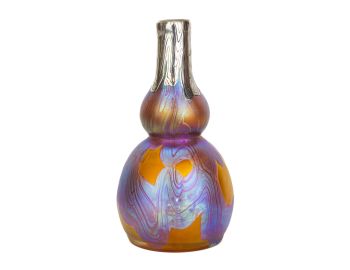
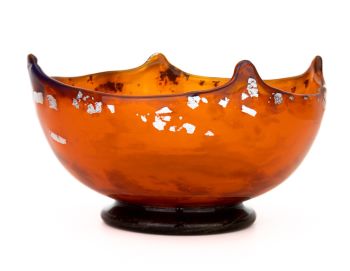
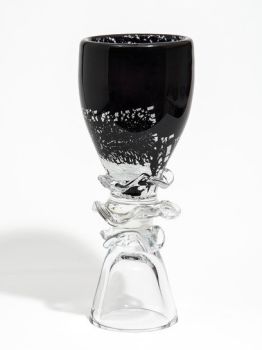
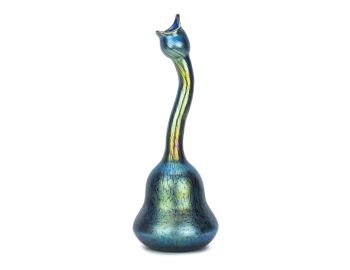
    This remarkable bowl was created by Johann Loetz Witwe and dates back to the early 20th century. With a generous body diameter of 21 cm (8.27 inches) and a height of 13.5 cm (5.31 inches), this is an impressive decorative object that reflects the transition from the Art Nouveau to the Art Deco era.

    The bowl is crafted in Ausführung 134, a technique introduced in 1914, at the onset of the First World War. This execution is based on the Titania technique, developed in 1905 as a response to the waning interest in iridescent glass. With Titania, Loetz introduced a new aesthetic by layering metallized glass threads over a base-colored glass and finishing it with a transparent glass coating. This process created a mysterious play of colors and a unique depth effect, giving the glasswork a refined and captivating appearance.

    In terms of color, the bowl features a stunning light blue base, combined with a deep blue-gray Titania layer. Unfortunately, photographs often fail to capture the true colors and nuances of the bowl, slightly understating its enchanting depth and play of colors.

    A distinctive feature of this bowl is the applied snake, crafted from cobalt blue glass. The graceful snake lies elegantly across the bowl, with carefully formed details such as a hand-shaped head and applied glass eyes. Additionally, the upper rim of the bowl is accentuated with a cobalt blue glass thread, further enhancing its refined appearance.

    As is customary for Loetz glass after 1902, the bowl is unsigned. After the First World War, Loetz introduced a new etched mark, “CZECHO-SLOVAKIA,” for their glassware, but this does not apply to this piece.

    This bowl combines artistic innovation and historical significance, making it a valuable object for both Art Nouveau enthusiasts and Loetz glass collectors.
  • Sur l'artiste

    La verrerie Loetz a existé à Klostermuhle, en Autriche, pendant un peu plus de cent ans, à partir de 1840. Mais son apogée a eu lieu du vivant de Max Ritter Von Spaun, petit-fils du premier Johann Loetz qui avait fondé l'entreprise.

    Von Spaun a repris l'entreprise en 1879 et l'a dirigée jusqu'en 1908, un an avant sa mort. Il est assisté d'Eduard Prochaska, son spécialiste technique, et ensemble ils inventent, conçoivent et produisent toute une série de merveilleux nouveaux types de verre, en déposant plusieurs brevets et en remportant des prix dans toutes les grandes expositions mondiales des années 1890 et des premières années de le nouveau siècle.

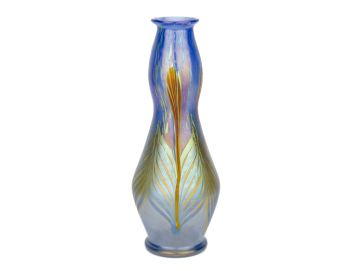
    La société Loetz figurait parmi les leaders du design Art Nouveau et en particulier du verre d'art irisé. Le verre "Papillon", comme le vase de gauche, est parfois appelé aujourd'hui verre "à tache d'huile". Une autre coloration préférée de Loetz était le verre irisé avec des traînées tirées appelé verre « Phenomenon ».

    Il y avait des vases irisés avec des rubans de couleurs métalliques enroulés sur la surface, et de nombreux motifs spectaculaires avec des traînées appliquées de belles couleurs, ou simplement retirés du corps du verre pour former des poignées ou une décoration.

    Vers 1900, la société a commencé à collaborer avec des designers extérieurs et de grands artistes ont conçu des pièces pour Lotz, notamment Joseph Hofmann, Koloman Moser, Maria Kirchner et Hofstatter.

    En 1908, Loetz a été repris par le fils de Max Von Spaun, également appelé Max, et bien qu'il ait connu des difficultés financières (faillite en 1911 et à nouveau en 1931), il y avait plusieurs grands designers dont le travail a été produit par Loetz au cours de ces années et à travers l'art période déco. Ceux-ci comprenaient Adolf Beckert et Michael Powolny.

Êtes-vous intéressé par l'achat de cette oeuvre?