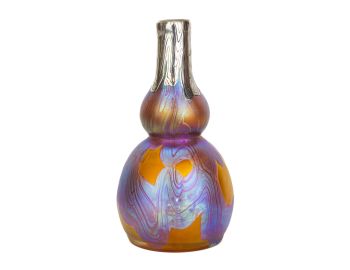
Johann Loetz Witwe – Phänomen Genre 299 – Tricolor vase by Johann Loetz (Lötz) Witwe Klostermühle

Johann Loetz Witwe – Phänomen Genre 299 – Tricolor vase 1900 - 1902

Johann Loetz (Lötz) Witwe Klostermühle

VerreÉtainOrMétal
29 cm, ø 9 cm
ConditionVery good
Prix sur demande

Antiques Emporium

  • Sur l'oeuvre d'art
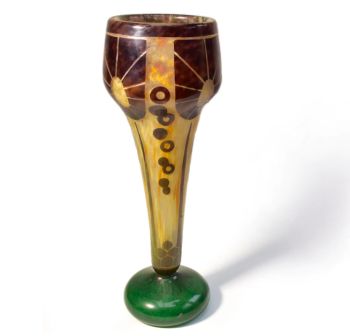
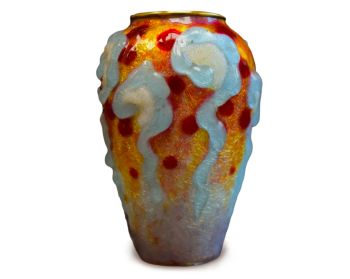
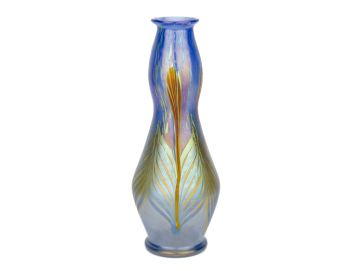
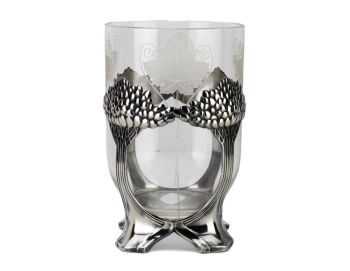
    This Johann Loetz Witwe vase, executed in the exceptional Phänomen Genre 299, known as Tricolor, masterfully embodies the splendor and artistic ingenuity of Jugendstil glass. Standing 29 cm tall, this vase is a refined and rare piece that, due to its color composition and craftsmanship, represents a highly coveted collector’s item. The exquisite Tricolor decoration, introduced around 1900 shortly after the Paris World Exhibition, features broad vertical stripes in rich blue, intense red, and vibrant yellow—a color palette that captivates with its depth and iridescent sheen.
    The delicate color pattern is accentuated by a subtle, oil-like sheen that seems to dance across the glass surface, adding an extra dimension and giving the vase a dynamic appearance. This visual richness is further enhanced by the gilded Jugendstil-style mount, crafted by the renowned German firm Bitter & Gobbers, which seamlessly integrates with the glasswork, lending the vase a noble elegance.

    The Tricolor technique exemplifies the technical mastery of the Loetz workshop and their ability to create timeless glassworks. This piece symbolizes the innovative aesthetics of Art Nouveau, celebrating iridescent color transitions and natural forms. This Loetz vase is not merely an art object but also a testament to a style period that continues to be admired worldwide for its refined craftsmanship and enduring beauty.

    Condition: The vase is in very good condition. The glass is flawless, and the gilding shows minimal wear. The mount has a small fracture.
  • Sur l'artiste

    La verrerie Loetz a existé à Klostermuhle, en Autriche, pendant un peu plus de cent ans, à partir de 1840. Mais son apogée a eu lieu du vivant de Max Ritter Von Spaun, petit-fils du premier Johann Loetz qui avait fondé l'entreprise.

    Von Spaun a repris l'entreprise en 1879 et l'a dirigée jusqu'en 1908, un an avant sa mort. Il est assisté d'Eduard Prochaska, son spécialiste technique, et ensemble ils inventent, conçoivent et produisent toute une série de merveilleux nouveaux types de verre, en déposant plusieurs brevets et en remportant des prix dans toutes les grandes expositions mondiales des années 1890 et des premières années de le nouveau siècle.

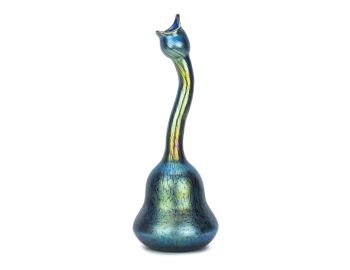
    La société Loetz figurait parmi les leaders du design Art Nouveau et en particulier du verre d'art irisé. Le verre "Papillon", comme le vase de gauche, est parfois appelé aujourd'hui verre "à tache d'huile". Une autre coloration préférée de Loetz était le verre irisé avec des traînées tirées appelé verre « Phenomenon ».

    Il y avait des vases irisés avec des rubans de couleurs métalliques enroulés sur la surface, et de nombreux motifs spectaculaires avec des traînées appliquées de belles couleurs, ou simplement retirés du corps du verre pour former des poignées ou une décoration.

    Vers 1900, la société a commencé à collaborer avec des designers extérieurs et de grands artistes ont conçu des pièces pour Lotz, notamment Joseph Hofmann, Koloman Moser, Maria Kirchner et Hofstatter.

    En 1908, Loetz a été repris par le fils de Max Von Spaun, également appelé Max, et bien qu'il ait connu des difficultés financières (faillite en 1911 et à nouveau en 1931), il y avait plusieurs grands designers dont le travail a été produit par Loetz au cours de ces années et à travers l'art période déco. Ceux-ci comprenaient Adolf Beckert et Michael Powolny.

Êtes-vous intéressé par l'achat de cette oeuvre?