Large Dutch Delft chinoiserie plate from ‘De Paauw’ by Artiste Inconnu

Large Dutch Delft chinoiserie plate from ‘De Paauw’ 1680 - 1700

Artiste Inconnu

glaçageCéramiqueFaïencePeindre
40 cm
ConditionVery good
€ 1.950

Verkoulen Oriental & European Antiques
  • Sur l'oeuvre d'art
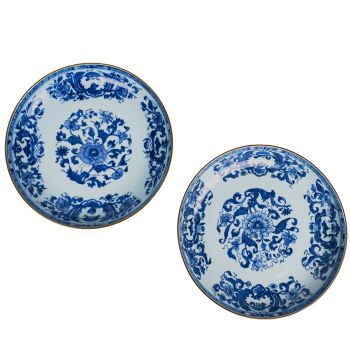
    A large chinoiserie plate with Transition and Kangxi inspired decoration, 17th century, around 1680-1700, Delft, Holland.
    Blue and white

    Dimensions: 40 cm. diameter.

    Signed D-PAUW for pottery factory ‘De Paauw / The Peacock’ (1651-1774).

    This earthenware plate has a beautiful dense and deep blue color, finished with black. In the middle we can see two Long Eliza’s in a fenced garden. On the left side of the fence there is an incense burner and cache-pot displayed.

    Long Eliza is an old common name for the decoration on Chinese export porcelain featuring elegant, slim and long women. The Dutch are credited with giving this Chinese export pattern its name ‘Lange Lijzen’ (or loosely translated Tall Eliza), which is typical for the Kangxi period (1662-1722). This of course did not go unnoticed by the Delft potters. The broad border of the plate is not decorated with a pattern but with similar scenes with lots of space and white in between. This is a typical element derived from the Chinese transitional period porcelain (1621-1662).


    The high-quality decoration of this plate is very recognizable for factory ‘De Paauw’ (The Peacock). The workshop was active from 1651-1774 on the addresses Koornmarkt and Oude Delft, in Delft. Before, in these buildings there was a beer brewery by Jacob Adriaensz Paauw (1558-1620), who also had been major of the Delft City. It was common to use the former name of the older factory (that were in most cases beer breweries) that were located in the pledge before the potters settled in there. A 'fire inspection' from 1668 mentions the presence of one kiln to fire the pottery, but around 1730 two kilns were producing. In 1775 the Paauw went bankrupt. In the 18th century, ways of making Chinese quality porcelain were developed through Europe. By the end of the 18th century the popularity of Delft pottery is rapidly declining and one company after another must close.

    Condition: Very good, some light retouches to the edge.
  • Sur l'artiste

    Il peut arriver qu'un artiste ou un créateur soit inconnu.

    Certaines œuvres ne doivent pas être déterminées par qui elles sont faites ou elles sont faites par (un groupe d') artisans. Les exemples sont des statues de l'Antiquité, des meubles, des miroirs ou des signatures qui ne sont pas claires ou lisibles, mais aussi certaines œuvres ne sont pas signées du tout.
    Vous pouvez également trouver la description suivante :

    •"Attribué à …." A leur avis probablement une oeuvre de l'artiste, au moins en partie

    •« Atelier de …. ou « Atelier de » À leur avis, une œuvre exécutée dans l'atelier ou l'atelier de l'artiste, éventuellement sous sa direction

    •« Cercle de… ». A leur avis une oeuvre de la période de l'artiste témoignant de son influence, étroitement associée à l'artiste mais pas forcément son élève

    •« Style de … ». ou "Suiveur de ...." Selon eux, une œuvre exécutée dans le style de l'artiste mais pas nécessairement par un élève ; peut être contemporain ou presque contemporain

    •« Manière de… ». A leur avis une oeuvre dans le style de l'artiste mais d'une date plus tardive

    •"Après …." A leur avis une copie (quelle qu'en soit la date) d'une oeuvre de l'artiste

    •« Signé… », « Daté… ». ou « Inscrit » À leur avis, l'œuvre a été signée/datée/inscrite par l'artiste. L'ajout d'un point d'interrogation indique un élément de doute

    • "Avec signature ….", "Avec date ….", "Avec inscription …." ou "Porte signature/date/inscription" à leur avis la signature/date/inscription a été ajoutée par quelqu'un d'autre que l'artiste

Êtes-vous intéressé par l'achat de cette oeuvre?