Palais impérial de Chine après William Alexander 1796
William Alexander
€ 195
Inter-Antiquariaat Mefferdt & De Jonge
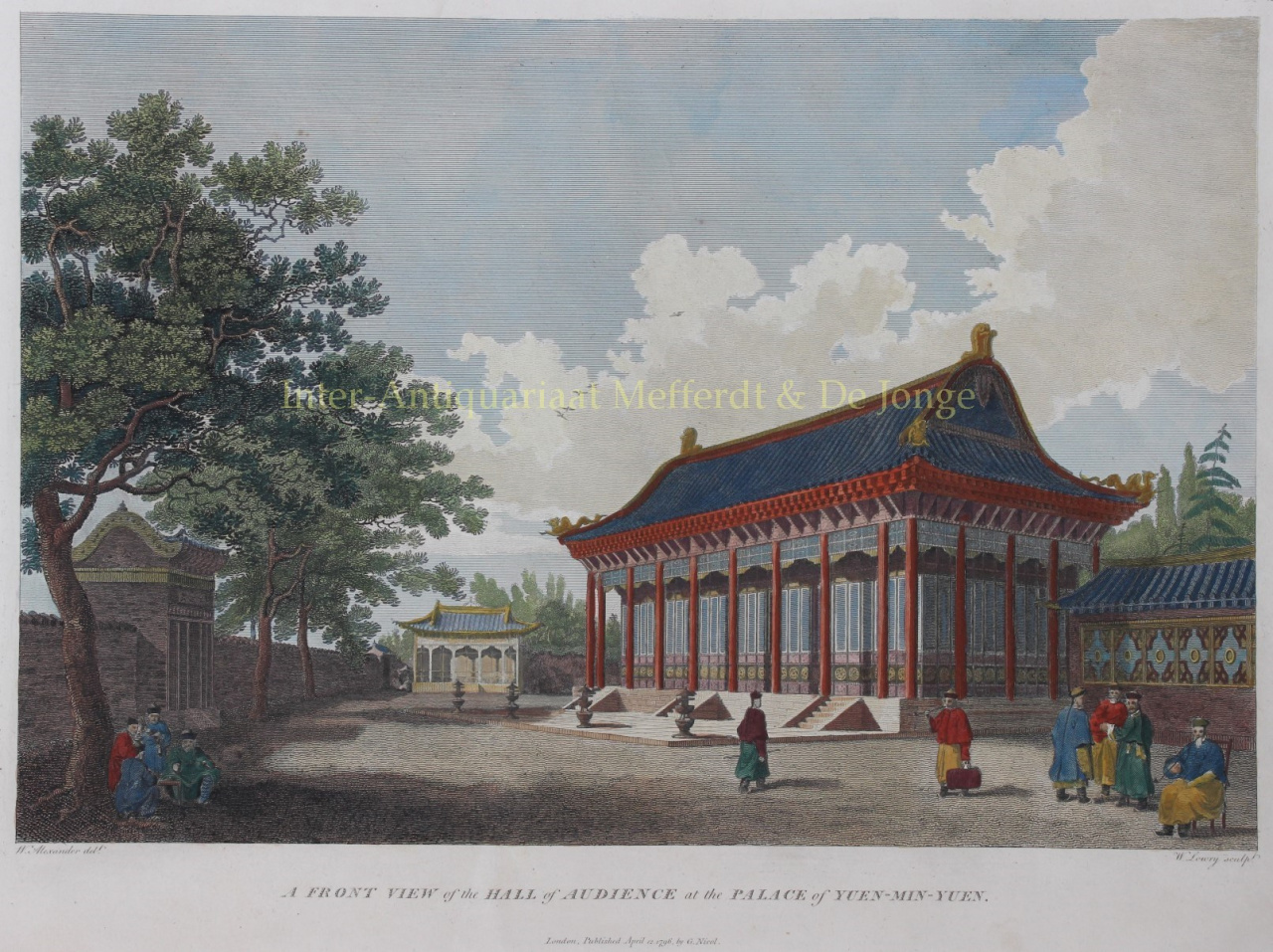
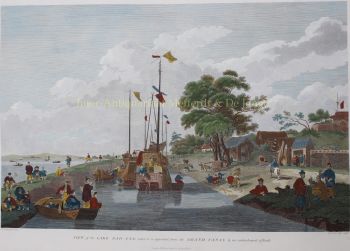
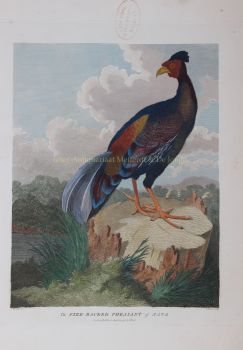
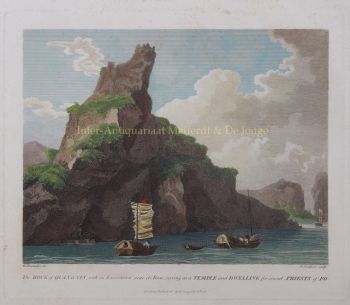
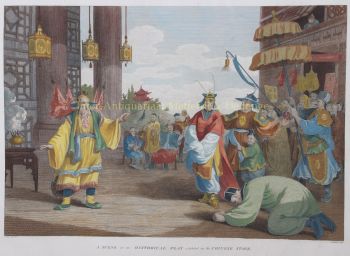
- Sur l'oeuvre d'art“A Front View of the Hall of Audience at the Palace of Yuen-Min-Yuen” Copper engraving by Wilson Lowry after a drawing by William Alexander (1767-1816 ) from the “Authentic account of an embassy from the King of Great Britain to the Emperor of China; including cursory observations made, and information obtained, in travelling through that ancient empire” written by Sir George Leonard Staunton and published April 12, 1796 in London by G. Nicol. Coloured by a later hand. Size (image): 23,9 x 35,8 cm. The embassy was headed by Earl George Macartney (1737-1806), who was dispatched to Beijing in 1792. He was accompanied by Staunton a medical doctor as his secretary, and a retinue of suitably impressive size, including Staunton’s 11-year-old son who was nominally the ambassador’s page. On the embassy’s arrival in China it emerged that the 11-year-old was the only European member of the embassy able to speak Mandarin, and thus the only one able to converse with the Emperor. Lord Macartney's embassy was unsuccessful, the Chinese resisting British overtures to establish diplomatic relations in view of opening the vast Chinese realms to free trade, but it opened the way for future British missions, which would eventually lead to the first Opium War and the cession of Hong Kong to Britain in 1842. It also resulted in this invaluable account, prepared at government expense, largely from Lord Macartney's notes, by Staunton, of Chinese manners, customs and artifacts at the height of the Qing dynasty. The engravings are of special interest because of their depiction of subjects that very few Europeans had heard of or seen, showing how advanced Chinese civilisation was on a technical, artistic and organizational level. Staunton describes the the hall of audience as follows: "The outside of this hall had a magnificent appearance. The approach to it was thro three quadrangular courts, surrounded by buildings, separated from each other. It was erected upon a platform of granite, raised about four feet above the level of the court before it. Its projecting roof was supported upon two rows of large wooden columns, the shafts of which were painted red, and varnished; and the capitals ornamented with various scrolls and devices, in vivid colouring, particularly with dragons, whose feet were armed with five claws each. Dragons may be marked on the edifices and furniture of the princes of the Emperor's court, but with four claws only to their feet; the fifth is reserved for his Imperial Majesty alone. A net of gilt wire, scarcely perceptible, is spread over the whole entablature of the building, to prevent birds from resting upon any of the projecting points, of which a great number are brought out in a regular order." Price: Euro 195,-
- Sur l'artiste
William Alexander (1767-1816) fut le seul artiste anglais de la fin du XVIIIe siècle à pénétrer au cœur de la Chine, un voyage qui allait marquer sa carrière et asseoir sa réputation. Né à Maidstone, dans le Kent, fils d'un carrossier, il manifesta très tôt des dons artistiques et étudia à Londres, probablement auprès de Julius Caesar Ibbetson, avant d'intégrer les écoles de la Royal Academy.
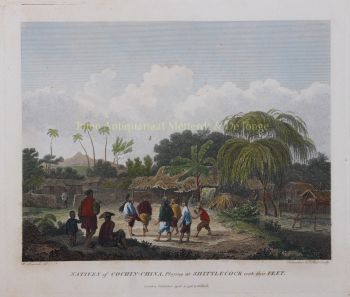
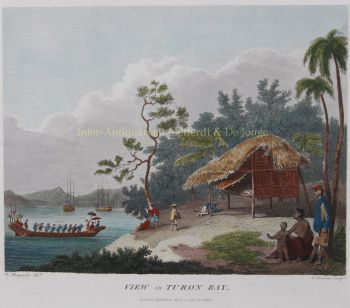
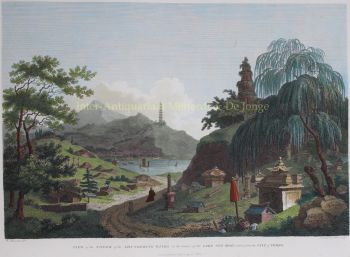
En 1792, Alexander rejoignit l'ambassade britannique de Lord Macartney en Chine en tant que dessinateur junior. Bien que la mission diplomatique n'ait pas permis d'établir des relations commerciales durables avec l'empereur Qianlong, elle offrit à Alexander une documentation de première main exceptionnelle. À une époque où la chinoiserie fascinait l'Europe, ses aquarelles détaillées de paysages, d'architecture et de scènes de la vie quotidienne chinoises furent largement saluées. Nombre d'entre elles furent gravées pour les comptes rendus officiels de l'ambassade et pour des publications telles que « View of the Headlands, Islands, etc. » (1798) et « A Voyage to Cochin China » de John Barrow (1806).
De retour en Angleterre, Alexander perfectionna ses croquis chinois pour en faire des œuvres d'exposition destinées à la Royal Academy et travailla au sein du cercle dynamique des aquarellistes gravitant autour du Dr Monro, aux côtés d'artistes tels que Thomas Girtin. En 1802, il devint professeur de dessin de paysage à la Royal Military Academy de Great Marlow.
En 1808, il démissionna de ce poste pour devenir l'un des premiers conservateurs du British Museum, occupant les fonctions de conservateur des estampes et des dessins et de bibliothécaire adjoint. Il y entreprit de dresser le premier inventaire des estampes et des dessins du musée et illustra d'importantes antiquités de la collection Townley. Membre de la Society of Antiquaries, Alexander se tourna ensuite de plus en plus vers les paysages pittoresques et les études d'objets classiques.
Il mourut en 1816 à Maidstone, à l'âge de quarante-neuf ans. Aujourd'hui, son œuvre est conservée dans d'importantes collections publiques, notamment la British Library, la Tate et le Victoria and Albert Museum, et demeure un témoignage visuel inestimable de la Chine de la fin du XVIIIe siècle, vue à travers le regard britannique.

Êtes-vous intéressé par l'achat de cette oeuvre?
Artwork details
Related artworks
- 1 - 4 / 12
- 1 - 4 / 24
- 1 - 4 / 12


![“Tentation” [temptation], lithograph by Eugène Grasset](https://media-3.gallerease.com/images/b891f1b8-508a-4829-a559-a56b7f765ca7/350x350/tentation-temptation-lithograph.jpg)


![European hunting party] by Artiste Inconnu](https://media-2.gallerease.com/images/cb8cbebf-7709-4817-9bdb-fef8ae1e93cf/350x350/european-hunting-party.jpg)