Victorian Harem Ring with Seven Gemstone Bands, circa 1890 by Artiste Inconnu

Victorian Harem Ring with Seven Gemstone Bands, circa 1890 1890

Artiste Inconnu

PierrediamantRubisTurquoiseperleSaphirGemme
€ 6.500

Adin Fine Antique Jewellery

  • Sur l'oeuvre d'art

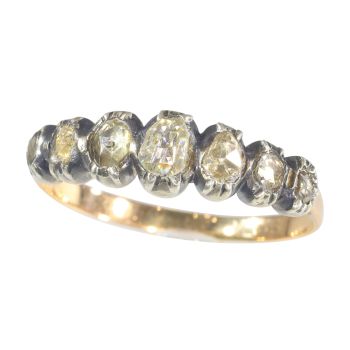
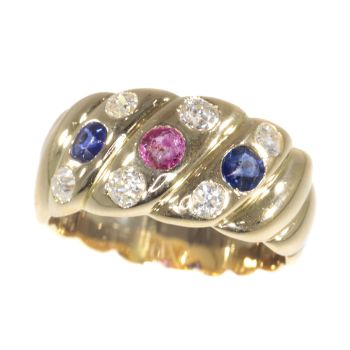
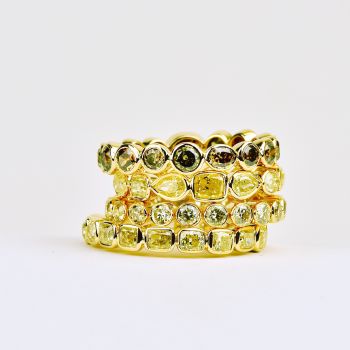
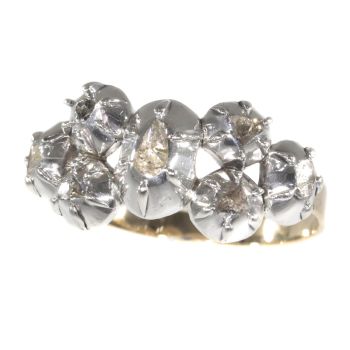
    A Victorian harem ring, circa 1890, formed as seven slender bands in warm reddish yellow gold, each set with its own line of gemstones: rose cut diamonds, turquoise, sapphires, seed pearls, amethysts, rubies and emeralds. It has that late Victorian gift for colour and variety, almost as if seven rings had been gathered into one, yet the effect remains composed and lively.

    Jewellery Type
    harem ring, also described as a stacked ring

    Condition
    Very good condition with minor wear consistent with age and use
    more info on our condition scale

    Country of origin
    unknown

    Style
    Victorian - Jewellery of the Victorian period, made during the reign of Queen Victoria (1837-1901).
    See also: Victorian
    more info on styles

    Style specifics
    Late Victorian or Aesthetic Period, circa 1880-1901.We consider this ring to belong to that later Victorian phase. Its unusual multi-band construction and its strong use of contrasting coloured gemstones suit a period taste for refined, decorative jewels with lightness, variety, and visual effect.

    Period
    ca. 1890
    Events & facts of this era, poetry of this era, fashion of this era.

    Material18K reddish yellow gold (touchstone tested). The tone sits between yellow gold and red gold.
    more info on precious metals

    Diamonds
    rose cut diamonds.

    All diamonds in our antique and vintage jewellery are verified by the IJGC laboratory as natural diamonds.

    Gemstones and pearls
    Seven turquoises
    Seven sapphires
    Seven half seed pearls
    Seven amethysts
    Seven rubies
    Seven emeralds
    It is common practice for gemstones to be treated to improve colour or clarity. This item has not been tested in that regard.

    Birthstones
    Amethyst is the birthstone (or month stone) for February, Diamond is the birthstone (or month stone) for April, Emerald is the birthstone (or month stone) for May, Pearl is the birthstone (or month stone) for June, Ruby is the birthstone (or month stone) for July, Sapphire is the birthstone (or month stone) for September and Turquoise is the birthstone (or month stone) for December.
    more info on birthstones

    Hallmarks
    No trace of hallmarks.
    more info on hallmarks

    Dimensions
    width across top of ring 1.90 cm (0.75 inch)
    see picture with a ruler in millimeters and inches

    Weight
    8,00 grams (5,14 dwt)

    Ring size EU 53 / 17 mm, US 6¼, UK M

    Resizing
    This ring cannot be resized because of its construction.
    more info on ring sizes

    Adin Reference Nº
    26026-0224

    Copyright photography
    Adin, fine antique jewellery

    Additional information
    our latest acquisitions
    jewelry glossary
    wall of fame
    visit us in Antwerp
    subscribe to our mailinglist

  • Sur l'artiste

    Il peut arriver qu'un artiste ou un créateur soit inconnu.

    Certaines œuvres ne doivent pas être déterminées par qui elles sont faites ou elles sont faites par (un groupe d') artisans. Les exemples sont des statues de l'Antiquité, des meubles, des miroirs ou des signatures qui ne sont pas claires ou lisibles, mais aussi certaines œuvres ne sont pas signées du tout.

    Vous pouvez également trouver la description suivante :

    •"Attribué à …." A leur avis probablement une oeuvre de l'artiste, au moins en partie

    •« Atelier de …. ou « Atelier de » À leur avis, une œuvre exécutée dans l'atelier ou l'atelier de l'artiste, éventuellement sous sa direction

    •« Cercle de… ». A leur avis une oeuvre de la période de l'artiste témoignant de son influence, étroitement associée à l'artiste mais pas forcément son élève

    •« Style de … ». ou "Suiveur de ...." Selon eux, une œuvre exécutée dans le style de l'artiste mais pas nécessairement par un élève ; peut être contemporain ou presque contemporain

    •« Manière de… ». A leur avis une oeuvre dans le style de l'artiste mais d'une date plus tardive

    •"Après …." A leur avis une copie (quelle qu'en soit la date) d'une oeuvre de l'artiste

    •« Signé… », « Daté… ». ou « Inscrit » À leur avis, l'œuvre a été signée/datée/inscrite par l'artiste. L'ajout d'un point d'interrogation indique un élément de doute

    • "Avec signature ….", "Avec date ….", "Avec inscription …." ou "Porte signature/date/inscription" à leur avis la signature/date/inscription a été ajoutée par quelqu'un d'autre que l'artiste

Êtes-vous intéressé par l'achat de cette oeuvre?