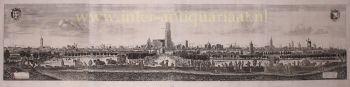
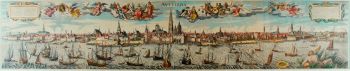
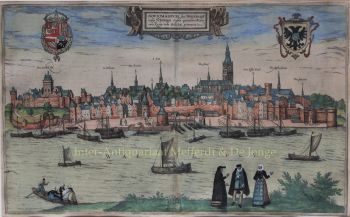
VIEW OF 17TH CENTURY AMSTERDAM 1650
Caspar Merian
PapierImprimer
19 ⨯ 70 cm
€ 1.250
Inter-Antiquariaat Mefferdt & De Jonge
- Sur l'oeuvre d'artVIEW OF 17TH CENTURY AMSTERDAM "Amsterdam", engraving printed from two copperplates, made around 1650, published in Frankfurt am Main by Caspar Merian in 1659. Coloured by a later hand. Size: 19.5 × 70.5 cm. From the Topographia Germaniae Inferioris. From left to right one can distinguish the Rijzenhoofd, the Antoniespoort, the West India warehouse, the Montelsbaanstoren, Zuiderkerk tower, Munttoren, and Schreierstoren, the Walloon Church, Sint-Olofskapel,(Chapel of St. Olaf), the Old Church, the Nieuwezijds Kapel, the stock exchange, the Waag, the old Town Hall with its pointed tower, the Nieuwe Kerk with its completed tower, the Jan Rodenpoort tower, Haringpakkers tower, and Wester tower, the Noorderkerk, the Bickers tower, and the Haarlemmerpoort. The city’s grain warehouses are also depicted; the old Town Hall had not yet burned down (1652). Topographia Germaniae Inferioris was part of the Topographia Germaniae, the most important work of engraver and publisher Matthäus Merian the Elder (1593–1650). He published this monumental work together with Martin Zeiler (1589–1661) of Ulm, who was responsible for the text. The work contains around 2,000 illustrations and plans of towns, monasteries, and castles and is considered one of the most significant achievements in the field of topographical illustration. Merian had begun in 1642 with the publication of a survey of town views, landscapes, and maps, for which he had been collecting drawings for decades. Up to 1688 the series was expanded with further descriptions of European regions, ultimately reaching 30 volumes with a total of 92 maps and 2,142 town views, making it one of the largest publications of its time. The first volumes were engraved and published by Matthäus Merian himself. Later, much of the engraving work was commissioned from several prominent engravers of the day, while his sons Matthäus the Younger and Caspar took over the publishing activities. Price: Euro 1.250,-

- Sur l'artiste
Caspar Merian (1627-1686) était un graveur topographique, cartographe et éditeur suisse-allemand de renom, qui joua un rôle déterminant dans la pérennité de l'une des dynasties d'éditeurs les plus influentes du XVIIe siècle. Issu de la célèbre famille Merian, il était le fils de Matthäus Merian l'Ancien, dont l'atelier à Francfort était devenu un centre majeur pour les livres illustrés et les cartes en Europe.Caspar Merian (1627-1686) était un graveur topographique, cartographe et éditeur suisse-allemand de renom, qui joua un rôle déterminant dans la pérennité de l'une des dynasties d'éditeurs les plus influentes du XVIIe siècle. Issu de la célèbre famille Merian, il était le fils de Matthäus Merian l'Ancien, dont l'atelier à Francfort était devenu un centre majeur pour les livres illustrés et les cartes en Europe.
Avec son frère, Matthäus Merian le Jeune, Caspar reprit la maison d'édition familiale à Francfort et contribua à asseoir sa réputation d'excellence en matière d'ouvrages topographiques et historiques. Leurs publications alliaient une grande précision géographique à une narration visuelle riche, contribuant ainsi de manière significative à la diffusion des connaissances sur les régions et les villes européennes.
Parmi leurs œuvres les plus importantes figurent les volumes de la série Topographia, notamment la Topographia Germaniae Inferioris vel Circuli Burgundici, qui offre des descriptions détaillées et des gravures des principales villes et régions des Dix-Sept Provinces (les Pays-Bas). Ils contribuèrent également à la poursuite du monumental Theatrum Europaeum, une chronique exhaustive des événements politiques et militaires européens.
Plus tard, en raison de problèmes de santé, Caspar Merian quitta Francfort pour Wertheim en 1672, puis la Frise en 1677, où il rejoignit la communauté religieuse labadiste. Malgré ces changements de vie, son œuvre demeura profondément influente. Par ses gravures et ses publications, Caspar Merian contribua à façonner la cartographie et la représentation topographique de l'Europe du début de l'époque moderne, préservant et enrichissant l'héritage de la maison d'édition Merian.
Êtes-vous intéressé par l'achat de cette oeuvre?
Artwork details
Related artworks
Artiste Inconnu
Een Gotische zuidelijke Nederlanden wandklok1580 - 1590
Prix sur demandeNico van den Assem restauratie
Gobert Denis Chambon/ Jean Janvier, S.G. Longschamps
Magnificient antiek World map1754
€ 17.500Inter-Antiquariaat Mefferdt & De Jonge
Sélectionné parDanny Bree
Vincent Laurensz van der Vinne
Portrait of a man and woman1640 - 1650
Prix sur demandeArt Gallery Voûte
1 - 4 / 24- 1 - 4 / 24
Erasmus Dülmen-Krumpelmann
Markttafereel in Amsterdam1900 - 1920
Prix sur demandeBruning Heintz Fine Art
Evert Jan Ligtelijn
Magere Brug over de Amstel rivier1920 - 1940
Prix sur demandeBruning Heintz Fine Art
1 - 4 / 24- 1 - 4 / 24
- 1 - 4 / 12


![RARE ARMORIAL MAP: LEO BRABANTIAE Lion of the most noble Duchy of Brabant] by Sibertus Waterloos](https://media-3.gallerease.com/images/325cc033-a3b6-495f-9da8-6d06caf29b14/350x350/rare-armorial-map-leo-brabantiae-lion-of-the-most-noble-duchy-of-brabant.jpg)