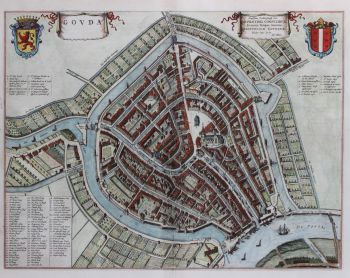
Wind chart, anemographical map 1650
Johannes Janssonius
ImprimerGravure
43.50 ⨯ 54.50 cm
€ 2.250
Inter-Antiquariaat Mefferdt & De Jonge
- Sur l'oeuvre d'artWIND ROSE BY JANSSON, ONE OF THE EARLIEST ANEMOGRAPHIC CHARTS "Tabula Anemographica seu Pyxis Nautica Ventorum nomina sex linguis repraesentans" [Anemographic charts or nautical wind compass representing the names of the winds in six languages], copper engraving published by Johannes Janssonius (a.k.a. Jan Jansson) in 1650 as part of his "Groote Atlas, vervattende de Water-Weereld" [gand atlas, including the water world]. Coloured by a later hand. Size: 43.5 x 54.5 cm. "This chart depicts the sea compass with the magnetic needle, which sailors use on the wild and raging sea, where one sees nothing but sky and water and has no given path before them, and thus determine their true course and may find the places where they wish to sail." This chart was made during a time when directional observation was changing, a time when transitioning from a wind rose to a compass rose. In ancient Greece - before the invention of the magnetic compass - sailors defined directions based on the different winds and where they came from. Homer spoke of four main wind directions, but as navigation and cartography developed further, more directions were added. Names for wind directions were named after gods, constellations of stars, or weather conditions in Greek, Latin, and other languages. The use of different names for the same wind directions made it even more confusing. This "Table of Winds" provided a solution. On a 360° compass, 32 wind directions are indicated with names in Dutch, French, Italian, Latin, and Greek. Each wind is represented by a blowing figure with the characteristics of the people from the area where the wind was associated. The main wind directions are depicted larger. The top left quadrant represents the north: bearded Germanic or Scandinavian types. Top right are the winds from the east: beardless, dark men. The smooth faces from the south and west are less easily identifiable but probably represent the Greeks and indigenous inhabitants of America. So-called anemographic charts like this were functional and used as references. Sea charts already existed in the 17th century, but much use was made of sailors' guides in which (as text) it might say, for example, "follow the southwest wind for three days," then "go with the east wind." A seafarer could consult a chart like this to determine the sailing direction. Price: Euro 2.250,- (incl. frame)
- Sur l'artiste
Janssonius est né à Arnhem en tant que fils de Jan Jansz, imprimeur et éditeur là-bas. Très jeune, il s'installe à Amsterdam, alors centre de l'imprimerie et du commerce de cartes. En 1612, il épousa Elisabeth Hondius, fille de Jodocus Hondius. Elisabeth mourut en 1627 et Janssonius se remaria en 1629 avec Elisabeth Carlier. Il est allé travailler pour son beau-père et a continué l'entreprise d'édition avec Henricus Hondius (fils de) après sa mort. Cela a été développé dans l'un des plus grands de son temps. Il y avait des succursales à Berlin, Francfort, Genève, Lyon et Stockholm, entre autres.
Sous la direction de Janssonius, l'Atlas Mercator-Hondius a été élargi et publié sous le nom d'Atlas Novus. Cette édition initialement en un volume est rapidement devenue un atlas en plusieurs volumes, complété sur demande par des cartes marines et/ou des cartes célestes. Il y avait des publications en néerlandais, français, espagnol et latin. Tout comme ses contemporains, Janssonius a également utilisé des plaques de cuivre existantes, notamment celles des livres de ville de Braun & Hogenberg et la Description de touts les Pays Bas (Description de tous les Pays-Bas) de Lodovico Guicciardini - (édition Cornelis Claesz.) de 1609 Bien que Janssonius ait souvent été accusé de copier l'œuvre de Willem Blaeu, on peut noter que des cartes de Janssonius sont également apparues sur le marché plus tôt.
Après la mort de Janssonius, l'entreprise a été poursuivie par son gendre, Johannes (Jan) van Waesbergen, qui était marié à sa fille Elisabeth Janssonius (1615-1681). De nombreuses plaques de cuivre des livres de la ville ont été utilisées (parfois légèrement modifiées) par Frederik de Wit. Le bâtiment de la place du Dam a été loué à Gérard Valck ; Il a également acheté un certain nombre de plaques d'impression en 1694.

Êtes-vous intéressé par l'achat de cette oeuvre?
Artwork details
Related artworks
- 1 - 4 / 6
Vincent Laurensz van der Vinne
Portrait of a man and woman1640 - 1650
Prix sur demandeArt Gallery Voûte
Artiste Inconnu
Dutch School pair of equestrian paintings 1650 - 1750
Prix sur demandeGallerease Selected
Artiste Inconnu
Antique Dutch still life flowers in vase1740 - 1800
Prix sur demandeGallerease Selected
Gobert Denis Chambon/ Jean Janvier, S.G. Longschamps
Magnificient antiek World map1754
€ 17.500Inter-Antiquariaat Mefferdt & De Jonge
Sélectionné parDanny Bree
Peter Paul Rubens (follower of )
Portrait of a man dressed up as an oriental man1750 - 1850
Prix sur demandeGallerease Selected
1 - 4 / 24- 1 - 4 / 24
- 1 - 4 / 24
- 1 - 4 / 24
- 1 - 4 / 12