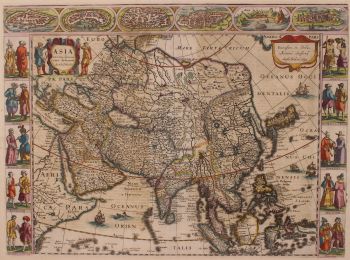
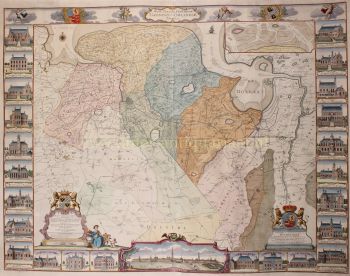
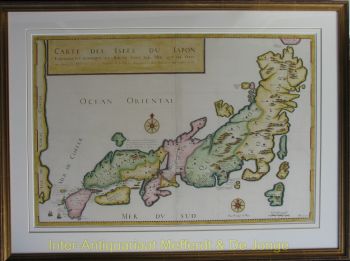
World - Covens & Mortier after Guillaume De L'Isle, 1745 by Artiste Inconnu
Scroll to zoom, click for slideshow

World - Covens & Mortier after Guillaume De L'Isle, 1745 1745

Artiste Inconnu

Papier
50 ⨯ 63 cm
€ 2.250

Inter-Antiquariaat Mefferdt & De Jonge

  • Sur l'oeuvre d'art
    Mappe-Monde Dressé sur les Observations de Mrs. De L'Academie Royale des Sciences et quelques autres et sur les memoires les plus recens Par M. De L'Isle. (World Map based on the Observations of the Gentlemen of the Royal Academy of Sciences and some others, and on the most recent memoirs by Mr. De L'Isle) Copper engraving published by Covens & Mortier in Amsterdam around 1745. Original hand colouring with later additions. Size: 50,8 x 63,5 cm. Guillaume De L'Isle's world map was originally published in 1700 and then revised and republished throughout the 18th century by De L'Isle and by subsequent map publishers. Dutch publishers Covens & Mortier's first version of De L'Isle's map was produced in 1720 adding the seascape with ships on the horizon at the bottom decorated with a second cartouche in the shape of a sea monster with a mermaid, merman and dolphins. They issued a later edition of that map (shown here) in about 1745 with the additional subtitle "Nouvellement corrigée apres les dernieres Decouvertes faites par l'Academie de Petersbough" (newly corrected after the latest discoveries made by the Academy of Saint Petersburg"). The map consists of two central hemispheres, eastern and western, surrounded by four smaller polar projections. The right hand projections focus on the Northern Hemisphere while the left hand projections depict the Southern. At top center there is an elaborate decorative cartouche with various allegorical elements depicting the four great continents in female form, from top left: America, Europa, Africa, and Asia. The routes of a number of the most famous explorers of the major oceans of the world are shown from 1542 to approximately 1730, ending with the Russian voyages of Aleksei Chirikov and Vitus Bering. Some of the more noteworthy features of the map includes the Russian explorations along the Northwestern coast of America, Aleutian islands shown in a semi-mythical configuration and attached to a highly conjectural Alaska; astronomer Edmond Halley's sighting of Antarctic ice; Jean-Baptiste Bouvet de Lozier's large "Cap de la Circoncision"; A depiction of the tracks of Dutch merchant Francisco Pelsaert's route from Australia to Java; Carpentaria attached to New Guinea; explorer Abel Tasman's route, along with a depiction of Tasmania, distinctly separate from Australia. The map also retains one of the more curious peninsula depictions of California. Price: Euro 2.250,-
  • Sur l'artiste

    Il peut arriver qu'un artiste ou un créateur soit inconnu.

    Certaines œuvres ne doivent pas être déterminées par qui elles sont faites ou elles sont faites par (un groupe d') artisans. Les exemples sont des statues de l'Antiquité, des meubles, des miroirs ou des signatures qui ne sont pas claires ou lisibles, mais aussi certaines œuvres ne sont pas signées du tout.

    Vous pouvez également trouver la description suivante :

    •"Attribué à …." A leur avis probablement une oeuvre de l'artiste, au moins en partie

    •« Atelier de …. ou « Atelier de » À leur avis, une œuvre exécutée dans l'atelier ou l'atelier de l'artiste, éventuellement sous sa direction

    •« Cercle de… ». A leur avis une oeuvre de la période de l'artiste témoignant de son influence, étroitement associée à l'artiste mais pas forcément son élève

    •« Style de … ». ou "Suiveur de ...." Selon eux, une œuvre exécutée dans le style de l'artiste mais pas nécessairement par un élève ; peut être contemporain ou presque contemporain

    •« Manière de… ». A leur avis une oeuvre dans le style de l'artiste mais d'une date plus tardive

    •"Après …." A leur avis une copie (quelle qu'en soit la date) d'une oeuvre de l'artiste

    •« Signé… », « Daté… ». ou « Inscrit » À leur avis, l'œuvre a été signée/datée/inscrite par l'artiste. L'ajout d'un point d'interrogation indique un élément de doute

    • "Avec signature ….", "Avec date ….", "Avec inscription …." ou "Porte signature/date/inscription" à leur avis la signature/date/inscription a été ajoutée par quelqu'un d'autre que l'artiste

Êtes-vous intéressé par l'achat de cette oeuvre?