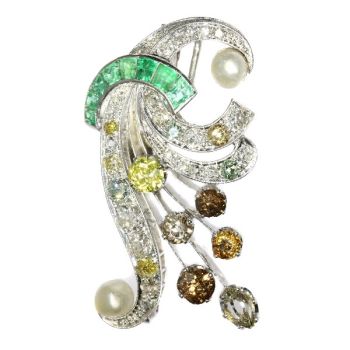
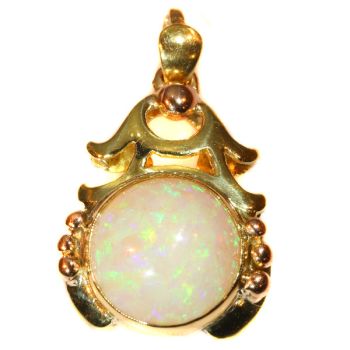
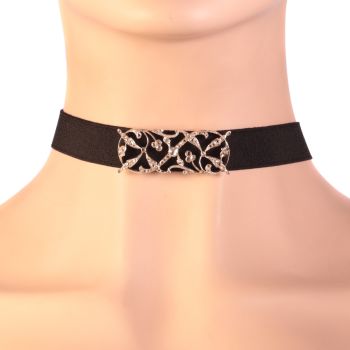
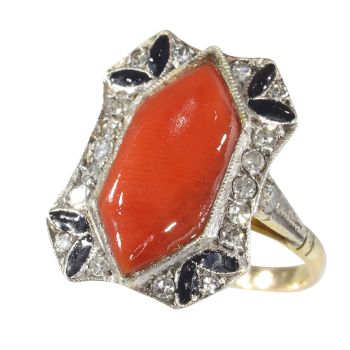
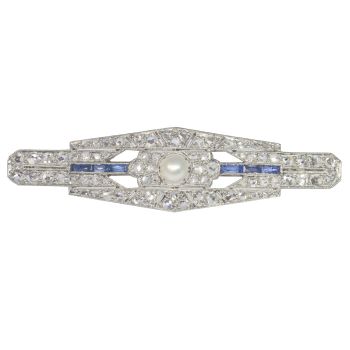
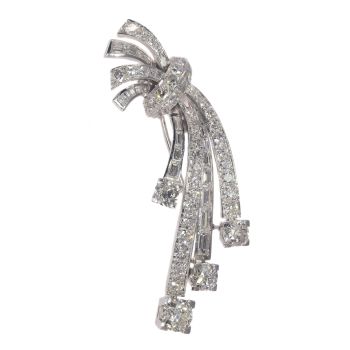
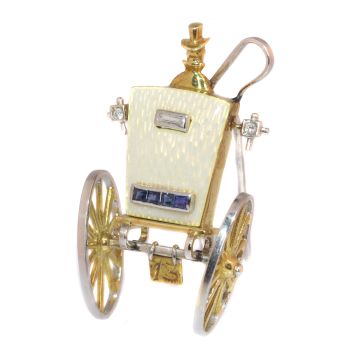
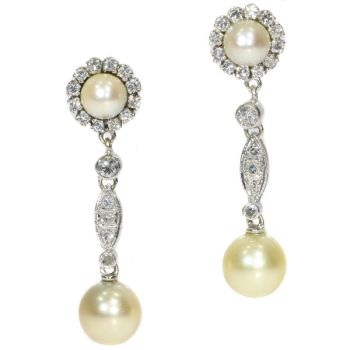
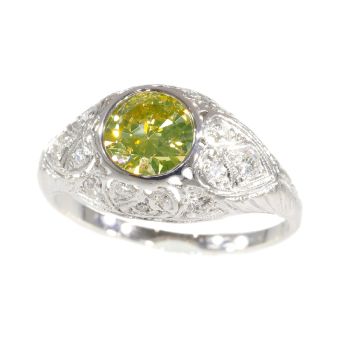
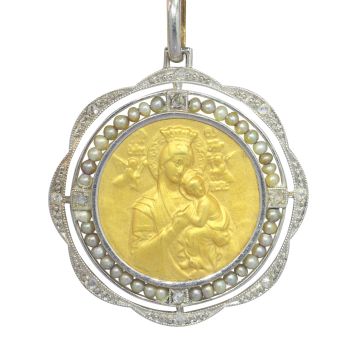
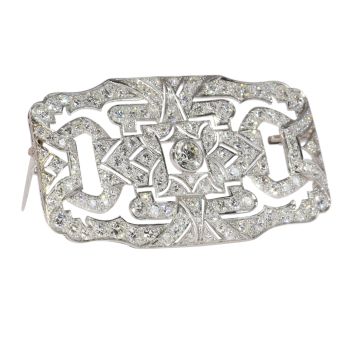
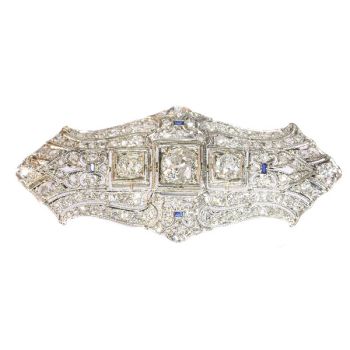
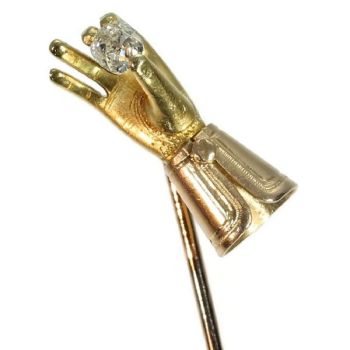
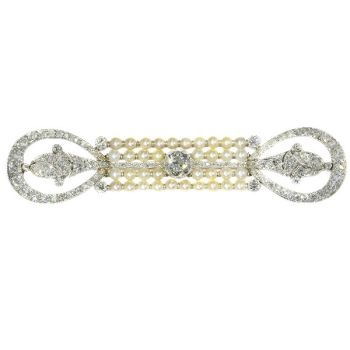
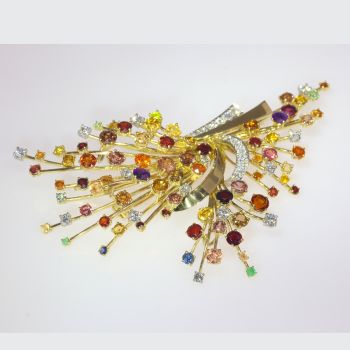
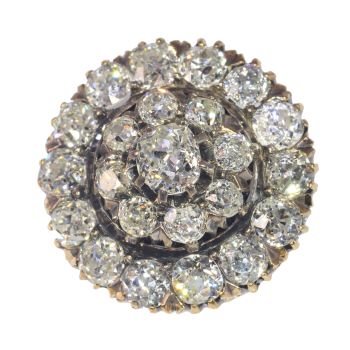
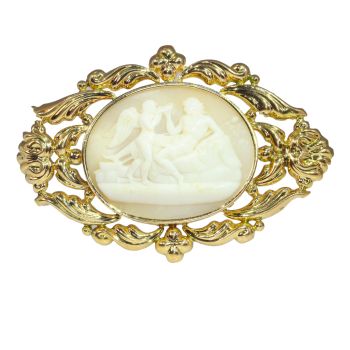
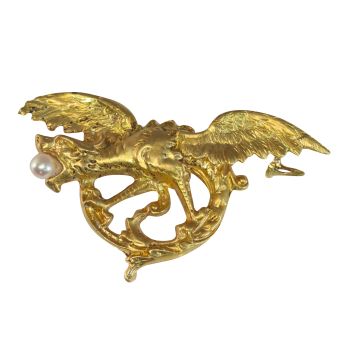
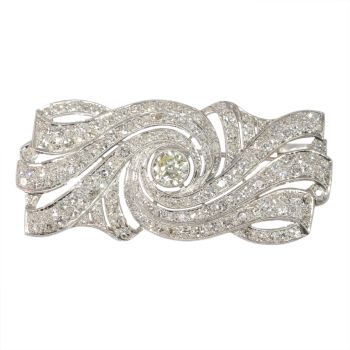
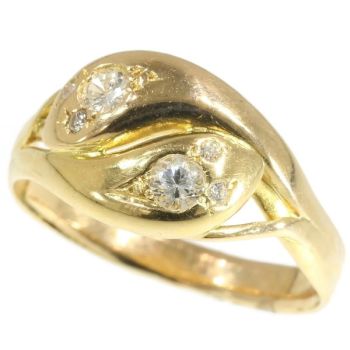
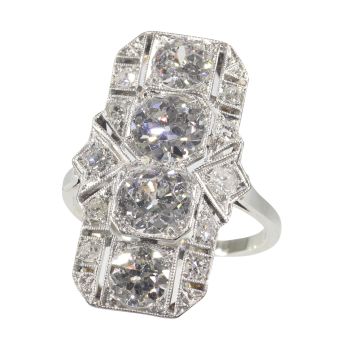
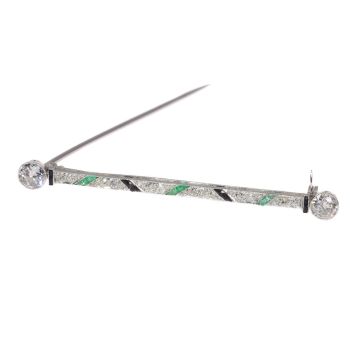
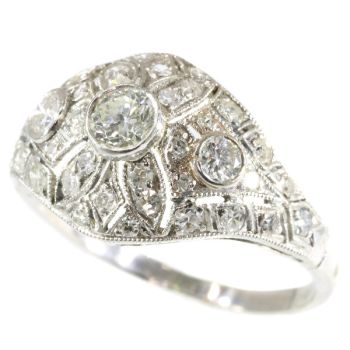
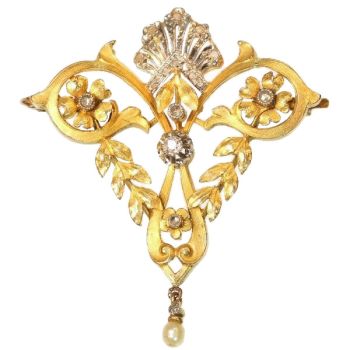
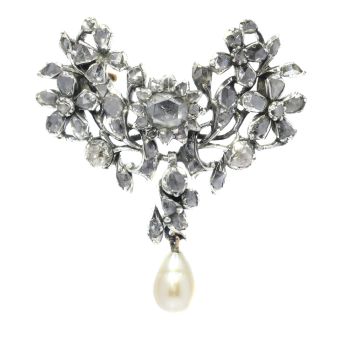
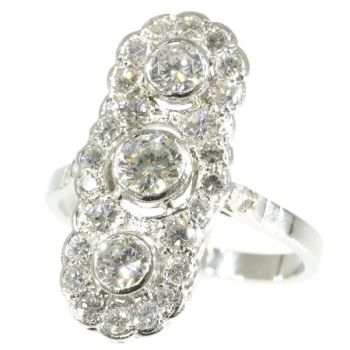
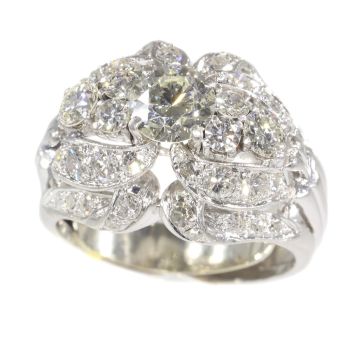
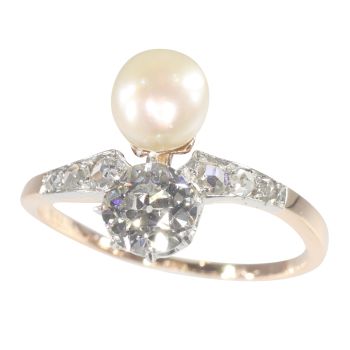
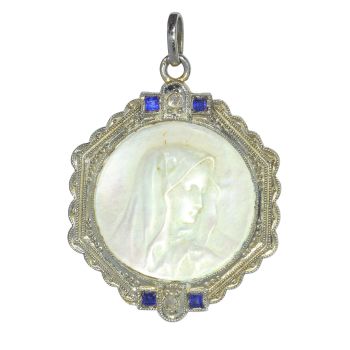
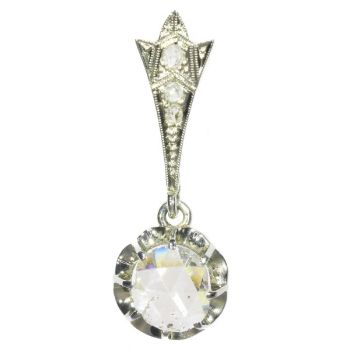
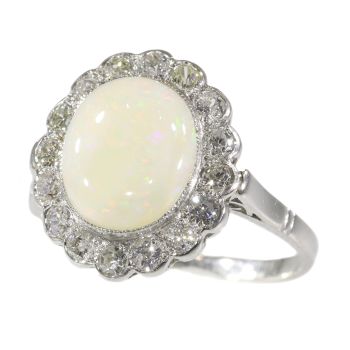
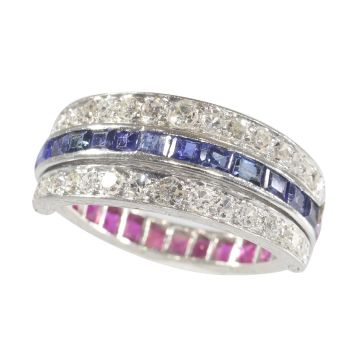
This remarkable brooch, dating to circa 1950, exudes timeless elegance with its masterful blend of design and symbolism. Its vibrant palette of blue, white, and red is brought to life by dazzling diamonds, sapphires, and rubies, meticulously set in 18Kyellow gold and platinum. Reflecting the ideals of liberty, equality, and brotherhood, the brooch’s bold geometry and impeccable artistry speak of refined sophistication. Whether seen as a tribute to the French tricolour or the American flag, this jewelcombines historical significance with an enduring sense of grace and beauty.
Antique jewelry object group clip/brooch
Condition very good condition more info on our condition scale
Country of origin While it bears no discernible control marks, we attribute its origin to either France or America.
Style Between Retro and Fifties See also: Retro and Fifties (of the twentieth century) more info on styles
Style specifics Retro Style is a recent designation for the period in the forties when large scale, stylized geometric forms, drapes, bows or ribbons were all the rage. Pink Gold, set with colored stones, sometimes in floral forms was common.
Period ca. 1950 Events & facts of this era, poetry of this era, fashion of this era.
Source of inspiration the ideals of liberty, equality, and brotherhood
Theme Patriotism and cultural identity
Material 18K yellow gold and platinum (touchstone tested) more info on precious metals
Extra information This captivating jewel, featuring the bold and vibrant hues of blue, white, and red, offers intriguing possibilities of patriotic symbolism. It may honour the French tricolour, evoking national pride and the ideals of liberty, equality, and brotherhoodduring the interwar or post-WWII era. Alternatively, the colours could reference the American flag, symbolising patriotism or reflecting the glamour of Hollywood’s jewellery trends in the 1940s-50s. The exceptional craftsmanship suggests the work of amaster jeweller, potentially French or American. While its exact origin remains a mystery, the artistry of this piece speaks profoundly to its historical and cultural significance.
French Connection The colours blue, white, and red reference the French tricolour, a symbol of national pride and revolutionary ideals since 1789. A common interpretation suggests that the white in the flag represents the monarchy, held captive between the Parisiancolours of blue and red. However, this explanation remains controversial, as it seems unlikely that the republic, which distanced itself so strongly from monarchy, would intentionally retain a reference to the Bourbons, even in a subordinate role. Morelikely, the flag symbolises the values of Liberté (freedom), Égalité (equality) and Fraternité (brotherhood), with blue, white, and red representing these ideals.
American Connection The colours blue, white, and red may also symbolise the American flag, with its strong associations with liberty and independence. During the 1940s-1950s, particularly in the wake of World War II, patriotic jewellery became popular in the United States,often showcasing the nation’s core values of democracy and freedom. Additionally, the flamboyant design of this piece reflects the influence of Hollywood in the same period, where jewellery was not only decorative but also a bold statement of style andidentity.
Diamonds Eleven old mine brilliant cut diamonds with an estimated weight of ± 1.00ct One baguette (long rectangular) cut diamondwith an estimated weight of ± 0.35ct
Total diamond count Twelve pcs.
Total diamond weight approx. 1.35 crt with an average colour and clarity F/J, vs/i
- When we provide weights, colour grades, and clarity of diamonds, these are approximate unless otherwise stated, as we do not remove diamonds from their settings to preserve the integrity of the piece.
- All diamonds, regardless of their size or shape, in our vintage and antique jewellery are verified as 100% natural by the IJGC laboratory.
- We do not sell lab-grown (synthetic) diamonds.
Precious stones One cabochon and eightcarre cut rubies. We did not check if the rubies are lab produced or not as this information has no influence on the value of this jewel. Natural rubies and lab produced rubies were both used in this era, rather more for their effect than for their intrinsic value. with an estimated weight of ± 1.77ct
Thirteen sapphires. We did not check if the sapphires are lab produced or not as this information has no influence on the value of this jewel. Natural sapphires and lab produced sapphires were both used in this era, rather more for their effect than for their intrinsic value.with an estimated weight of ± 1.10ct
All color stone weights are approximate since stones are not removed from their mounts to preserve the integrity of the setting.
It is a very common practice to treat gemstones to intensify their clarity or colour. The item in question has not been tested in this regard.
Birthstones Diamond is the birthstone (or month stone) for April, ruby for July and sapphire for September. more info on birthstones
Hallmarks No trace. more info on hallmarks
Dimensions 3,22 cm (1,27 inch) x 2,95 cm (1,16 inch) see picture with a ruler in millimeters and inches
Weight 11,20 gram (7,20 dwt)
Adin Reference Nº 25006-0095
Copyright photography Adin, fine antique jewellery
Additional information our latest acquisitions jewelry glossary wall of fame visit us in Antwerp subscribe to our mailinglist
Può succedere che un artista o un creatore sia sconosciuto.
Alcune opere non sono determinate da chi sono state realizzate o sono state realizzate da (un gruppo di) artigiani. Esempi sono statue dell'antichità, mobili, specchi o firme non chiare o leggibili ma anche alcune opere non sono affatto firmate.
Inoltre puoi trovare la seguente descrizione:
•"Attribuito a …." A loro avviso probabilmente opera dell'artista, almeno in parte
•“Studio di ….” o “Officina di” A loro avviso un'opera eseguita nello studio o nella bottega dell'artista, eventualmente sotto la sua supervisione
•“Cerchio di…” A loro avviso un'opera del periodo dell'artista che mostra la sua influenza, strettamente legata all'artista ma non necessariamente al suo allievo
•"Stile di..." o "Seguace di..." A loro avviso un'opera eseguita nello stile dell'artista ma non necessariamente da un allievo; può essere contemporaneo o quasi contemporaneo
•“Modalità di…” A loro avviso un'opera nello stile dell'artista ma di epoca successiva
•"Dopo …." A loro avviso una copia (di qualsiasi data) di un'opera dell'artista
•“Firmato…”, “Datato…” o “Iscritto” A loro avviso l'opera è stata firmata/datata/inscritta dall'artista. L'aggiunta di un punto interrogativo indica un elemento di dubbio
•"Con firma....", "Con data...", "Con iscrizione..." o “Riporta firma/data/iscrizione” a loro avviso la firma/data/iscrizione è stata aggiunta da qualcuno diverso dall'artista
Sei interessato ad acquistare questa opera d'arte?