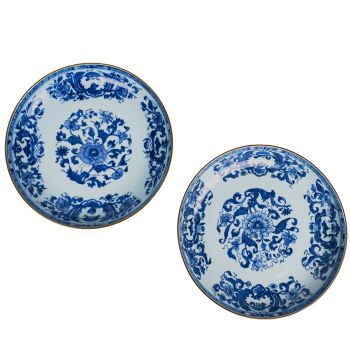
A pair of inscribed blue and white ‘Wild Goose Pagoda’ dishes for the Japanese market, Ko-Sometsuke, Ming dynasty, Tianqi Period (1621–1627). by Artista Sconosciuto

A pair of inscribed blue and white ‘Wild Goose Pagoda’ dishes for the Japanese market, Ko-Sometsuke, 1621 - 1672

Artista Sconosciuto

PorcellanaPorcellana cinese
ø 21 cm
ConditionGood
Prezzo su richiesta

Menken Works of Art
  • A proposito di opere d'arte
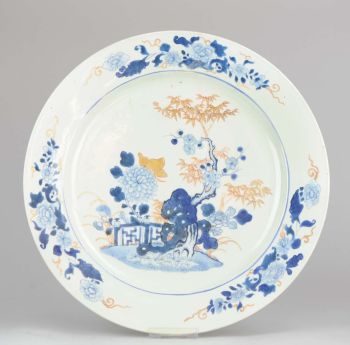
    A pair of inscribed blue and white ‘Wild Goose Pagoda’ dishes for the Japanese market, Ko-Sometsuke.
    Ming dynasty, Tianqi Period (1621–1627).

    The central scene depicts three geese standing in the foreground, with a fourth goose flying above them. Next to this scene appears a four-character inscription that can be translated as: “May your name be inscribed on the wall of the Wild Goose Pagoda in Chang’an.” In the distance, a promontory is shown with a pagoda and a nearby building.

    Below this scene, painted upside down, is another four-line verse. This composition gives the impression of a reflection of the pagoda above. The text can loosely be translated as: “May you enjoy the Imperial Spring Banquet in the Apricot Grove.” Beside the inscription is a flowering apricot plant, with three swallows flying above it. The indented cavetto is decorated with a scrolling lotus motif set against a blue ground, while the outer border features a Greek key pattern on a pale blue background.

    The first inscription, “May Your Name Be Inscribed on the Wall of the Wild Goose Pagoda in Chang’an,” refers to a tradition that began during the Tang dynasty (618–907). Candidates who successfully passed the highest level of the Jinshi civil service examinations were honored by having their names recorded on the wall of the Wild Goose Pagoda in Chang’an, the capital of the Tang empire.

    The second inscription, “May You Enjoy the Imperial Spring Banquet in the Apricot Grove,” alludes to a celebratory banquet traditionally held near the Wild Goose Pagoda for those who had achieved success in the examinations. This message is further emphasized through a visual rebus that combines images of spring swallows with blooming apricot branches, both symbols associated with spring and scholarly achievement.

    Diameter 21 cm.

    Provenance:
    Fa. A.C. Beeling & Zn., Leeuwarden, The Netherlands (sticker on one of the dishes)
    Leegstra collection, Warffum, The Netherlands (sticker on both dishes)

    Ref:
    A similar dish is illustrated in Leaping the Dragon Gate: The Sir Michael Butler Collection of 17th-Century Chinese Porcelain (Katharine Butler, Teresa Canepa, 2021
    Also see Four Centuries of Blue and White – The Frelinghuysen Collection of Chinese and Japanese Export Porcelain (Becky Macguire, 2023), p. 304, no. 248.
    Another dish is in the Groninger Museum collection, object number 2018.0013.

    Worldwide registered and insured shipping.

    Inv. No: MW381
  • A proposito di opere artista

    Può succedere che un artista o un creatore sia sconosciuto.

    Alcune opere non sono determinate da chi sono state realizzate o sono state realizzate da (un gruppo di) artigiani. Esempi sono statue dell'antichità, mobili, specchi o firme non chiare o leggibili ma anche alcune opere non sono affatto firmate.

    Inoltre puoi trovare la seguente descrizione:

    •"Attribuito a …." A loro avviso probabilmente opera dell'artista, almeno in parte

    •“Studio di ….” o “Officina di” A loro avviso un'opera eseguita nello studio o nella bottega dell'artista, eventualmente sotto la sua supervisione

    •“Cerchio di…” A loro avviso un'opera del periodo dell'artista che mostra la sua influenza, strettamente legata all'artista ma non necessariamente al suo allievo

    •"Stile di..." o "Seguace di..." A loro avviso un'opera eseguita nello stile dell'artista ma non necessariamente da un allievo; può essere contemporaneo o quasi contemporaneo

    •“Modalità di…” A loro avviso un'opera nello stile dell'artista ma di epoca successiva

    •"Dopo …." A loro avviso una copia (di qualsiasi data) di un'opera dell'artista

    •“Firmato…”, “Datato…” o “Iscritto” A loro avviso l'opera è stata firmata/datata/inscritta dall'artista. L'aggiunta di un punto interrogativo indica un elemento di dubbio

    •"Con firma....", "Con data...", "Con iscrizione..." o “Riporta firma/data/iscrizione” a loro avviso la firma/data/iscrizione è stata aggiunta da qualcuno diverso dall'artista

Sei interessato ad acquistare questa opera d'arte?