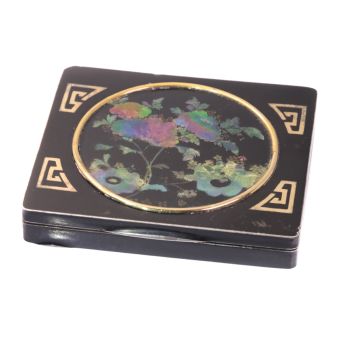
A rare Sawasa ware book-form box and cover, Edo period, early 18th century by Artista Sconosciuto

A rare Sawasa ware book-form box and cover, Edo period, early 18th century 1700 - 1750

Artista Sconosciuto

OroMetalloDoratoLacca
7 ⨯ 4 ⨯ 1 cm
ConditionGood
Prezzo su richiesta

Menken Works of Art

  • A proposito di opere d'arte
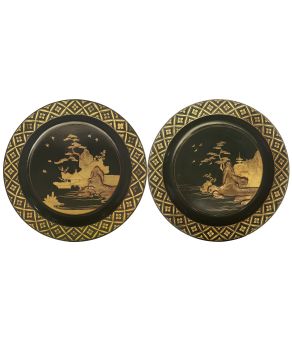
    A rare Sawasa-ware book-form box and cover.
    Edo period, early 18th century.

    The book-shaped box with an integrated hinged lid with a wide inner rim. The front and back are decorated with trees, pavilions and birds in high black lacquered relief designs on a gilt granulated background, contained within a double frame. The spine of the book showing traces of gilt. The inside is gilded as well. The box seemingly opens on the wrong side, probably because the Asian craftsman was unfamiliar with books of this type.

    Dimensions:
    Length 7,5 cm, width 4,5 cm, depth 1,5 cm.

    Lit:
    Two identical boxes are illustrated in Sawasa: Japanese Export Art in Black and Gold 1650-1800 (Rijksmuseum Amsterdam, 1998), pp. 77-78, no’s B.19.1 and B.19.2
    Note:
    The luxurious Sawasa tobacco- and snuffboxes, shaped according to European taste, were commissioned by the Dutch East India Company. Receiving such assignments from foreign customers was no novelty for the Chinese and Japanese craftsmen, since they were already accustomed to catering for other Asian markets. However, although the boxes had European shapes, they were decorated in Oriental style.

    It is difficult to determine whether a tobacco box was made by a Chinese or Japanese craftsman, since the Japanese copied the Chinese. Sawasa ware was thought for many years to be of Chinese origin and was originally labelled as Tonkin Ware. However, it is now thought that these objects, manufactured until the mid-18th century, were made in Nagasaki and exported via Deshima. Most surviving examples of Sawasa ware take the form of Dutch originals, such as tobacco boxes, tea sets, cups and saucers, tea kettles and coffee urns.

    For other examples of Sawasa ware see the collections of the Rijksmuseum, Amsterdam, the Victoria and Albert Museum, London and the Metropolitan Museum of Art, New York.
    Inv. No: MW380
  • A proposito di opere artista

    Può succedere che un artista o un creatore sia sconosciuto.

    Alcune opere non sono determinate da chi sono state realizzate o sono state realizzate da (un gruppo di) artigiani. Esempi sono statue dell'antichità, mobili, specchi o firme non chiare o leggibili ma anche alcune opere non sono affatto firmate.

    Inoltre puoi trovare la seguente descrizione:

    •"Attribuito a …." A loro avviso probabilmente opera dell'artista, almeno in parte

    •“Studio di ….” o “Officina di” A loro avviso un'opera eseguita nello studio o nella bottega dell'artista, eventualmente sotto la sua supervisione

    •“Cerchio di…” A loro avviso un'opera del periodo dell'artista che mostra la sua influenza, strettamente legata all'artista ma non necessariamente al suo allievo

    •"Stile di..." o "Seguace di..." A loro avviso un'opera eseguita nello stile dell'artista ma non necessariamente da un allievo; può essere contemporaneo o quasi contemporaneo

    •“Modalità di…” A loro avviso un'opera nello stile dell'artista ma di epoca successiva

    •"Dopo …." A loro avviso una copia (di qualsiasi data) di un'opera dell'artista

    •“Firmato…”, “Datato…” o “Iscritto” A loro avviso l'opera è stata firmata/datata/inscritta dall'artista. L'aggiunta di un punto interrogativo indica un elemento di dubbio

    •"Con firma....", "Con data...", "Con iscrizione..." o “Riporta firma/data/iscrizione” a loro avviso la firma/data/iscrizione è stata aggiunta da qualcuno diverso dall'artista

Sei interessato ad acquistare questa opera d'arte?