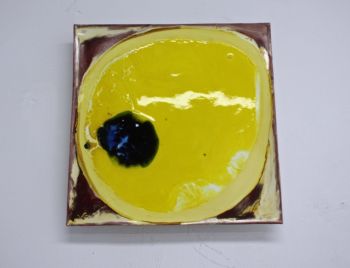
A unique glazed stoneware footed square bowl – Gustavsberg Sweden 1974
Berndt Friberg
PietraSmaltoGresDipingere
9 ⨯ 15 ⨯ 15 cm
ConditionVery good
€ 700
Van Kerkhoff Art
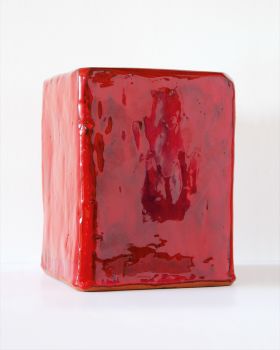
- A proposito di opere d'arteA unique glazed stoneware square footed bowl with a oxblood, cream and blue glaze. Handthrown by Berndt Friberg at the Swedish ceramics studio Gustavsberg in 1974. Fully marked.
About Berndt Friberg
Berndt Friberg (1899–1981) was a Swedish ceramic artist known for his refined stoneware with delicate glazes and perfectly balanced forms. His work, characterized by its simplicity and craftsmanship, made him one of Sweden’s most respected ceramicists.
Friberg was born in Höganäs, Sweden, in 1899 into a family of potters. From a young age, he was exposed to ceramics and began working as an apprentice at Höganäs Pottery when he was just 13. This early training gave him a deep understanding of clay and form, skills that would define his career.
In 1934, he joined Gustavsberg, one of Sweden’s most renowned porcelain manufacturers. There, he worked as a thrower for the famous designer Wilhelm Kåge, refining the technical skills that would later set his own work apart. Over time, he developed his unique artistic style and moved from being a craftsman to a celebrated ceramic artist in his own right.
Friberg’s ceramics are distinguished by their elegant shapes, flawless surfaces, and subtle yet complex glazes. He was known for spending hours perfecting each form, ensuring every piece was precisely balanced. His signature shapes—small vases with narrow necks, rounded bowls, and elongated silhouettes—demonstrated both technical mastery and artistic sensitivity.
A defining feature of his work was his use of soft, layered glazes in muted tones, often with a silky, almost velvety texture. Inspired by Asian ceramics, particularly Chinese Song dynasty pottery, he developed glazes that gave his pieces a timeless and harmonious quality.
Friberg gained international recognition in the 1950s and 1960s, winning numerous awards, including gold medals at the Milan Triennale. His work was highly sought after, both in Sweden and abroad, and remains popular among collectors today.
Unlike many of his contemporaries, Friberg preferred to work alone, throwing and glazing each piece himself. This dedication to craftsmanship ensured that every object he created was of the highest quality. He continued working at Gustavsberg until his death in 1981, leaving behind a body of work that is considered some of the finest Swedish ceramics ever made.
Today, Friberg’s ceramics are displayed in major museums and collections worldwide. His timeless designs, attention to detail, and mastery of form have made him a lasting figure in Scandinavian design history.
Marked
Marked underneath the base: Friberg – Gustavsberg Studio Hand – 1974
Execution
Gustavsberg, Sweden 1974
Condition
This bowl is in very good condition. No cracks or chips.
Literature
Mel Bryans – The Design Encyclopedia
Dimensions
Height 9 cm
Width 15,5 cm
Depth 15,5 cm - A proposito di opere artista

Berndt Friberg venne fondato nel 1899 a Höganäs, in Svezia, in una regione die bekend stond om zijn rijke keramiektraditie. Al vroeg raakte hij vertrouwd met het ambacht: als jongen werkte hij mee in de keramiekfabriek van zijn family, waar hij de base leerde van draaien and glazuren. Zijn uitzonderlijke gevoel voor vorm en techniek bracht hem al snel verder dan het ambachtelijke – Friberg begon keramiek te benaderen als kunst.
Nel 1934 kreeg zijn carrière een beslissende wending toen hij ging werken bij Gustavsberg, een vooraanstaande porseleinfabriek. Daar kwam hij over de vleugels van Stig Lindberg, die zjn talent herkende and hem stimuleerde om zich te ontwikkelen ass zelfstandig kunstenaar binnen de fabriek. Friberg werkte jarenlang als meester-draaier en zette vanaf 1944 ook eigen artistieke lijnen uit, waarbij ieder stuk handgedraaid en gesigneerd werd.
Friberg werd beroemd om zijn Perfecte, vaak kleine en verfijnde vormen — kommen, schalen en vazen — die een zeldzame elegantie uitstralen. Zijn glazuren, veelal in diepe aardse tinten zoals mosgroen, kastanjebruin en blauwgrijs, werden minutieus opgebouwd in lagen die een zachte, bijna zijdeachtige structuur given. Zijn werk kenmerkt zich door een uitzonderlijk technisch meesterschap: volledige symmetrie, dun gedraaide wanden and een haast meditatieve eenvoud.
Hoewel Friberg een bescheiden en teruggetrokken leven leidde, groeide zijn reputatie door de jaren heen tot internationale hoogte. Musea en verzamelaars over de hele world prijzen zijn keramiek als hoogtepunten van Scandinavisch modernism. Alci lavoro è ancora una volta di vakmanschap e tijdloze schoonheid.
Berndt Friberg ha superato nel 1981, maar zijn nalatenschap leeft voort nelle collezioni di altri al Nationalmuseum di Stoccolma e al Röhsska Museum di Göteborg. Zijn work blijft een bron van inspiratie voor keramisten die die streven naar Perfectie in eenvoud — een kunst die hij als geen ander beheerste.
Sei interessato ad acquistare questa opera d'arte?
Related artworks
- 1 - 3 / 3
Tapio Wirkkala
Two rare Art-objects, model 3585 & 3586 – Iittala, Finland1956
Prezzo su richiestaVan Kerkhoff Art
Arne Jacobsen
A vintage ‘Swan’ sofa, model 3321 – Fritz Hansen, Denmark1970 - 1979
Prezzo su richiestaVan Kerkhoff Art
1 - 4 / 24- 1 - 4 / 24
Rudolf de Bruyn Ouboter
Still life with red bowl, blue salt cellar, weck jar and Japanese print1940 - 1960
Prezzo su richiestaAdelwein Kunst
1 - 4 / 24Artista Sconosciuto
Set Arita 'dog training' plates, 18th century 1700 - 1730
Prezzo su richiestaVerkoulen Oriental & European Antiques
1 - 4 / 24Alvar Aalto
A set of four ‘Käsikranaatti’ (Hand Grenade) pendants, model A110 – Louis Poulsen 1960’s1960 - 1969
Prezzo su richiestaVan Kerkhoff Art
Shinkichi Tajiri
“Koan” 1988 – papier-mâché / cotton on paper, original frame1988
Prezzo su richiestaVan Kerkhoff Art
1 - 4 / 12