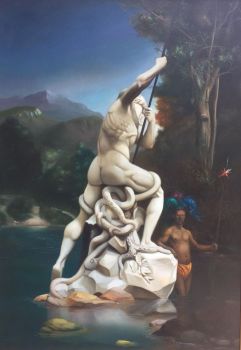
Allegorical Scene of the Lewis and Clark Expedition (1804–1806) Attributed to Léon Cogniet (1794–1880) by Léon Cogniet

Allegorical Scene of the Lewis and Clark Expedition (1804–1806) Attributed to Léon Cogniet (1794–188 1850 - 1870

Léon Cogniet

Olio originale su tela
80 ⨯ 110 cm
ConditionGood
Prezzo su richiesta

Spectandum Gallery

  • A proposito di opere d'arte
    Allegorical Scene of the Lewis and Clark Expedition (1804–1806)
    Attributed to Léon Cogniet (1794–1880)

    This ambitious and romanticized composition captures a defining moment in American history: the Lewis and Clark Expedition, commissioned by President Thomas Jefferson to chart a route to the Pacific Ocean through the newly acquired western territories. The painting centers on meticulously rendered figures—Lewis, Clark, Seaman (?), Charbonneau, Sacajawea, and her brother—each embodying the mythos surrounding the legendary journey.

    A student of Pierre-Narcisse Guérin, like Delacroix and Géricault, Léon Cogniet worked during a stylistic transition, moving away from strict Neoclassicism while still retaining elements of it. His early work, Briséis Weeping over Patroclus, though unsuccessful in securing the Prix de Rome in 1815, reveals his classical roots and emerging coloristic sensibility. During his stay in Rome (1817–1822), he painted Castor and Pollux Rescuing Helen, a competition piece with a somber, mannerist tone influenced by Guérin.

    Upon returning to France, Cogniet gained recognition, particularly at the Salon of 1824 with Scene of the Massacre of the Innocents, which marked a departure from the idealized narratives of Neoclassicism. Though he received official commissions and honors such as the Légion d'Honneur, he remained a discreet contributor to major public projects like the Musée de Versailles.

    Highly praised by Baudelaire in 1845, Cogniet's portraits were favored over his historical vignettes. His works are held in various collections, including the Musée des Beaux-Arts d’Orléans. He also created a number of inventive landscape studies, showcasing his versatility and imaginative approach.

    Provenance:
    Marc Arthur Kohn Auctions, Hôtel Le Bristol, Paris, July 2, 2013
    Cornelius Engelen, Leuven, Belgium
    Private Collection, Belgium

    For more detailed information on the Lewis and Clark Expedition, see:
    http://lewisandclarkyearofdiscovery.blogspot.com/2016/
  • A proposito di opere artista

    Léon Cogniet (1794–1880) è stato un pittore francese e stimato insegnante, noto per le sue scene storiche, i ritratti e il ruolo influente nell'arte accademica francese del XIX secolo.

    Nato a Parigi da una famiglia di artigiani, Cogniet fu ammesso all'École des Beaux-Arts in giovane età. Lì studiò con Pierre-Narcisse Guérin e sviluppò uno stile fortemente radicato nel Neoclassicismo, ma che in seguito iniziò a mostrare influenze del dramma romantico. Nel 1817 vinse il prestigioso Prix de Rome con un dipinto di Annibale sulle Alpi, che gli valse una residenza a Villa Medici a Roma.

    Tornato in Francia, Cogniet divenne un celebre pittore di grandi scene storiche. Una delle sue opere più note è "L'esecuzione dell'imperatore Massimiliano" (1827), che dimostra la potenza drammatica del suo stile. Le sue opere venivano regolarmente esposte al Salon e apprezzate per la loro potenza compositiva, l'uso controllato del colore e la precisione accademica.

    Oltre alla sua attività pittorica, Cogniet si distinse anche come insegnante. Dal 1831 insegnò all'École des Beaux-Arts di Parigi, dove formò molti artisti influenti, tra cui Léon Bonnat e Jean-Paul Laurens. Tra il 1847 e il 1860, inoltre, diresse un proprio studio per artiste, un'esperienza eccezionale per la sua epoca.

    Negli ultimi anni della sua vita, Cogniet abbandonò quasi completamente il pennello per dedicarsi interamente all'insegnamento. Il suo stile passò in parte di moda con l'ascesa del realismo e dell'impressionismo, ma il suo contributo alla tradizione accademica e la sua opera pedagogica rimasero di grande importanza.

    Léon Cogniet morì a Parigi nel 1880. Le sue opere sono oggi conservate in collezioni tra cui il Louvre, il Musée d'Orsay e il Musée des Beaux-Arts di Nantes.

Sei interessato ad acquistare questa opera d'arte?

Artwork details