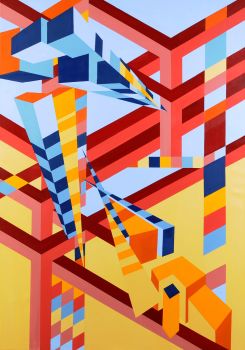
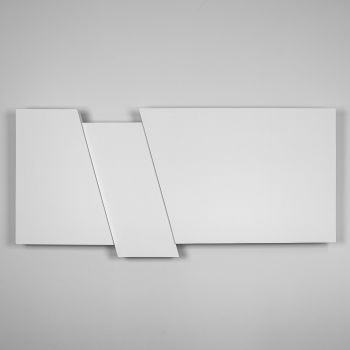
“Compositie”, 1941-1942 – oil on board by Pieter de Haard

“Compositie”, 1941-1942 – oil on board 1941 - 1942

Pieter de Haard

Olio originale su tela
24 ⨯ 74 cm
ConditionVery good
Prezzo su richiesta

Van Kerkhoff Art

  • A proposito di opere d'arte
    An original geometric-abstract oilpainting on board, “Composition”. Painted by Dutch artist Pieter de Haard in 1941-1942. Signed, dated and titled (verso).

    About Pieter de Haard
    Pieter de Haard (Rotterdam 1914 – Rotterdam 2000) was a Dutch painter and illustrator, most known for his geometric abstract oeuvre he created from the 1940’s onward.

    As a young boy, Pieter grew an interest in art and started visiting exhibitions in the Boijmans van Beuningen Museum in his hometown, Rotterdam. The museum director Dirk Hannema noticed the young visitor and advised the boy to go to the Kunstnijverheids School, the predecessor of the Art Academy.

    In 1931/1932 PdH went to Münich where he studied Philosophy and Mathematics. When he returned to Rotterdam, he continued to paint. In the pastels De Haard painted during World War II he continued researching into the representation of spatial dynamics until he finally settled for mathematics, its natural ratios and the Golden Section in particular.

    The oeuvre from his mathematical period which started in 1946 when after he returned to Rotterdam constituted the height of his career, was gradually stripped bare of colour and the compositions became ever more straightforward.

    From the later ’40s to mid-’50s, Pieter de Haard was (partly) living in Paris, where he created an oeuvre partially based on musical rhythms. While in Paris Pieter de Haard worked for an American impresario of theatre shows for whom he painted decors. That American liked his work and introduced De Haard to gallerists, art dealers and American collectors.

    Pieter de Haard returned to Rotterdam in the 1950’s and got married. Times were difficult for him in the next two decades and he got a job as an art-teacher by the Social Department of the city of Rotterdam.

    Since the 1970s, interest in Pieter de Haard’s work has been growing, as evidenced by the exhibitions organised of his work since then.

    Signed
    Verso signed, titled and dated; De Haard, "Comp", '41-'42.
    Unreadble line and Papenburg Beekbergen

    Condition
    Good original condition, professionally framed. Some stains and scratches on the frame.

    Provenance
    Klasema Art

    Dimensions
    Artwork
    Height 24 cm
    Width 74 cm

    Frame
    Height 44 cm
    Width 88 cm
    Depth 3 cm
  • A proposito di opere artista

    Durante gli anni del liceo trascorreva spesso le ore libere al Museum Boymans. Nel suo ultimo anno scolastico ha combinato questo con i corsi serali presso l'Accademia di arti visive di Rotterdam. Ha ricevuto la sua formazione tecnica in pittura a Monaco, dopo di che si è guadagnato da vivere per un po' come restauratore. Inizialmente ha lavorato in senso figurato; Dalla fine degli anni '30 iniziò a sperimentare l'astrazione.

    Durante gli anni della guerra lesse Spinoza, Kant e Goethe. Spinoza e Kant furono importanti per lo sviluppo delle sue idee sullo spazio e sull'infinito, mentre Goethe lo affascinò particolarmente con la sua teoria del colore. De Haard ha approfondito anche le idee e il lavoro degli artisti di De Stijl, dove la dinamica di Van Doesburg lo ha particolarmente affascinato. Sentiva una forte relazione tra arte visiva e musica e vedeva questa relazione esclusivamente in termini di colori reali rispetto a toni e timbri. Nella sua pittura ha variato la luminosità e la saturazione dei colori.

    Già durante la Seconda Guerra Mondiale realizza le sue prime opere astratte geometriche: figure geometriche, basate su antichi sistemi di misurazione, con la sezione aurea come sua preferita. Una linea è divisa in modo tale che la parte più corta sia uguale al doppio della parte più lunga. Le relazioni risultanti sembrano sempre armoniose.

    Il lavoro di De Haard ha un carattere cosmico e si distingue per le sue emozionanti combinazioni di colori.

Sei interessato ad acquistare questa opera d'arte?