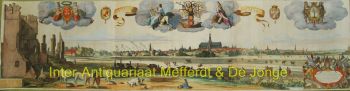
Dutch Loango-Angola - Salomon Saverij after Frans Post, 1647 1647
Artista Sconosciuto
Stampa
38 ⨯ 100 cm
€ 1.250
Inter-Antiquariaat Mefferdt & De Jonge
- A proposito di opere d'arteLUANDA ON THE DUTCH LOANGO-ANGOLA COAST “Loanda S. Pauli” (São Paulo de Luanda), etching and engraving printed from two plates made by Salomon Saverij, after a drawing by Frans Post of 1645, from Caspar Barlaeus’, “Rerum per octennium in Brasilia et alibi nuper gestarum sub praefectura J. Mauritii, Nassoviae, c. comitis... historia” piblished by Joan Blaeu in 1647. Size: approx. 38 x 100 cm. View of Luanda in Angola with several Dutch ships off the coast. The fort was part of the Dutch Loango-Angola coast. In the seventeenth century, the city of Luanda was the largest Portuguese slave depot in West Africa. Therefore, on behalf of the Dutch West India Company (WIC), admiral Piet Hein attempted to conquer the city, defended by a fort, as early as 1624. However, due to a lack of troops and ships, this attack failed. In 1641, a second and successful attempt followed under the leadership of Cornelis Jol, a.k.a. "Houtebeen" (pegleg), after which the city and the fort (renamed Fort Aardenburgh) came under the control of the WIC. Due to its southern location, the city was not governed from Elmina (in present-day Ghana), and a new government was established under the name Luango-Angola, with the governor's seat in Luanda. However, in the period until 1648, 'only' 14,000 slaves were transported from the city, and the Dutch colony was not profitable. When the city was recaptured by Portugal in 1648, it was decided not to sail to places south of Congo. The Portuguese were considerably more 'successful' in the slave trade. From around 1550 to 1850, over 2.8 million slaves were shipped from Luanda. This print was part of a series depicting the journey to and stay in Brazil of Governor-General John Maurice of Naussau in the years 1636-1644. The drawings were made by Frans Post, who was the first European to capture the New World. We now see that journey to Brazil passed through Luanda, which was under the control of the WIC for about 8 years. Price: 1.250,-
- A proposito di opere artista
Può succedere che un artista o un creatore sia sconosciuto.
Alcune opere non sono determinate da chi sono state realizzate o sono state realizzate da (un gruppo di) artigiani. Esempi sono statue dell'antichità, mobili, specchi o firme non chiare o leggibili ma anche alcune opere non sono affatto firmate.
Inoltre puoi trovare la seguente descrizione:
•"Attribuito a …." A loro avviso probabilmente opera dell'artista, almeno in parte
•“Studio di ….” o “Officina di” A loro avviso un'opera eseguita nello studio o nella bottega dell'artista, eventualmente sotto la sua supervisione
•“Cerchio di…” A loro avviso un'opera del periodo dell'artista che mostra la sua influenza, strettamente legata all'artista ma non necessariamente al suo allievo
•"Stile di..." o "Seguace di..." A loro avviso un'opera eseguita nello stile dell'artista ma non necessariamente da un allievo; può essere contemporaneo o quasi contemporaneo
•“Modalità di…” A loro avviso un'opera nello stile dell'artista ma di epoca successiva
•"Dopo …." A loro avviso una copia (di qualsiasi data) di un'opera dell'artista
•“Firmato…”, “Datato…” o “Iscritto” A loro avviso l'opera è stata firmata/datata/inscritta dall'artista. L'aggiunta di un punto interrogativo indica un elemento di dubbio
•"Con firma....", "Con data...", "Con iscrizione..." o “Riporta firma/data/iscrizione” a loro avviso la firma/data/iscrizione è stata aggiunta da qualcuno diverso dall'artista

Sei interessato ad acquistare questa opera d'arte?
Artwork details
Related artworks
- 1 - 4 / 12
- 1 - 4 / 24
- 1 - 4 / 24
- 1 - 4 / 24
- 1 - 4 / 12