Johann Loetz Witwe – Ausfuehrung 134 with applied Cobalt Papillon snake 1914 - 1918
Johann Loetz (Lötz) Witwe Klostermühle
Bicchiere
13 cm, ø 21 cm
ConditionExcellent
Prezzo su richiesta
Antiques Emporium
- A proposito di opere d'arteThis remarkable bowl was created by Johann Loetz Witwe and dates back to the early 20th century. With a generous body diameter of 21 cm (8.27 inches) and a height of 13.5 cm (5.31 inches), this is an impressive decorative object that reflects the transition from the Art Nouveau to the Art Deco era.
The bowl is crafted in Ausführung 134, a technique introduced in 1914, at the onset of the First World War. This execution is based on the Titania technique, developed in 1905 as a response to the waning interest in iridescent glass. With Titania, Loetz introduced a new aesthetic by layering metallized glass threads over a base-colored glass and finishing it with a transparent glass coating. This process created a mysterious play of colors and a unique depth effect, giving the glasswork a refined and captivating appearance.
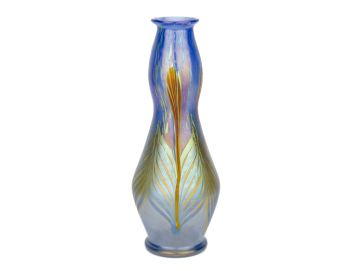
In terms of color, the bowl features a stunning light blue base, combined with a deep blue-gray Titania layer. Unfortunately, photographs often fail to capture the true colors and nuances of the bowl, slightly understating its enchanting depth and play of colors.
A distinctive feature of this bowl is the applied snake, crafted from cobalt blue glass. The graceful snake lies elegantly across the bowl, with carefully formed details such as a hand-shaped head and applied glass eyes. Additionally, the upper rim of the bowl is accentuated with a cobalt blue glass thread, further enhancing its refined appearance.
As is customary for Loetz glass after 1902, the bowl is unsigned. After the First World War, Loetz introduced a new etched mark, “CZECHO-SLOVAKIA,” for their glassware, but this does not apply to this piece.
This bowl combines artistic innovation and historical significance, making it a valuable object for both Art Nouveau enthusiasts and Loetz glass collectors. - A proposito di opere artista
La vetreria Loetz esisteva a Klostermuhle, in Austria, da poco più di cento anni, a partire dal 1840. Ma il suo periodo di massimo splendore fu durante la vita di Max Ritter Von Spaun, nipote dell'originale Johann Loetz che aveva fondato l'azienda.
Von Spaun rilevò l'azienda nel 1879 e la diresse fino al 1908, un anno prima della sua morte. Fu assistito da Eduard Prochaska, suo tecnico specialista, e insieme inventarono, progettarono e produssero tutta una serie di meravigliosi nuovi tipi di vetro, ottenendo numerosi brevetti e vincendo premi in tutte le maggiori esposizioni mondiali durante gli anni 1890 e i primi anni del il nuovo secolo.
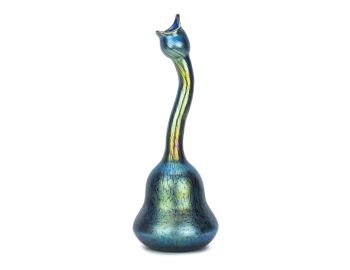
L'azienda Loetz era tra i leader nel design Art Nouveau e in particolare nel vetro artistico iridescente. Il vetro "Papillon", come il vaso a sinistra, è talvolta noto oggi come vetro "macchia d'olio". Un'altra colorazione preferita di Loetz era il vetro irridizzato con scie tirate chiamato vetro "Fenomeno".
C'erano vasi irrigiati con nastri di colori metallici che si snodavano sulla superficie, e molti disegni spettacolari con scie applicate di bellissimi colori, o semplicemente tirati fuori dal corpo del vetro per formare maniglie o decorazioni.
Intorno al 1900 l'azienda iniziò a collaborare con designer esterni e alcuni grandi artisti disegnarono pezzi per Lotz, in particolare Joseph Hofmann, Koloman Moser, Maria Kirchner e Hofstatter.
Nel 1908 Loetz fu rilevata dal figlio di Max Von Spaun, anche lui chiamato Max, e sebbene stentasse finanziariamente (fallendo nel 1911 e di nuovo nel 1931) ci furono diversi grandi designer il cui lavoro fu prodotto da Loetz in quegli anni e attraverso l'arte periodo déco. Questi includevano Adolf Beckert e Michael Powolny.
Sei interessato ad acquistare questa opera d'arte?
Artwork details
Related artworks
Johann Loetz (Lötz) Witwe Klostermühle
Johann Loetz Witwe – Phänomen Genre vaas in blauw opaal – 19021902 - 1903
Prezzo su richiestaAntiques Emporium
Johann Loetz (Lötz) Witwe Klostermühle
Johann Loetz Witwe – Phänomen Genre 299 – Tricolor vase1900 - 1902
Prezzo su richiestaAntiques Emporium
Johann Loetz (Lötz) Witwe Klostermühle
Johann Loetz Witwe – Phänomen Genre 1/18 vase1901 - 1905
Prezzo su richiestaAntiques Emporium
Johann Loetz (Lötz) Witwe Klostermühle
Johann Loetz Witwe – Phänomen Genre 377- silver overlay1900 - 1902
Prezzo su richiestaAntiques Emporium
Johann Loetz (Lötz) Witwe Klostermühle
Johann Loetz Witwe – Phänomen Genre 8065 – Thea1899 - 1900
Prezzo su richiestaAntiques Emporium
Johann Loetz (Lötz) Witwe Klostermühle
Johann Loetz Witwe - Phänomen Genre 7773 – Orange1900 - 1910
Prezzo su richiestaAntiques Emporium
1 - 4 / 8Dirk Smorenberg
Winters Loosdrecht vanuit het huis1920 - 1930
Prezzo su richiestaBruning Heintz Fine Art
1 - 4 / 24Artista Sconosciuto
François-Théodore Legras – Tall “Fleurs de Pommier” apple blossoms vase1900 - 1909
Prezzo su richiestaAntiques Emporium
Johann Loetz (Lötz) Witwe Klostermühle
Johann Loetz Witwe - Phänomen Genre 7773 – Orange1900 - 1910
Prezzo su richiestaAntiques Emporium
Tapio Wirkkala
Two rare Art-objects, model 3585 & 3586 – Iittala, Finland1956
Prezzo su richiestaVan Kerkhoff Art
Johann Loetz (Lötz) Witwe Klostermühle
Johann Loetz Witwe – Phänomen Genre 8065 – Thea1899 - 1900
Prezzo su richiestaAntiques Emporium
Kaj Franck
A complete set of glass Art-Object “Pilari”, Model KF249 & KF250 – Nuutajärvi-Notsjö, Finland1958 - 1960
Prezzo su richiestaVan Kerkhoff Art
Johann Loetz (Lötz) Witwe Klostermühle
Johann Loetz Witwe – Phänomen Genre 299 – Tricolor vase1900 - 1902
Prezzo su richiestaAntiques Emporium
Johann Loetz (Lötz) Witwe Klostermühle
Johann Loetz Witwe – Phänomen Genre 1/18 vase1901 - 1905
Prezzo su richiestaAntiques Emporium
1 - 4 / 24Rudolf de Bruyn Ouboter
Still life with red bowl, blue salt cellar, weck jar and Japanese print1940 - 1960
Prezzo su richiestaAdelwein Kunst
1 - 4 / 24Johann Loetz (Lötz) Witwe Klostermühle
Johann Loetz Witwe - Phänomen Genre 7773 – Orange1900 - 1910
Prezzo su richiestaAntiques Emporium
Johann Loetz (Lötz) Witwe Klostermühle
Johann Loetz Witwe – Phänomen Genre vaas in blauw opaal – 19021902 - 1903
Prezzo su richiestaAntiques Emporium
1 - 4 / 24Johann Loetz (Lötz) Witwe Klostermühle
Johann Loetz Witwe – Phänomen Genre 8065 – Thea1899 - 1900
Prezzo su richiestaAntiques Emporium
Johann Loetz (Lötz) Witwe Klostermühle
Johann Loetz Witwe – Phänomen Genre 1/18 vase1901 - 1905
Prezzo su richiestaAntiques Emporium
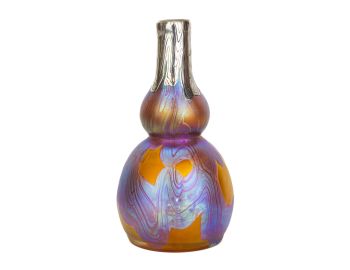
Daum Nancy
Daum Nancy – Tall Bryones / Bryonia dioica vase with applied berries1902 - 1907
Prezzo su richiestaAntiques Emporium
Johann Loetz (Lötz) Witwe Klostermühle
Johann Loetz Witwe – Phänomen Genre vaas in blauw opaal – 19021902 - 1903
Prezzo su richiestaAntiques Emporium
Johann Loetz (Lötz) Witwe Klostermühle
Johann Loetz Witwe – Phänomen Genre 377- silver overlay1900 - 1902
Prezzo su richiestaAntiques Emporium
Johann Loetz (Lötz) Witwe Klostermühle
Johann Loetz Witwe - Phänomen Genre 7773 – Orange1900 - 1910
Prezzo su richiestaAntiques Emporium
Artista Sconosciuto
François-Théodore Legras – Tall “Fleurs de Pommier” apple blossoms vase1900 - 1909
Prezzo su richiestaAntiques Emporium
Frères Foundry Susse
Auguste Ledru – Gilded Bronze Art Nouveau Ewer-Vase – Susse Frères, Paris1898 - 1902
Prezzo su richiestaAntiques Emporium
1 - 4 / 12