Large Dutch Delft chinoiserie plate from ‘De Paauw’ by Artista Sconosciuto

Large Dutch Delft chinoiserie plate from ‘De Paauw’ 1680 - 1700

Artista Sconosciuto

SmaltoCeramicaterracottaDipingere
40 cm
ConditionVery good
€ 1.950

Verkoulen Oriental & European Antiques

  • A proposito di opere d'arte
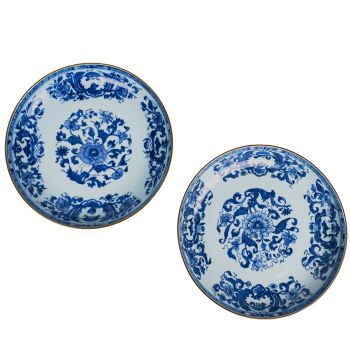
    A large chinoiserie plate with Transition and Kangxi inspired decoration, 17th century, around 1680-1700, Delft, Holland.
    Blue and white

    Dimensions: 40 cm. diameter.

    Signed D-PAUW for pottery factory ‘De Paauw / The Peacock’ (1651-1774).

    This earthenware plate has a beautiful dense and deep blue color, finished with black. In the middle we can see two Long Eliza’s in a fenced garden. On the left side of the fence there is an incense burner and cache-pot displayed.

    Long Eliza is an old common name for the decoration on Chinese export porcelain featuring elegant, slim and long women. The Dutch are credited with giving this Chinese export pattern its name ‘Lange Lijzen’ (or loosely translated Tall Eliza), which is typical for the Kangxi period (1662-1722). This of course did not go unnoticed by the Delft potters. The broad border of the plate is not decorated with a pattern but with similar scenes with lots of space and white in between. This is a typical element derived from the Chinese transitional period porcelain (1621-1662).


    The high-quality decoration of this plate is very recognizable for factory ‘De Paauw’ (The Peacock). The workshop was active from 1651-1774 on the addresses Koornmarkt and Oude Delft, in Delft. Before, in these buildings there was a beer brewery by Jacob Adriaensz Paauw (1558-1620), who also had been major of the Delft City. It was common to use the former name of the older factory (that were in most cases beer breweries) that were located in the pledge before the potters settled in there. A 'fire inspection' from 1668 mentions the presence of one kiln to fire the pottery, but around 1730 two kilns were producing. In 1775 the Paauw went bankrupt. In the 18th century, ways of making Chinese quality porcelain were developed through Europe. By the end of the 18th century the popularity of Delft pottery is rapidly declining and one company after another must close.

    Condition: Very good, some light retouches to the edge.
  • A proposito di opere artista

    Può succedere che un artista o un creatore sia sconosciuto.

    Alcune opere non sono determinate da chi sono state realizzate o sono state realizzate da (un gruppo di) artigiani. Esempi sono statue dell'antichità, mobili, specchi o firme non chiare o leggibili ma anche alcune opere non sono affatto firmate.

    Inoltre puoi trovare la seguente descrizione:

    •"Attribuito a …." A loro avviso probabilmente opera dell'artista, almeno in parte

    •“Studio di ….” o “Officina di” A loro avviso un'opera eseguita nello studio o nella bottega dell'artista, eventualmente sotto la sua supervisione

    •“Cerchio di…” A loro avviso un'opera del periodo dell'artista che mostra la sua influenza, strettamente legata all'artista ma non necessariamente al suo allievo

    •"Stile di..." o "Seguace di..." A loro avviso un'opera eseguita nello stile dell'artista ma non necessariamente da un allievo; può essere contemporaneo o quasi contemporaneo

    •“Modalità di…” A loro avviso un'opera nello stile dell'artista ma di epoca successiva

    •"Dopo …." A loro avviso una copia (di qualsiasi data) di un'opera dell'artista

    •“Firmato…”, “Datato…” o “Iscritto” A loro avviso l'opera è stata firmata/datata/inscritta dall'artista. L'aggiunta di un punto interrogativo indica un elemento di dubbio

    •"Con firma....", "Con data...", "Con iscrizione..." o “Riporta firma/data/iscrizione” a loro avviso la firma/data/iscrizione è stata aggiunta da qualcuno diverso dall'artista

Sei interessato ad acquistare questa opera d'arte?