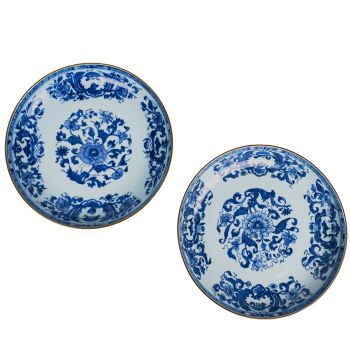
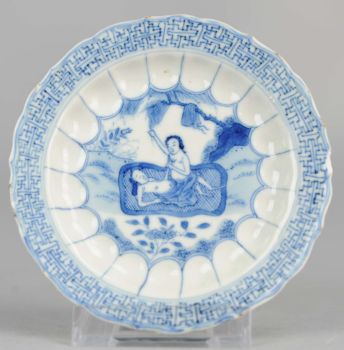
A blue and white ‘Sense of Smell’ dish, Kangxi mark and period, ca. 1700 1700
Artista Desconhecido
PorcelanaPorcelana chinesa
6.40 cm, ø 34.50 cm
ConditionGood
Preço em pedido
Menken Works of Art
- Sobre arteA blue and white ‘Sense of Smell’ dish.
Kangxi mark and period, ca. 1700.
The deep dish with a flat, slightly upturned rim, painted in underglaze blue with a group of Europeans in fashionable dress on a tiled terrace by a pavilion with a classical cornice. The lady seated to the right holds a flower to her face. The girl hands her another from a basket held by a servant, while a man in the background also holds up a flower spray. The ladies' hair is dressed à la mode Fontanges, and the man wears a long wig. Round the sides in eight arcaded panels is repeated a design of two ladies standing on either side of a plant; one holding a flower spray and the other a fan.
This scene illustrates the popular pastime amongst the genteel society of the 17th and 18th Centuries of guessing the name of a flower from its scent. The design is taken from an unidentified print and judging from the hair-styles it probably dates to shortly before 1700, and may have been part of a set of 'The Senses'.
Condition:
Good condition with some wear, see photo's.
Ref:
An identical plate was sold at Christie's New York, 17 Jan 2019, lot 450, hammer price USD 9,375
Lit:
See Howard and Ayers, China for the West, vol.I, London and New York, 1978, p.78 for a discussion on the print source, where the authors suggest that it could have been by one of the Bonnart brothers, and no.36 for a similar dish in the Mottahedeh Collection, which had formerly been in the Ionides Collection. Other examples are in the Hodroff Collection, see D. Howard, The Choice of the Private Trader, London, 1994, p.41, no.7; and in the G. Duff Collection, Lisbon, illustrated by M. Beurdeley, Porcelain of the East India Companies, London, 1962, p.27, fig.12.
Diameter 34.5 cm, height 6.4 cm.
Worldwide registered and insured shipping.
Inv. No: MW307 - Sobre artista
Pode acontecer que um artista ou criador seja desconhecido.
Algumas obras não devem ser determinadas por quem são feitas ou são feitas por (um grupo de) artesãos. Exemplos são estátuas dos tempos antigos, móveis, espelhos ou assinaturas que não são claras ou legíveis, mas também algumas obras não são assinadas.
Além disso, você pode encontrar a seguinte descrição:
•"Atribuído a …." Na opinião deles, provavelmente uma obra do artista, pelo menos em parte
• “Estúdio de…” ou “Oficina de” Em sua opinião um trabalho executado no estúdio ou oficina do artista, possivelmente sob sua supervisão
• "Círculo de ..." Na opinião deles, uma obra da época do artista mostrando sua influência, intimamente associada ao artista, mas não necessariamente seu aluno
•“Estilo de…” ou “Seguidor de…” Na opinião deles, um trabalho executado no estilo do artista, mas não necessariamente por um aluno; pode ser contemporâneo ou quase contemporâneo
• "Maneira de ..." Na opinião deles, uma obra no estilo do artista, mas de data posterior
•"Depois …." Na opinião deles uma cópia (de qualquer data) de uma obra do artista
• “Assinado…”, “Datado…” ou “Inscrito” Na opinião deles, a obra foi assinada/datada/inscrita pelo artista. A adição de um ponto de interrogação indica um elemento de dúvida
• "Com assinatura ….”, “Com data ….”, “Com inscrição ….” ou “Tem assinatura/data/inscrição” na opinião deles a assinatura/data/inscrição foi adicionada por outra pessoa que não o artista

Você está interessado em comprar esta obra de arte?
Artwork details
Related artworks
- 1 - 4 / 12
- 1 - 4 / 14
Artista Desconhecido
Set Arita 'dog training' plates, 18th century 1700 - 1730
Preço em pedidoVerkoulen Oriental & European Antiques
1 - 4 / 24- 1 - 4 / 24
- 1 - 4 / 24
- 1 - 4 / 12